Get Full Government Meeting Transcripts, Videos, & Alerts Forever!
Get email alerts on the Emergency Warming Stations topic
No spam. Unsubscribe anytime.
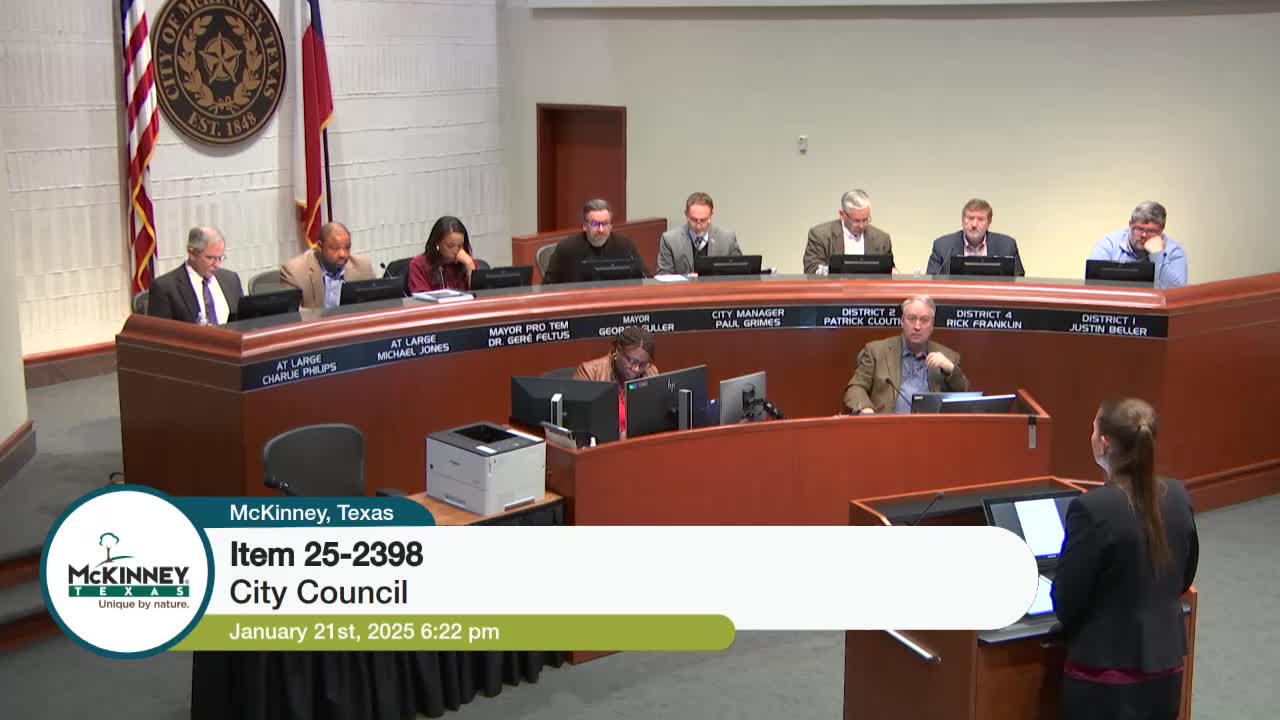
McKinney council allows First Baptist warming station to open earlier, raises occupancy to 75 with precipitation trigger
Summary
The City Council approved a temporary-use modification allowing First Baptist Church’s emergency warming station to activate at a higher wind‑chill threshold, increase its occupant limit to 75 and use precipitation as an additional trigger.
The McKinney City Council on Jan. 21 approved a change to a temporary-use permit that lets First Baptist Church operate its emergency overnight warming station when forecast conditions show a wind chill of 39 degrees and raised the facility’s occupant limit from 40 to 75, adding precipitation as an activation trigger.
City planning staffer Suzanne (last name not specified in the record) told council that the Unified Development Code currently allows warming stations to activate when ambient temperature drops below 32 degrees. First Baptist requested replacing that ambient threshold with a forecasted wind chill of 39 degrees and increasing the allowed occupant load to 75 for its facility at 6115 West Louisiana Street. Suzanne cited public‑health guidance saying hypothermia risk can arise above 40 degrees when wind or moisture are present and reported that staff reviewed egress, restrooms and food service and found the church could safely accommodate 75 people.
Paul Ballesteros, who identified himself as founder of Emmanuel Labor and one of the organizations operating warming‑station sites, told council his teams had already sheltered dozens during recent cold weather events and that multiple organizations—including First United Methodist and First Baptist—are working together to serve people who experience homelessness.
A council member moved to approve the modification with an addendum that explicitly makes precipitation a trigger; another council member seconded the motion. The motion passed on a voice vote; the clerk’s minutes record the item as approved by council.
Why it matters: City staff said the two currently permitted warming stations (First United Methodist and First Baptist) previously had a combined occupant load of about 80, while the city’s estimated number of people experiencing homelessness is more than twice that. The council’s action increases immediate short‑term shelter capacity at a location staff said is equipped to serve larger numbers during extreme weather.
Council discussion and next steps: Council members expressed a desire that other providers (notably First United Methodist and Salvation Army, which staff said are part of the operational network) align their opening thresholds to avoid confusing people who rely on the shelters. Suzanne and Paul said the organizations are coordinating operations and that Methodist volunteers are already transporting people to the Baptist location on some nights. Staff said the change is for this temporary use permit and remains subject to permit conditions and life‑safety reviews.
The action modifies the temporary‑use permit terms for First Baptist Church’s emergency warming station; staff will follow up under existing permit and life‑safety review processes.