Get Full Government Meeting Transcripts, Videos, & Alerts Forever!
Get email alerts on the Transition To Kindergarten topic
No spam. Unsubscribe anytime.
Transition to Kindergarten now codified; OSPI says enrollment growth outpaces current appropriation
Summary
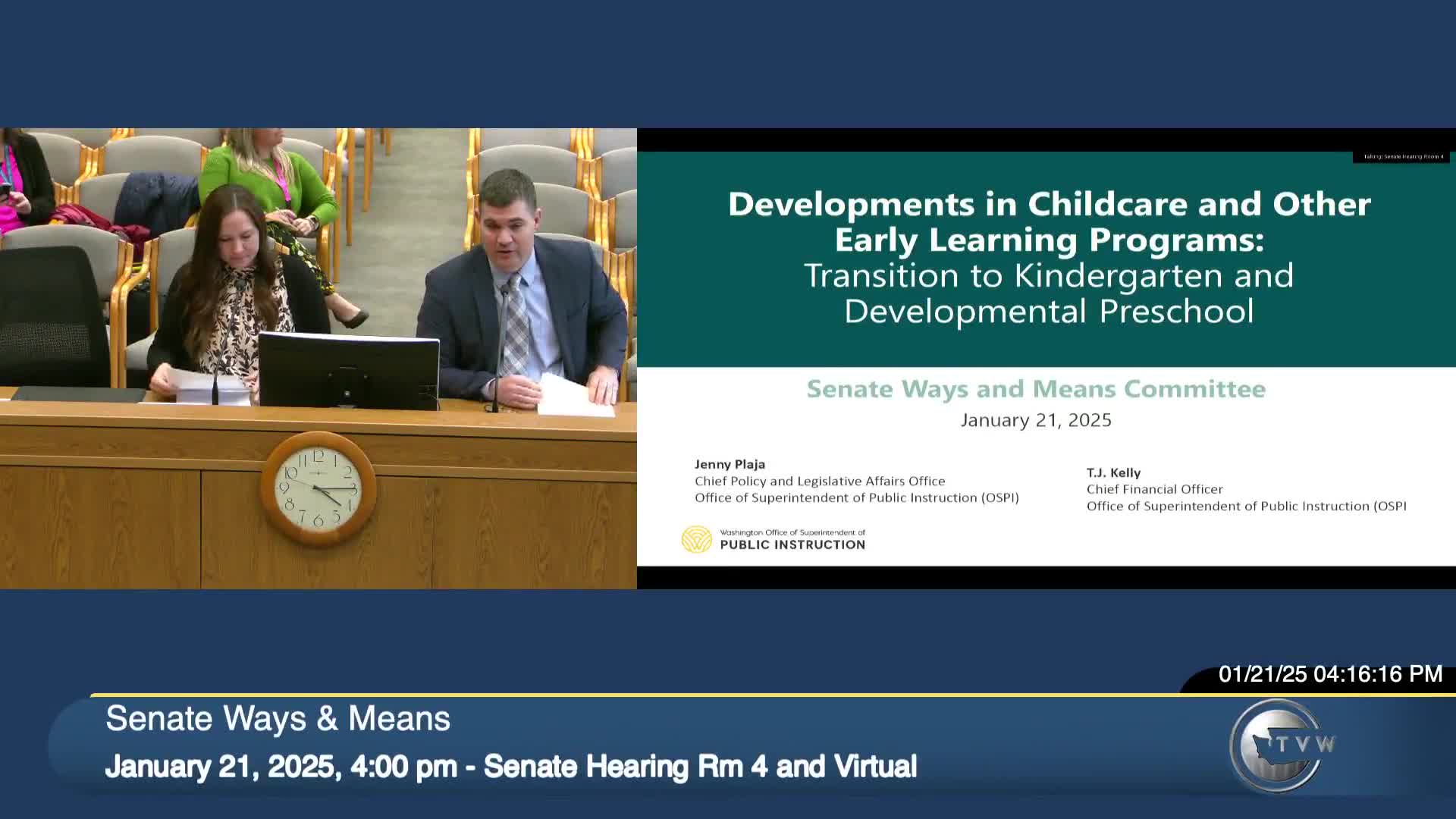
OSPI briefed the Senate Ways & Means Committee on the statutory establishment, enrollment, funding mechanics and early outcomes for the Transition to Kindergarten (TK) program created by House Bill 1550; OSPI reported caseloads above the budgeted appropriation and promised an updated apportionment estimate after January enrollment data.
OSPI officials told the Senate Ways & Means Committee that Transition to Kindergarten (TK) — a program for 4‑year‑olds identified through screening as needing additional preparation for kindergarten — is now established in statute by House Bill 1550 (2023) and is funded outside basic education.
Jenny Pladjette, OSPI’s chief policy and legislative affairs officer, described TK as a program for children who are at least 4 years old by Aug. 31 and who are screened and identified as needing additional preparation. OSPI’s role, she said, includes rulemaking for administration and allocation of funding, developing minimum standards and conducting site visits in partnership with educational service districts.
Why it matters: OSPI presented enrollment and funding data showing TK’s reported full‑time‑equivalent (FTE) enrollment rising from an approximate 418 FTE in 2019–20 to about 6,814 FTE in the current school year. OSPI said historical TK counts were previously included with kindergarten and required extrapolation from student reporting data to create comparable FTE series.
OSPI officials noted that TK funding is treated like kindergarten under the prototypical school model (funded by caseload), but the program is not classified as basic education. TK expenditures are coded to program 9 and must be deposited into and spent from the enrichment subfund 1 of the general fund. OSPI told the committee that the 2023–24 appropriation included a large federal COVID relief allocation redirected for TK in that year; of an aggregate $48 million, roughly $41 million was federal money.
OSPI said current enrollments are tracking above the amount funded in the budget. OSPI staff described a decision package submitted in August estimating a roughly $21 million deficit; members were told OSPI would update that estimate after January enrollment adjustments and apportionment recalculation within about two weeks.
OSPI also presented early outcomes data it has begun to track: students who participated in TK showed higher kindergarten‑readiness measures across multiple domains compared with other students, with differences particularly pronounced for some subgroups, including low‑income students, multilingual students and students with disabilities.
Committee members pressed for operational details: Senators asked whether a single child could receive TK and ECAP or WCC, and OSPI said TK is intended to be based on individual student need and can vary in duration (full‑day or half‑day or partial year). OSPI emphasized TK programs operate on the school calendar (school‑day hours, not weekends or summers) and that districts must follow community consultation and selection priorities when establishing programs.
OSPI confirmed there is no statutory barrier to a district creating a TK classroom once sufficient screened students exist; districts must follow required consultation processes and account for TK funds as restricted to program use.
OSPI referenced statutory language in RCW 28A.225.160 that allows districts to adopt entry‑qualification rules and to make individualized exceptions as provided by law or OSPI rules.
Officials agreed to provide committee members the updated apportionment and enrollment reconciliation and to make previously commissioned evaluation studies of TK available to the committee.