Get Full Government Meeting Transcripts, Videos, & Alerts Forever!
Get email alerts on the Hoa Finance Density topic
No spam. Unsubscribe anytime.
Residents raise HOA funding and density concerns in Rockwall open forum
Summary
During open forum at the Jan. 21 City Council meeting, residents described financial strain on homeowners associations after developers deed common areas and urged changes to the Unified Development Code; others criticized how gross-density calculations allow tightly packed subdivisions.
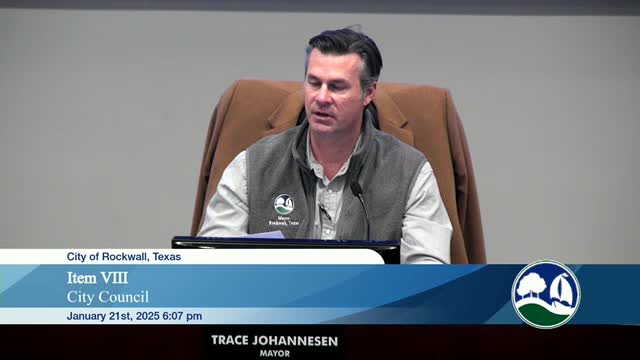
At the Jan. 21 Rockwall City Council meeting, multiple residents used the open forum to urge the city to examine developer practices and zoning calculations that they say leave homeowners associations (HOAs) responsible for costly infrastructure and produce higher-density developments that lack neighborhood character.
Bob Wacker described long-term financial strain in his Stone Creek HOA, saying the developer deeded common areas to the association before sufficient assessments were collected. Wacker said early years had low assessment revenue while landscape, irrigation, pool and amenity-center costs accumulated, producing a cumulative deficit he estimated at about $208,000 in the first six years. He described a developer-originated loan in the HOA’s governing documents (including interest set at prime plus 2 percent) that he said left residents liable for repayment and said the association ultimately used a special assessment to retire the debt.
Wacker asked the council to revise the Unified Development Code so that an HOA must have sufficient income to maintain common areas before a developer can deed them to the HOA. City staff responded that covenants, conditions and restrictions (CC&Rs) are private contracts between property owners and developers and that the city is not a party to those contracts, limiting the council’s ability to impose such requirements through zoning code.
Another resident, Stan Javis, spoke about the Southside Hills development and argued that the city’s gross-density calculation (lots divided by gross acreage) can be used to meet density limits while allowing sections of a subdivision to be built at significantly higher lot-per-acre levels. Javis said many proposed lots were small — he referenced 62-foot lots in his remarks — and said stacking houses “row after row” produces a high-density character that he said lost the intended neighborhood feel. He urged the council to reconsider how it defines and measures density.
City staff explained to the council that Rockwall’s Unified Development Code currently computes density on the basis of gross acreage and that other jurisdictions sometimes use a net calculation that excludes floodplain and open-space areas. The staff noted that different cities use different approaches; net calculations can either limit density or incentivize it depending on multiplier choices. Council members acknowledged the recurring nature of the complaints and said changes to density standards would require code work.
Council members and staff indicated they would look into the concerns but cautioned that CC&Rs and private contractual arrangements limit the city’s legal authority to dictate private HOA finance terms. Staff offered to research possible policy options and returned with the suggestion that some changes might require state-level legal review before local code amendments could be pursued.