Get Full Government Meeting Transcripts, Videos, & Alerts Forever!
Get email alerts on the Resilience Planning topic
No spam. Unsubscribe anytime.
Houston recovery office lays out neighborhood-first resilience plan, scorecard and hubs
Summary
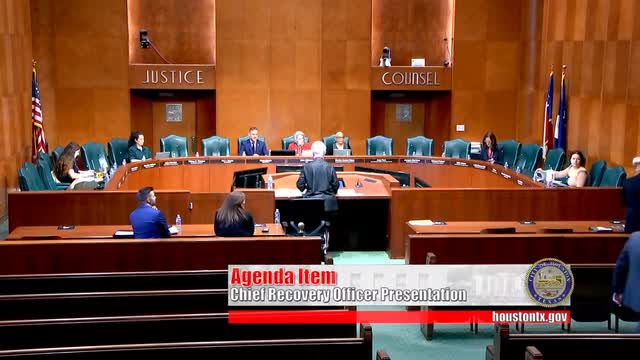
Angela Blanchard, the City of Houston’s chief recovery and resilience officer, told the Resiliency Committee that her office will pursue a neighborhood-by-neighborhood strategy to shore up basic services, build community resilience hubs and create a city-specific resilience scorecard.
Angela Blanchard, the City of Houston’s chief recovery and resilience officer, told the Resiliency Committee that her office will pursue a neighborhood-by-neighborhood strategy to shore up basic services, build community resilience hubs and develop a city-specific “resilience scorecard.” The presentation, given during a Resiliency Committee meeting, also outlined efforts to coordinate public, private and philanthropic partners and to speed procurement of backup generators for critical facilities.
Blanchard said the office’s immediate priorities are guaranteeing “the basic safety and core city services under all conditions,” specifically water and power, and then layering programs and innovation on that foundation. “We are responsible for drinkable water. We want the water to be drinkable, and that's going to be a priority, come hell, wind, or high water,” she said.
Why it matters: The plan is intended to reduce gaps the city encountered in recent events, including a derecho and the winter freeze, when coordination between emergency responders, volunteer groups and long-term recovery organizations proved uneven. Council members who asked questions emphasized timing, generator availability and how residents and council offices can contribute to planning and outreach.
Details of the approach
Resilience scorecard — Blanchard said the office will spend roughly four months collecting input from institutions and partners to create a scorecard that reflects Houston’s unique strengths. She asked council members to contribute information about what institutions are already investing in resilience and to nominate private and nonprofit partners. “If an organization says they do something, but there's no line item in the budget for it, they don't do it,” Blanchard said, describing a focus on verifiable investment rather than rhetoric.
Inventory and partners — The Greater Houston Partnership has begun collecting data on corporate and institutional investments in resilience that will feed into the city’s inventory. Blanchard said the inventory will include everything from grassroots neighborhood hubs to large energy-company investments so the city can leverage existing capabilities.
Neighborhood resilience hubs — The office will evaluate existing hub plans and program models, but Blanchard said hubs will not be expanded widely until the city can be confident the fundamentals — water, sewer, power — are reliable at those sites. “Every neighborhood needs a place of respite. Every community needs access to a place where they're understood and welcomed. But none of those places will work if they have no water,” she said.
Disaster roundtable and coordination — Blanchard described the Mayor’s disaster roundtable as a quarterly convening of about 65–70 partners that she facilitates; working groups meet more frequently. The roundtable’s purpose is to connect the “uniforms” who respond in the emergency phase with long-term recovery actors so responses are linked from incident to recovery. Blanchard described the table as problem-solving rather than command-and-control.
STEER (vulnerable-population outreach) — The office reviewed a recent technical glitch that affected the STEER locator system and said the issue — tied to locator data formatting — has been fixed after investigation. Blanchard said roughly 4,000–5,000 people are registered in STEER and that recent outreach attempts reached about half of those contacted; the office said follow-up calls would be required for the rest. She urged council offices to help encourage registrations and to educate vulnerable residents to respond to outreach messages.
Generators and timing — Council members repeatedly asked about generator procurement and siting. Blanchard said the administration is streamlining procurement to avoid historically slow timelines; she said previous procurement timelines could take about two-and-a-half years and the city is working to shorten that. She also said the mayor will announce a more substantial plan soon and urged council offices to provide site nominations and logistical input. “We are really trying to be thoughtful and strategic,” Blanchard said, noting procurement must include plans for maintenance and site readiness.
Roles and handoffs — Blanchard clarified the recovery office’s role relative to Houston Emergency Management (OEM): OEM manages the emergency phase and produces the incident-level data; the recovery office uses that data to align long-term partners and resource deployments. “Our role starts when activation ends on paper. But well before that… recovery begins at the start of the event,” she said.
Operational concerns raised by council members
- Timing: Council Member Amy Peck (District A) pressed for how far the plan will be advanced by hurricane season and sought clarity on which neighborhood facilities will be primed as activation sites. Blanchard said the office is evaluating sites and invited council offices to submit locations and trusted community facilities for pre-activation planning.
- Lines and logistics: Council Member Sally Alcorn (At Large, Position 5) and other members flagged long lines at water and ice distribution points and urged better logistics, including mobile capabilities, forklifts and satellite distribution locations. Blanchard said map-based coverage exercises are helping the city identify gaps and that OEM is building contingencies.
- Vulnerable populations and senior facilities: Blanchard said the roundtable is examining policy changes to require greater power protection at licensed senior-care facilities and acknowledged additional challenges with unlicensed facilities. She said some county and state actions are in progress but did not provide statute numbers or final actions.
What’s next
Blanchard said the office will continue collecting inventory data and invited council members to nominate organizations and institutions for the resilience working group. She requested roughly four months of input to shape an initial scorecard and said she would return to the committee with updates. The mayor’s office is expected to make a larger announcement on generator procurement and siting in the near term.
Speakers were united in urging that short-term, “in the meantime” solutions be communicated to residents while longer-term procurement and infrastructure work continues.
Ending
Committee Chair Twyla Carter closed the meeting after members and staff raised logistics, generator maintenance and site-readiness questions; no formal votes or motions were recorded during the session. The recovery office will provide updates to the committee as the scorecard and generator plans develop.