Get Full Government Meeting Transcripts, Videos, & Alerts Forever!
Get email alerts on the Zoning Variance topic
No spam. Unsubscribe anytime.
Zoning board continues decision on proposed convenience store at 1625 Shelby Street after 2-1 vote
Summary
The Metropolitan Board of Zoning Appeals, Division 3, heard arguments over variances for a proposed convenience store at 1625 Shelby Street and voted 1–2, producing an indecisive result that automatically continued the case to the board's February 18, 2025 hearing.
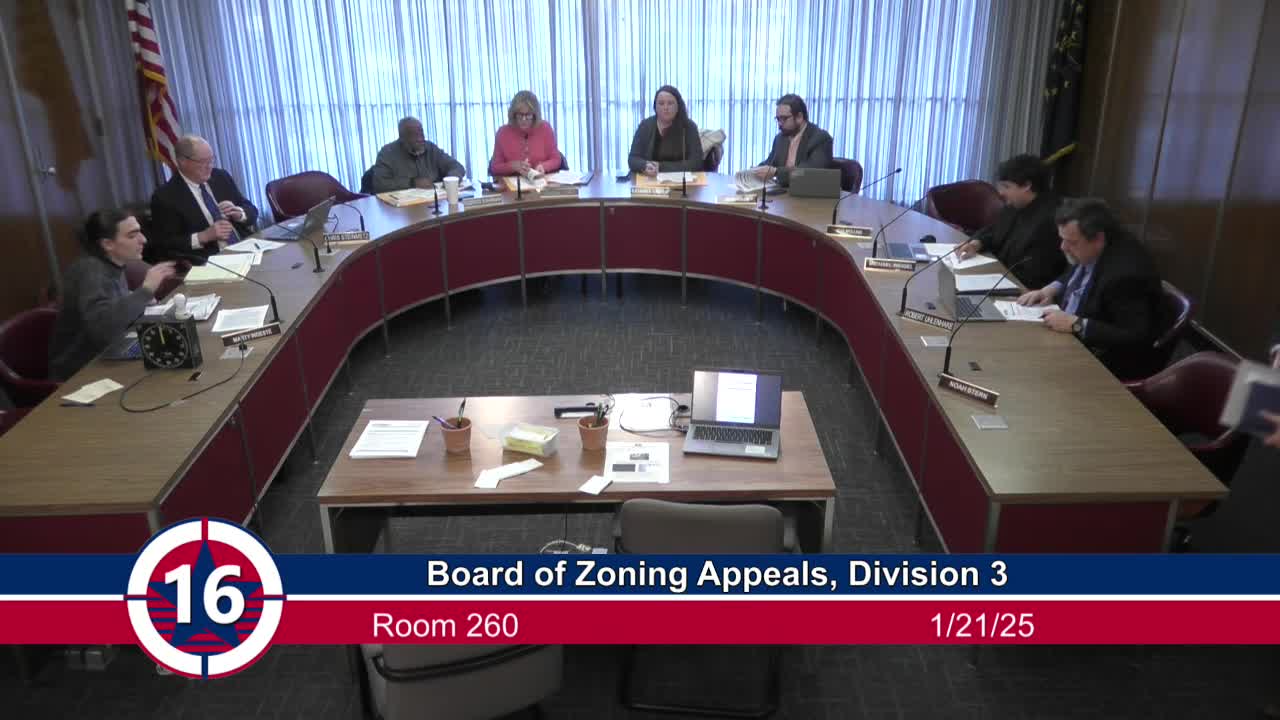
The Metropolitan Board of Zoning Appeals, Division 3, on Friday continued action on a request to allow a new convenience store and related variances at 1625 Shelby Street after an indecisive 1–2 vote.
David Rutherford, a zoning attorney representing petitioner Jugad LLC, told the panel the site is a legally established former gas station and argued the property's small, triangular shape and existing fuel infrastructure make full compliance with the Transit Oriented Development (TOD) overlay and consolidated zoning and subdivision ordinance impracticable. “It is an existing gas station. It's legally established. He wants to add a very nice convenience store to the back of the property that would really dress the site up,” Rutherford said.
City planning staff recommended denial, saying the proposed building layout and site plan deviate substantially from TOD and the city’s comp plan guidance and that the site’s existing canopies, while preexisting, do not excuse the proposed low percentage of frontage and transparency along Shelby Street. “That layout deviates substantially from both strict application and intent of the ordinance and comp plans,” a city planning staff speaker told the board, recommending denial.
The petitioner presented an amended site plan and a list of commitments made during negotiations with staff and transit officials. Those commitments, presented at the hearing, included: prohibiting alcohol sales; banning vape advertising; enforcing loitering laws; restricting hours of operation (no opening before 5:30 a.m. and no closing later than 10:30 p.m.); closing one curb cut on Shelby Street and building new sidewalks and curbs; reconfiguring and adding landscape islands where feasible; and submitting final landscaping and site details for administrative approval. Rutherford said the owner plans a full site refresh and estimated the investment as “He's going to spend $3,400,000 on this site to redo it,” as stated at the hearing.
Staff and the petitioner differed on whether the site's existing fuel canopies and tanks create a legally cognizable practical difficulty. Staff argued the need for additional convenience-store area and the decision to retain nonconforming canopies were largely self-imposed and that removal of the canopies could allow a layout closer to TOD standards. Rutherford countered that tank removal and environmental remediation would be economically prohibitive and cited pedestrian and safety improvements the petitioner proposes.
On the technical variance requests, the petitioner said the application now seeks relief limited to: (1) a reduced front building line width along Shelby Street (the petitioner cited a proposed 10.64% building frontage versus an 80% requirement); (2) deficient transparency on an individual west-facing wall (approximately 17.6% versus a 40% requirement on that façade); and (3) limited landscape width along a pump island where right-of-way improvements and curb geometry constrain planting. Rutherford said the building would be oriented toward the intersection because the lot is triangular and that the building is roughly 67 feet wide on a portion of the lot that measures about 110 feet, which the petitioner argued supported the requested measurement approach.
With no demonstrators present, the board voted on case 2024-DV3-037: Rod Bohannon voted yes; Rayanna Bender voted no; and Joanna Taft voted no. Under the board’s rules, a 2–1 negative result is an indecisive vote that triggers an automatic continuance. The petition has been continued to the February 18, 2025 Division 3 hearing.
The board’s discussion and the record show the core disagreement centers on how strictly to apply TOD frontage and transparency requirements to a small, irregularly shaped lot with preexisting fueling infrastructure and whether the petitioner’s proposed commitments meaningfully address pedestrian and neighborhood concerns.
If the petitioner returns with additional changes or with a revised plan that alters the site’s relationship to the TOD frontage requirements, the board will reconsider at the next hearing. In the meantime, the petitioner’s commitments and the staff recommendation are part of the case record.