Get Full Government Meeting Transcripts, Videos, & Alerts Forever!
Get email alerts on the Rezoning Recovery Facility topic
No spam. Unsubscribe anytime.
Ocala council approves rezoning to allow women’s recovery facility at Compassion United Methodist site
Summary
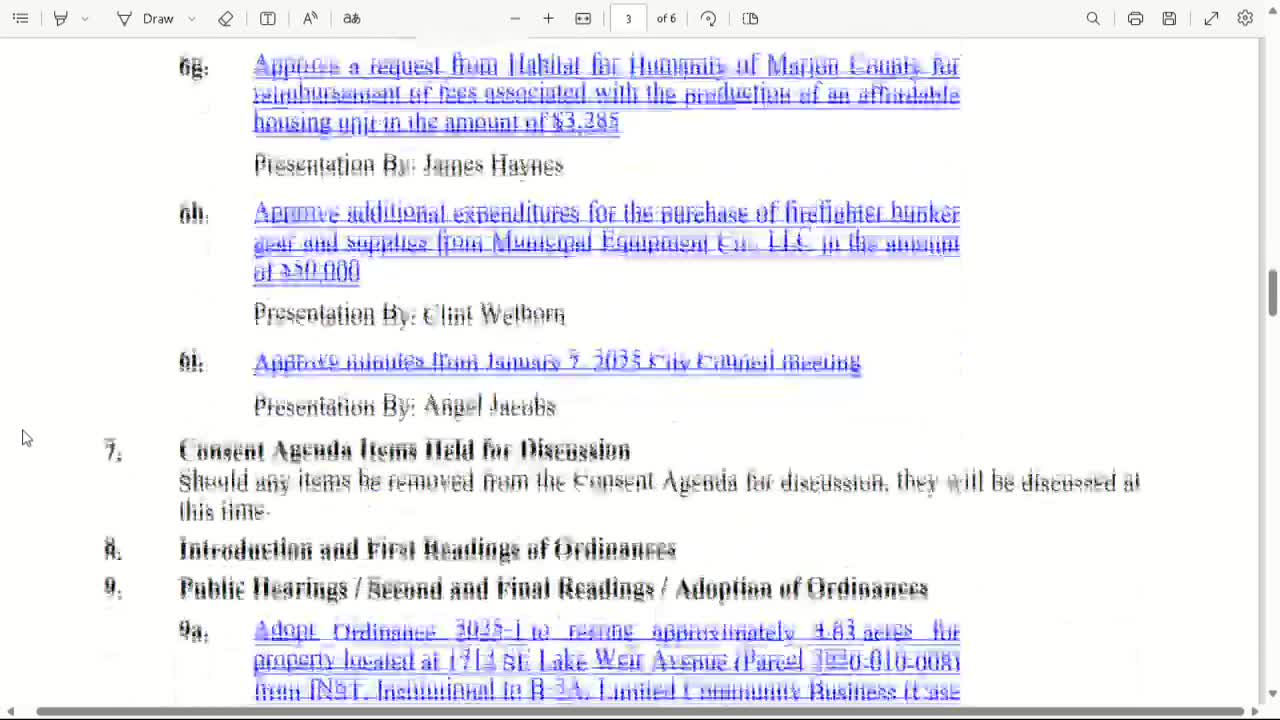
The Ocala City Council on Jan. 7 adopted Ordinance 2025-1 to rezone a 4.63-acre property at 1712 SE Lake Weir Avenue from Institutional to B-2A, clearing the way for a transitional recovery facility for women operated by Open Arms Village and hosted on property owned by the Florida Annual Conference of the United Methodist Church.
Ocala — The Ocala City Council voted 4-1 on Jan. 7 to adopt Ordinance 2025-1, rezoning a 4.63-acre parcel at 1712 Southeast Lake Weir Avenue (parcel 2920-010-008) from Institutional to B-2A Limited Community Business to allow a women’s transitional recovery facility to operate on the site.
The motion to adopt the ordinance cited staff findings of consistency with the city comprehensive plan and compatibility with surrounding uses. Council members Jay Musley, Jim Hilty and Eiry Bethea voted in favor; Council President Kristin Dreyer voted no.
City planning director Aubrey Hill summarized staff findings, saying the property’s future land use is “low intensity” and that the B-2A zoning would allow commercial office and limited commercial uses while permitting continuation of the existing church use. Hill told council that “there are also adequate public facilities to service the proposed development,” and recommended approval based on those findings.
The applicant’s attorney, Tim Haines of Grama and Haines, and representatives from Open Arms Village presented the request and emphasized differences between the proposed facility and other low-barrier shelters in the city. Haines told council, “If I thought what Open Arms was going to do at this facility was going to become anything like the Salvation Army and have the effect on the neighborhood that the Salvation Army has … I wouldn't be here.”
Open Arms Village volunteers and staff described the program as a “high barrier” transitional recovery model. Mark Iams, a volunteer board member, said the program accepts roughly one in seven applicants and provides job placement, counseling, random drug testing and requirements such as curfews and chores. He said the program’s men’s facility has placed graduates in employment and the proposed site would offer similar services for women.
Supporters from the community included graduates and users of Open Arms who described personal recovery stories. Nick Covington, identified in the record as a graduate, said his life had “taken off” since completing the program. Several criminal justice and court officials, including Lori Cotton, presiding judge of the DUI court, and a circuit court judge who works with diversion programs, spoke in support, citing the need for high-barrier transitional housing that connects participants to services.
Opposition centered on the location of the rezoning in a neighborhood near schools and an assisted-living facility. Jordan Rainey, who said he lives a block from the site, opposed rezoning on the grounds that B-2A allows a range of commercial uses and that the change would be permanent. James Knopfel, principal at Saint John Lutheran School, said school safety was his primary concern and that he would have preferred a conditional use permit or a different location.
Open Arms staff and board members told council the Florida Annual Conference of the United Methodist Church will be the landlord, the facility will be for women only, and the program will include on-site case management and security measures including restricted visitors, cameras and an on-site house manager. Open Arms representatives said renovation costs were expected to be substantially lower than new construction because the campus already includes kitchen and support facilities; one speaker referenced an approximate renovation cost of about $700,000.
Council discussion referenced the success and conduct of the existing Open Arms men’s facility at St. Mark’s and the organization’s acceptance standards. Council members who voted in favor said the site’s location on a commercial corridor and the program’s safeguards and track record made the rezoning appropriate. Council President Dreyer said she supported the program but opposed rezoning the church property to B-2A because the zoning change would permit other future uses beyond the current agreement and could not be limited to Open Arms by zoning alone.
The ordinance as adopted includes standard language directing staff to implement the map amendment, to reconcile any inconsistencies with other codes and to provide an effective date. The council’s official motion text recorded in the minutes states the ordinance was adopted “as provided by the Charter of City of Ocala, except that adoption by sections on second reading be waived and based on staff’s recommendation for case number ZON24-4575 and other evidence presented to city council.”
Community members and Open Arms representatives said the facility would be intended as a program for women who are motivated to enter recovery; Open Arms officials said they have not needed to call law enforcement at their existing facility and that they maintain relationships with local detox and treatment providers for residents who do not complete the program.
The council’s approval authorizes the rezoning only. Any renovation, building permit, or future change of use would require separate staff review and applicable permits. Open Arms and the Florida Methodist Conference will be responsible for program operations and any lease terms required by the property owner.
Votes at a glance: Musley — yes; Hilty — yes; Bethea — yes; Dreyer — no. Outcome: approved.