Get Full Government Meeting Transcripts, Videos, & Alerts Forever!
Get email alerts on the Legislative Priorities topic
No spam. Unsubscribe anytime.
Wake County board trims draft legislative agenda to three priorities and debates funding, class‑size flexibility and accountability
Summary
Board members reviewed a condensed legislative agenda focusing on funding public education, local operational flexibility and fair, transparent measures of school performance; discussion touched on vouchers, school meals funding, class‑size waivers and teacher licensure reciprocity. The session ended with a voice vote to enter closed session.
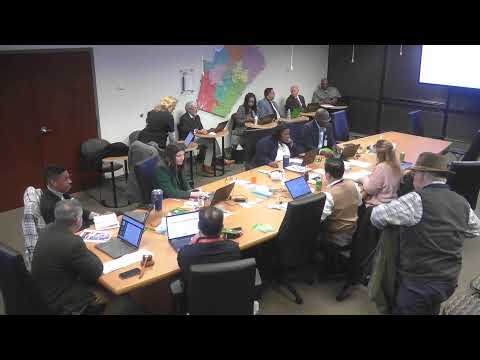
At a Wake County Schools Board work session, board members reviewed a draft legislative agenda that the board's government relations team advised be simplified to highlight the district's top priorities: funding of public education, local operational flexibility and fair, transparent access to school performance data.
Board members said the priorities are intended to make the district's requests clearer to state legislators and to focus on items with the highest local impact. "Funding for public schools needs to be prioritized and met before public funds are provided to private schools," a board discussion paper cited during the presentation.
Under funding, the draft calls for competitive salaries to retain educators, modernization of the special education funding formula and supplemental support for school meal programs. Doctor Taylor noted a statewide figure often cited by the district: "North Carolina can close the remaining gap for no cost breakfast in grades K‑5 ... for approximately $140,000,000," a number included to illustrate the scale of a possible state investment.
Board members raised questions about private school vouchers and transparency. Miss Edmonds urged clearer accountability for providers that receive public dollars, citing recent state allocations: "For the 24, 25 school year, the legislature with HB 10 allocated $616,000,000 for vouchers for that 1 school year," she said, arguing that families should have comparable achievement and budget information from private providers that accept public funds.
On operational flexibility, the board discussed requests that would allow greater local discretion on calendar adjustments, temporary local revenue measures for capital needs, and broader waivers to K‑3 class‑size rules in limited circumstances. Board members proposed language to permit additional flexibility for non‑low‑performing schools or to provide options to use local funding mechanisms for facility needs such as HVAC systems.
Board members also discussed licensure flexibility to ease hiring of experienced teachers from other states. Staff and trustees agreed to draft language on provisional certification and reciprocity to bring to the February work session; participants cautioned that full reciprocity across states is rare now.
The session concluded with a motion to enter closed session. Board member Mister Hershey moved to "go into closed session to consider confidential information under GS 143‑318.11(a)(6) and GS 115C‑319." The motion was seconded by Vice Chair Swanson and carried on a voice vote; no opposed voices were recorded in the transcript.
Staff said they will revise the draft using the board's feedback, coordinate with the board's government relations team and return a formatted document for the February 4 work session with proposed amendments for consideration.