Get Full Government Meeting Transcripts, Videos, & Alerts Forever!
Get email alerts on the Fbo Redevelopment topic
No spam. Unsubscribe anytime.
Airport director outlines draft RFP for long-term FBO leases; seeks commission input on criteria and timeline
Summary
Airport Director Haster presented a draft RFP to seek long-term FBO tenants for the airport’s northeast quadrant, proposing to begin with the east site and inviting commissioner input on evaluation criteria and the proposer timeline.
Airport Director Haster presented a draft request for proposals for long-term fixed-base operator (FBO) leases at the Santa Barbara Airport, focusing first on the east parcel in the airport’s northeast quadrant. Director Haster said the RFP aims to select FBO tenants under long-term leases—potentially 30 to 50 years—to enable the capital investments the airport needs and to increase transparency and competition.
Director Haster told the commission the airport’s two current FBOs operate from short-term leases that limit their ability to recoup large capital investments, but that the RFP “does not mean that we're not happy with our current FBOs.” He said the primary goals are fairness, long-term viability and alignment with the master plan and sustainability goals.
Key points staff presented: - The RFP will begin with the east site (shown as a 22.4-acre parcel) because the airport lacks the temporary space to have both sites under construction simultaneously. The two parcels were described as approximately 22.6 acres (west) and 22.4 acres (east). - The fuel farm leases and current self-serve fuel arrangements have different terms from the FBO leases; staff plans to include the fuel farm lease in the master lease going forward and to handle the self-serve tank as a separate process. - Evaluation criteria under consideration include financial capacity, development plan, business plan, diversity/equity/inclusion, and community benefits such as local jobs, environmental stewardship and accommodating both large business jets and small piston general aviation. - Staff suggested proposers would be required to meet minimum aeronautical standards; additional “nice-to-haves” (e.g., hangar mix, sustainability features, community benefits) would be weighted in scoring. - Draft timeline options ranged from 45–90 days for proposers to submit responses; staff suggested 60 days was reasonable given a comprehensive information packet. - Staff cautioned the selection-to-construction timeline could be long: roughly 2½–3 years to reach construction in typical scenarios, accounting for lease negotiations, design review and required permits.
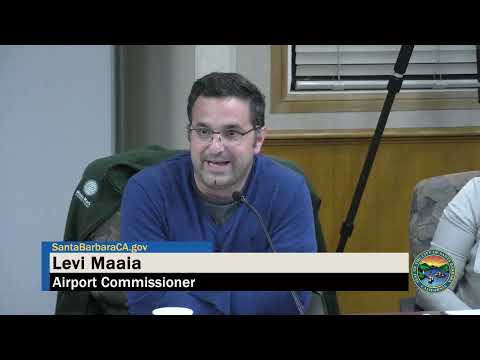
Commissioners asked for clarity on displacement of small general aviation tenants during construction and on site access from Hollister Avenue. Commissioner Bowen urged that planners “be planning for good access onto Hollister” and considered private parking or improved limousine access to make a future FBO operation viable. Director Haster said the west site has many small T-hangar tenants and the east-site development could help accommodate displaced tenants in phased construction. He said staff will work with proposers to phase construction to preserve operations.
Commissioners also discussed evaluation priorities. Some favored financial capacity and feasibility as heavily weighted criteria; others emphasized community benefits and protections for small-piston general aviation (including planning for the transition away from leaded avgas). Director Haster said staff will return with proposed weighting and recommended scoring after receiving commission input.
Staff did not bring an RFP document to the public packet because it is still a draft and contains facilities condition details staff intends to provide to proposers as part of the procurement package. Director Haster asked commissioners for guidance on scoring priorities and the RFP submission window before issuing the RFP for the east site.
No formal selection or vote occurred at the meeting; commissioners provided direction and questions for staff to incorporate into the draft RFP.