Get Full Government Meeting Transcripts, Videos, & Alerts Forever!
Get email alerts on the Homelessness topic
No spam. Unsubscribe anytime.
Pima County details encampment data and wins $7M and $11.5M HUD grants for housing initiatives
Summary
The county’s new Office of Housing Opportunities and Homeless Solutions reported about 2,000 confirmed encampment reports regionwide (roughly 15% in unincorporated Pima County) and announced successful HUD grant awards totaling tens of millions for housing preservation and access programs.
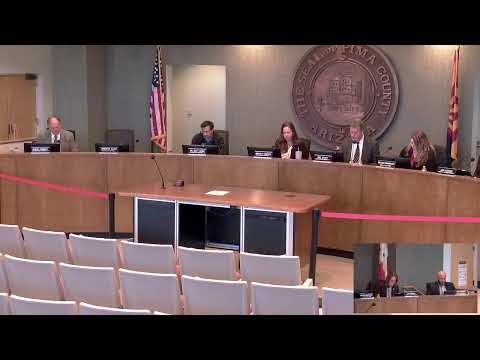
The director of Pima County’s Office of Housing Opportunities and Homeless Solutions presented a year‑end update to the Board of Supervisors on Jan. 21, reporting regionwide encampment and program data and announcing two competitive U.S. Department of Housing and Urban Development grants the county helped secure.
Director Jen Darling told the board the county recorded just over 2,000 confirmed encampment reports across the region in the 12‑month period ending Nov. 30, 2024. Of those, roughly 15%—about 323 reports—fell within unincorporated Pima County. Darling noted that a subset of reported encampments are on property that the county does not own or maintain (federal or state parcels), which limits county authority to clear or remediate those sites.
Darling summarized work remaining for the office’s five founding priorities, including creating a strategic and continuous improvement plan for county programming; aligning data systems so departments can share encampment and outreach data; and developing shared performance metrics across county partner agencies. She said the existing homeless protocol remains in effect while staff refine and memorialize operational best practices.
Darling said the county and its City of Tucson partners successfully competed for multiple HUD awards: a Pathways grant (“Pathways to Removing Obstacles to Housing”), totaling $7 million over five years, of which the county’s anticipated share is about $3 million to support affordable housing in higher‑opportunity neighborhoods and transportation fee subsidies for eligible projects. She also described another award described in the briefing as a preservation and reinvestment initiative totaling $11.5 million over five years, including roughly $5 million targeted for mobile‑home park and resident preservation and rehabilitation work.
Darling said the office is working with county IT and GIS staff to build a data system that will interface with regional reporting tools and better track encampment location, department responsibility, and the outcomes of interventions. She also said staff are developing measures to evaluate program efficacy so the county can track shelter use, rehousing rates and other outcomes across departments and nonprofit partners.
Board members pressed for clearer guidance the public can use to understand which agency or department to contact when they find an encampment, and requested that the office build a dashboard or a “grid” of responsibilities to reduce confusion among constituents and staff. Vice Chair Grijalva asked that county and city early‑voting and housing locations be co‑located where practical to reduce public confusion in other contexts; Darling concurred on the need for clearer interagency coordination.
Darling said her office will return with more detailed timelines and metrics as the planned data system and protocol revisions are finalized and piloted. Supervisors emphasized the need to track metrics for (1) outreach‑acceptance rates, (2) recidivism to cleared encampments, and (3) progress on additional shelter capacity.