Get Full Government Meeting Transcripts, Videos, & Alerts Forever!
Get email alerts on the Gaza Humanitarian Access topic
No spam. Unsubscribe anytime.
U.N. says Gaza ceasefire opened major humanitarian access as agencies scale up aid
Summary
The U.N. spokesperson said the recent ceasefire and hostage-release deal enabled more humanitarian aid to enter Gaza, with agencies prioritizing food, water, medical care and shelter; U.N. officials warned infrastructure damage and access constraints remain major obstacles.
The United Nations spokesperson said the ceasefire and hostage-release deal in Gaza has allowed a significant increase in humanitarian deliveries, with more than 630 trucks entering the territory on one recent day, about 300 of them to northern Gaza.
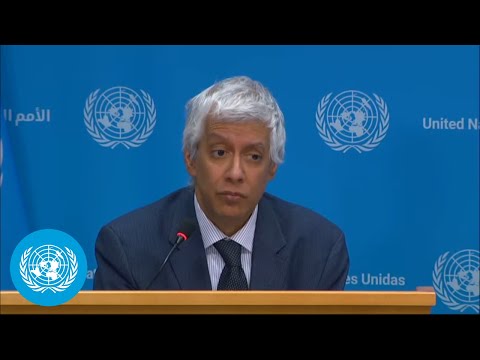
Farhan, the U.N. spokesperson, told reporters that the secretary-general described the deal as offering "a ray of hope" and urged parties to ensure it leads to the release of all hostages and a permanent ceasefire. He said the United Nations would "do all we can" to scale up assistance across Gaza while acknowledging "significant obstacles, challenges, and constraints".
The U.N. Office for the Coordination of Humanitarian Affairs and U.N. partners are prioritizing food, shelter, clean water and other essential supplies, the spokesperson said. He relayed the U.N.'s estimate that Gaza's entire population — more than 2,000,000 people — depends on those essentials and that children account for about half the population, with many surviving on one meal a day.
The World Health Organization outlined a 60-day plan to increase bed capacity at hospitals in northern and southern Gaza and to deploy additional health professionals from abroad. U.N. humanitarian briefings cited an estimated 30,000 people in Gaza with life-changing injuries who need specialized care, and partners said they are also looking at early-recovery measures to restore infrastructure and livelihoods where feasible.
On distribution and delivery, Farhan said the parties facilitating aid will collate and verify the number of trucks entering Gaza each evening; the U.N. will publish verified figures once that process is complete. He said the first surge included more than 630 trucks entering the day before, and that U.N. agencies and partners — including UNRWA, the World Food Programme and WHO — are working together at distribution points. "So far, so good," he said when asked about widespread looting or violence affecting deliveries, but he cautioned the situation remains fluid.
Farhan said UNRWA plans to prepare for resuming education for the roughly 650,000 Palestinian children in Gaza "once the fighting stops," while noting many former UNRWA schools are currently being used as displacement sites and would need to be reconfigured to return to schooling.
Humanitarian operations face infrastructure damage that could limit access, Farhan said: blocked or unsafe roads, rubble and mines will need to be cleared to reach some areas. He added that with the ceasefire in place, demining, rubble removal and similar activities can begin at scale.
The spokesperson said agencies are coordinating to prioritize life-saving assistance and that the U.N. continues to press countries with influence over the parties to ensure aid reaches civilians in need.
Ending note: The U.N. pledged daily updates on aid flows as figures are verified and reiterated calls for parties to facilitate safe, unimpeded humanitarian operations and the release of hostages as part of broader efforts toward a durable cessation of hostilities.