Get Full Government Meeting Transcripts, Videos, & Alerts Forever!
Get email alerts on the Hathaway Scholarship Amendments topic
No spam. Unsubscribe anytime.
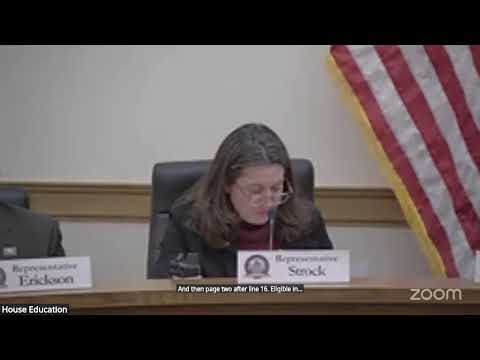
Wyoming Education Committee expands Hathaway eligibility to include in-state technical and trade schools; bill passes as amended
Summary
The House Education Committee voted to pass House Bill 36 as amended, removing a proposed payback clause and adding Wyoming-accredited technical and trade schools to eligibility for the Hathaway Scholarship; committee members and witnesses debated enforcement and workforce implications.
The House Education Committee voted to pass House Bill 36, amendments to the Hathaway Scholarship program, after approving changes that remove a proposed payback provision and add Wyoming-accredited technical and trade schools as eligible institutions.
The amendment approved by the committee deleted language that would have required repayment under certain conditions and inserted language making “Wyoming accredited for-profit or nonprofit technical or trade schools” eligible for Hathaway awards. Representative Harshman, the bill sponsor, and Vice Chair Lalli urged colleagues to separate the payback discussion from the workforce-focused changes so the committee could move the effort forward.
The change is intended to let students pursuing nondegree certificate and technical training use Hathaway scholarship funds in Wyoming rather than leaving the state for accredited programs. Devin Brubaker, airport director for the Southwest Wyoming Regional Airport and president of the Wyoming Airports Coalition, told the committee the aviation industry currently faces a “significant shortfall in pilots and aircraft mechanics” and said the bill’s language “provides clarity and makes sure that students in Wyoming can pursue these high paying jobs while still taking advantage of the Hathaway Scholarship.”
Committee members and witnesses described broad support for expanding eligibility. Clark Fairbanks of the Wyoming Youth Service Association said the amendment “provides expanded opportunities for kids that have very little parental support,” and Janelle Overlander, president of the Gillette Community College District, said her institution has both transfer and technical programs and that employers want workers with shorter, skills-focused training. Cindy Barlow, speaking as an individual and in her role with WyoTech, asked the committee to consider including accredited for‑profit technical schools so more Wyoming students could access training and stay in the state.
At the same time, Department of Education officials and members raised practical concerns about adding a work-or-stay requirement and about enforcing any payback provision. Mr. Shaner of the Wyoming Department of Education warned that a requirement for graduates to remain working in Wyoming “might have a chilling effect on students taking advantage of the Hathaway Scholarship” and said the department would face “logistical challenges” in tracking students and reclaiming funds if recipients did not comply. The bill’s text was held to apply prospectively: one committee member noted that “section 2 … only applies, going forward, starts July 1, 2025.”
The department’s accountability director, Sean McInerney, provided enrollment data for new Hathaway recipients in 2023–24, reporting roughly 412 provisional, 348 opportunity, 676 performance and 614 honors awards, for 2,050 new enrollments statewide; he told the committee that pre‑COVID yearly new-enrollment totals were above 2,400.
Committee discussion included a request to study related programs and statutory alignment in the interim. Vice Chair Lalli and other members asked staff to track possible interim study topics covering program alignment (for example, WIN, WWAMI, and WICHE) and constitutional or funding considerations before expanding eligibility more broadly. Several members said they supported the workforce focus of the amendment but wanted to ensure any expansion would be legally defensible.
On a voice/roll call, the committee approved House Bill 36 as amended. The clerk recorded nine ayes and no nays; the chair declared the bill passed out of committee.
The committee did not finalize detailed administrative rules or enforcement language at the hearing; members directed sponsors and staff to work on conforming language and potential rulemaking steps ahead of subsequent legislative consideration.