Get Full Government Meeting Transcripts, Videos, & Alerts Forever!
Get email alerts on the Taxes Property Tax Relief topic
No spam. Unsubscribe anytime.
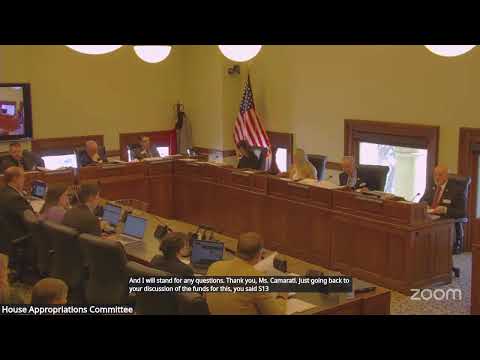
Appropriators approve short-term 50% residential property tax relief with $1M cap and proposed backfill
Summary
House Bill 169, which would provide a two-year 50% residential property tax reduction with a $1,000,000 fair-market-value cap and specified backfill amounts, passed the committee 6–1 after debate about effects on school funding and the Legislative Stabilization Reserve Account (LISRA).
The House Appropriations Committee voted to pass House Bill 169, a measure proposing a short-term 50% reduction in residential property tax assessment for properties with a fair-market-value cap of $1,000,000, by a 6–1 roll call vote. Representative Sherwood cast the lone no vote and explained it reflected constituent concerns about preserving stable school funding.
Chairman Locke, the bill sponsor, described the proposal as short-term relief intended to align in structure with a ballot initiative but not to conflict with the will of the voters. "My intent with this bill, this is of course short term relief and, it is structured, I would say somewhat like the ballot initiative but not directly like the ballot initiative. And I was very intentional in this bill to ensure it does not conflict with the will of the people," Chairman Locke said.
Committee discussion identified two elements of the bill: (1) a tax relief provision that reduces the taxable value of qualifying residential property by 50% with a cap of $1,000,000 in fair market value, and (2) a backfill mechanism intended to offset revenue impacts to local governments and schools. Committee members discussed language on pages two through six of the fiscal draft describing a mix of backfill sources. Committee members clarified the apparent reversal in an earlier reading: the final explanation given on the floor identified $100,000,000 coming from the Legislative Stabilization Reserve Account (LISRA) and $125,000,000 from the general fund as components of the backfill language.
Mr. Richards, a budget staff member, warned the committee that the Legislative Stabilization Reserve Account balance is limited and that, under current estimates, a 50% clawback could trigger a LISRA draw. "Right now, I believe you have roughly $175,000,000 available in that account... it looks like the grant and aid payments from the 600 series are roughly $100,000,000 per year for the school foundation program or $50,000,000 if half of that is impacted. So it is likely that the $100,000,000 threshold would be reached," Mr. Richards said.
Representative Sherwood said his no vote reflected constituent feedback. "When I was door knocking this summer, my constituents said, Yeah, it would be nice to have property tax relief, but not at the expense of stable funding for our public schools and our education," Sherwood said.
The committee recorded the roll call as follows: Representative Aleman, Aye; Representative Angelos, Aye; Representative Harrelson, Aye; Representative Pendergraft, Aye; Representative Sherwood, No; Representative Smith, Aye; Chairman Bair, Aye. The clerk announced six ayes and one no.
The sponsor and staff noted the bill is structured as a two-year measure intended to sunset before a possible ballot initiative would take effect and that the bill includes a cap and backfill provisions; committee discussion focused on how the backfill would affect the School Foundation Program and the LISRA balance. No amendments were adopted in committee.