Get Full Government Meeting Transcripts, Videos, & Alerts Forever!
Get email alerts on the School Safety Grants And Procurement topic
No spam. Unsubscribe anytime.
Task force approves funds and procurement for school safety after statewide needs assessments
Summary
The Utah School Security Task Force, citing results from statewide school safety needs assessments required under HB 84, approved funding and authorized procurement for a school safety dashboard, first-aid/bleed kits and panic-alert devices.
The Utah School Security Task Force voted to authorize immediate purchases and near-term work to address gaps identified in school safety needs assessments and to fund completion of a school safety dashboard.
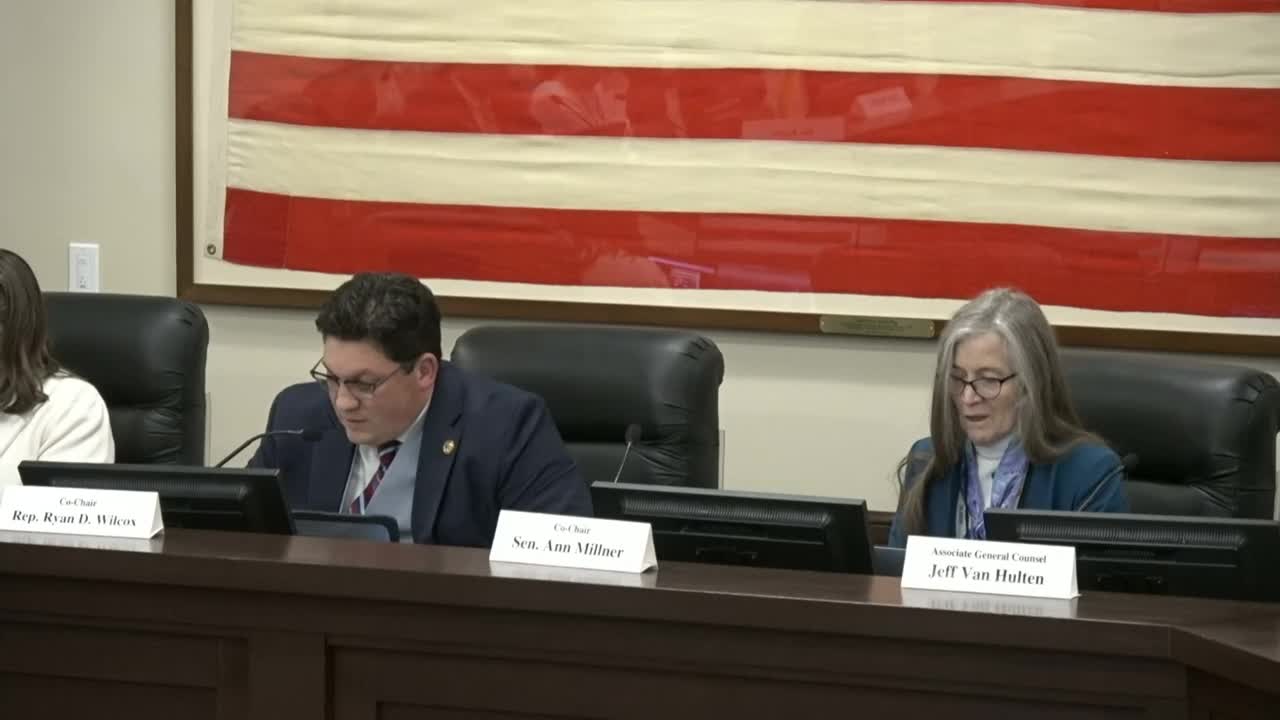
Representative Ryan D. Wilcox, chair of the task force, opened discussion by noting that the needs-assessment requirement stems from earlier legislation and that the group had initial results to use for prioritizing grants. Micah Wicksen, legislative research and general counsel, summarized recent appropriations: the Legislature previously established a $72,000,000 grant program under HB 61 and last year’s HB 84 appropriated roughly $100,000,000 for school security grants. Wicksen said that HB 84 divides new funding into two buckets — about $50,000,000 for general grants the task force can prioritize statewide and about $48,000,000 for targeted grants to specific local education agencies — and reminded members that districts generally have until the end of 2026 to spend earlier award funds.
Chantelle Cota, director of school safety and student services at the Utah State Board of Education, told the task force that 100% of Utah schools submitted the school safety needs assessment. Cota described the nine minimum standards laid out in HB 84 (limited entry points, video surveillance, ground-level window protections, internal door locks, bleed kits and first-aid kits, exterior entrance cameras, playground fencing and panic-alert devices) and said many schools are in the “mid range” of meeting four to five standards. She said priorities identified for immediate grant funding include bleed kits and first-aid kits and that panic-alert devices remain a focus.
On formal actions, the task force approved three motions during the meeting: - A motion to authorize $1,500,000 in matching funds from the HB 84 general-grants appropriation to the Utah State Board of Education to complete the school safety dashboard. Representative Wilcox moved the motion; members approved it by voice vote. - A motion by Senator Milner directing the task force to use funds from the general-grants appropriation to supply first-aid kits and bleed kits to public schools and to request that the State Board of Education and the state security chief begin the procurement process for those items. The motion as placed authorized procurement and asked for a report back to the grant subcommittee and the task force; members approved the motion by voice vote. - A motion to use general-grants appropriation funds to supply physical panic-alert devices (the “Alyssa’s Law” functionality referenced by members) to public schools and to request that the State Board of Education and the state security chief start procurement and standards development for those devices. The motion specified work on implementation standards and a limited vendor/implementation approach to avoid the interoperability/PSAP problems seen in other states; it was approved by voice vote.
Task force members discussed implementation details and limits of authority. Chief Huntington and other members raised that bleed-kit distribution may require associated training; the task force directed that initial procurement focus on equipment while leaving open future consideration of funding for training and coordination with school nurses and EMS. Senator Milner and others said procurement plans should consider cost-sharing or reimbursements when districts already have items or private partners offer donations, and the grant subcommittee will review cost‑effective delivery models before broader disbursement.
On the school safety dashboard, Cota said the Utah State Board of Education previously allocated $1,500,000 of discretionary funding toward development; the task force approved an additional $1,500,000 to complete the project after a separate federal grant application was unsuccessful. The dashboard is intended to live in the state parent portal and to include data such as disciplinary actions, minors found in possession of dangerous weapons, and law-enforcement actions; Cota and the board said they are coordinating a procurement and technical design. Representative Wilcox said the intent is to move the dashboard work quickly so schools benefit in the coming school year.
The task force also discussed grant prioritization: the $50,000,000 general grant pot can be used to purchase items for statewide deployment (for example, guardian identifiers), while the targeted $48,000,000 pot will fund district‑specific needs informed by the needs assessments.
The meeting record shows voice votes and no recorded oppositions for the motions above. Members asked that the State Board of Education and the state security chief report procurement approaches and cost models back to the grant subcommittee and the full task force before widespread disbursement.
The task force will use its grant subcommittee and the needs-assessment results to target purchases and to consider subsequent requests for training funding and other supports identified by districts.