Get Full Government Meeting Transcripts, Videos, & Alerts Forever!
Get email alerts on the Homeland Security Information Sharing topic
No spam. Unsubscribe anytime.
Committee approves bill letting Office of Homeland Security receive law-enforcement-sensitive information
Summary
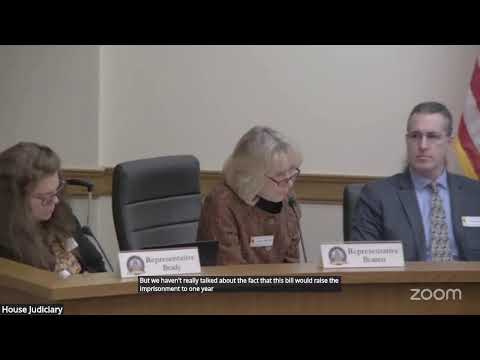
The Judiciary Committee voted to advance House Bill 50, a committee bill that authorizes the Wyoming Office of Homeland Security to receive law-enforcement-sensitive information on a need-to-know basis. Members adopted an amendment making the law effective immediately; final committee vote was 7-2.
The House Judiciary Committee voted 7-2 to report House Bill 50 favorably after testimony and an amendment to make the bill effective immediately.
House Bill 50 is a committee bill presented on behalf of the Wyoming Office of Homeland Security. Director Lynn Budd and deputy director George Nykin described the bill as narrowly intended to permit the office to receive law-enforcement-sensitive information from other agencies on a need-to-know basis to carry out statutory duties, including recent tasks assigned to the office and the Division of Criminal Investigation related to critical infrastructure protection.
Director Budd explained that the provision is modeled on the security-clearance concept: receiving agencies would see law-enforcement information only where there is a demonstrated need to know. She cited the value of combining disparate pieces of information to create a fuller picture that helps prepare for and respond to threats.
Why it matters: The change affects how state agencies coordinate on public-safety and infrastructure protections. Committee members probed limitations on sharing, retention of information and the nature of the information to be shared, particularly when other statutes list partner agencies.
Key discussion points and clarifications
- Division of Criminal Investigation Director (name given as Director Jones in committee) and other witnesses described operational examples where sharing is important, such as responses to hazardous-material scenes, methamphetamine lab investigations and bomb- or regional-response-team activations.
- Director Budd said the regional emergency response teams are activated as state teams (for liability and reimbursement purposes) and that sharing location and threat details allows the Office of Homeland Security to coordinate reimbursement and liability protections.
- Committee members asked about statutory language that referenced other agencies (for example, Department of Family Services) and whether the bill's drafting should be placed in a different statutory location. Director Budd said information-sharing with federal and state partners is already voluntary in practice and that the bill clarifies the Office's ability to receive information on a need-to-know basis.
Amendment and vote
Vice Chair Singh offered an amendment to make the bill effective immediately; the amendment was seconded and adopted with the department indicating it was prepared to begin under the immediate effective date. The committee then voted to report House Bill 50 favorably by roll call (7 ayes, 2 nos). Committeemembers voting no expressed concerns about the scope of mandatory sharing language appearing elsewhere in statute and sought clarity about one-way or two-way sharing obligations.
Context and limitations
Director Budd stated that classified or restricted federal material remains controlled by the owner agency and would not be redistributed by the Office without permission; the Office does not intend to create a central repository of classified records. Committee members requested follow-up clarification about the interplay of state statutes that use "shall" and intergovernmental coordination. The bill was advanced to the floor.