Get Full Government Meeting Transcripts, Videos, & Alerts Forever!
Get email alerts on the Guns School Safety topic
No spam. Unsubscribe anytime.
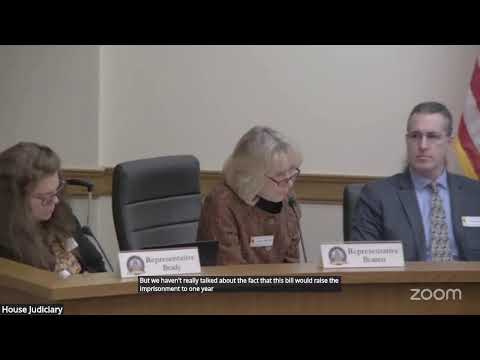
Wyoming House Judiciary Committee advances bill curbing gun-free zones after multiple amendments
Summary
The House Judiciary Committee advanced House Bill 172, which would repeal gun-free zones and make related preemption changes. The committee adopted several amendments, including delaying the bill's effective date to July 1, 2025, and passed the bill on an 8-1 vote.
The Wyoming House Judiciary Committee advanced House Bill 172 on a roll call of 8-1 after members debated several amendments addressing schools, training, and local policies.
The bill, described at the committee meeting as a repeal of gun-free zones with related preemption provisions, was moved by Vice Chair Singh and seconded by Representative Feiler. Committee business opened with the chair noting there would be no public comment because the public-comment period had closed Friday.
Why it matters: The bill would change where firearms may be carried and what local entities may regulate; committee debate centered on how the measure would affect school safety, university child-care programs and local policies such as safe-storage rules and handling by employees.
Committee action and key amendments
- Several amendments proposed by Representative Chastick were not seconded and therefore were not considered, including an item to exempt rural school districts from training requirements and an amendment requiring people carrying concealed weapons into school facilities to check in and provide contact and weapon information.
- An amendment proposed by Representative Chastick to allow the University of Wyoming's Early Childhood Education Center to be treated like licensed childcare facilities (and thus be covered by the existing exemption) was seconded but failed on voice vote.
- Representative Chastick offered and won an amendment changing the bill's effective date from immediate to July 1, 2025. Representative Chastick said institutions affected would need time "to ramp up and plan" for the changes; the committee approved the date change.
- Representative Kelly's technical amendment replacing grammar and verb forms (changing wording to read that a person "knowingly" carrying a concealed weapon could be removed for other unacceptable conduct) carried on a voice vote.
- Representative Feiler successfully moved inserting the Department of Corrections in a statutory list of agencies referenced by the bill; the amendment was moved with a friendly comma change suggested by Representative Chastick.
- Representative Kelly also replaced "subject to approval by" with "in consultation with" in language about establishing ongoing training, and the committee approved that change.
- A package of language the committee approved clarified that government entities may adopt rules for safe storage when firearms are not on a person, enact rules about safe handling while on campus or in facilities, and enact policies restricting particular persons from bringing firearms into disciplinary or similar hearings when articulable facts indicate they present a threat. That amendment was adopted by the committee.
Debate themes
Committee members who opposed the bill emphasized concerns about introducing more guns into schools and other sensitive places and questioned the reliability of some statistics cited by supporters. Representative Chastick (opposed) and others urged caution and cited studies they considered more credible. Supporters argued that allowing lawful, concealed carry could deter attacks and that statewide standards were consistent with how other constitutional protections are enforced.
Representative Feiler, a cosponsor, framed the measure in constitutional terms and said the bill provides additional tools for law enforcement and communities to respond to threats.
Final vote and next steps
The committee voted to report House Bill 172 favorably by a roll call of 8 ayes and 1 no. The roll call recorded ayes from Representatives Brady, Bratton, Feiler, Kelly, Lean, Singh, Webb and Chairman Wauschott; Representative Chastick cast the lone no vote. The bill will proceed to the next stage of the legislative process.
Context and limiting detail
Speakers repeatedly distinguished between discussion, direction and formal action; the committee explicitly changed statutory language in several places but did not enact any other off-record policy. Several proposed amendments were withdrawn or not seconded and therefore not considered. Where testimony or members referenced studies and national data, committee members disagreed about which sources were credible; the committee did not adopt any external-study findings as part of its motion notes.