Get Full Government Meeting Transcripts, Videos, & Alerts Forever!
Get email alerts on the Health Care Price Transparency topic
No spam. Unsubscribe anytime.
House panel backs bill to codify hospital price-transparency rule; directs state health agency enforcement
Summary
The House Labor, Health & Social Services Committee voted 7-0 to recommend a due-pass for House Bill 121, which would require hospitals to publish standardized, machine-readable pricing and give the Wyoming Department of Health rulemaking and enforcement authority to review compliance.
CHEYENNE — The House Labor, Health & Social Services Committee on Tuesday recommended a due pass for House Bill 121, a bill to codify and require enforcement of hospital price-transparency requirements in Wyoming.
The bill would direct the Wyoming Department of Health to develop rules and a standardized form for hospitals to publish minimum and maximum negotiated charges, to perform compliance reviews and to enforce corrective action plans and civil money penalties for noncompliant facilities.
The measure’s sponsor, Representative Daniel Singh, told the committee the bill is intended to ensure “consumer protection” if federal policy changes. “I think it would be imperative for us to get those in our own books,” Singh said during his presentation, citing recent federal policy changes that he said have weakened earlier requirements.
Why it matters: Supporters said state enforcement is needed because federal enforcement by the Centers for Medicare & Medicaid Services (CMS) has been limited and CMS guidance has allowed estimates rather than fixed, dollars-and-cents prices in some instances. Advocates said that lack of enforceable state requirements has left patients exposed to unexpectedly large bills.
What was said to the committee
- Stefan Johansson, Director, Wyoming Department of Health, outlined administrative duties the bill would place on his agency and said implementation would be a “bolt on” to existing survey and licensing processes. He urged the committee that the department would need time and stakeholder collaboration to design forms and compliance processes and to assess administrative impacts.
- Laura Hudspeth, Administrator, Office of Healthcare Licensing and Surveys, said Wyoming’s 31 licensed hospitals are surveyed every three to five years and that the department could perform the transparency review largely off-site by checking hospital websites and responding to complaints. She described standard deficiency/corrective-action procedures and said civil money penalties are currently imposed for serious nursing-home deficiencies.
- Patient advocates said enforcement at the state level is necessary. Marnie Carey, president of the nonprofit Power to the Patients, described a constituent who received a roughly $32,000 hospital bill after a COVID hospitalization and argued state enforcement would “put some teeth” into the federal rule. Alaria Santangelo, director of research at patientrightsadvocate.org, presented the group’s compliance report and criticized CMS guidance allowing estimates and algorithms in machine-readable pricing files.
- Hospital representatives said most Wyoming hospitals have taken steps to comply with federal rules and warned of unintended burdens from duplicative state regulation. Tim Thornell, CEO of Cheyenne Regional Medical Center, said his hospital posts machine-readable price files and consumer price-estimator tools and that CMS has fined hospitals for noncompliance. The Wyoming Hospital Association expressed concern that a state law duplicative of federal requirements would create administrative costs and potential conflicts if federal rules later change.
Committee action and vote
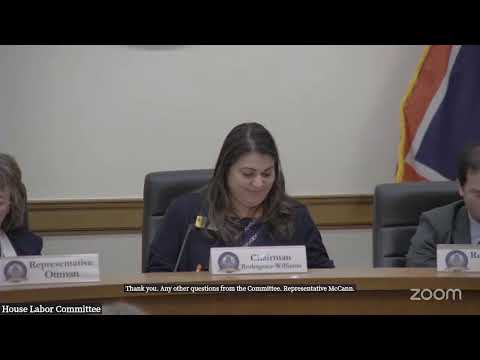
Vice Chair Otman moved the bill out of committee; Representative Guggenmoss seconded. The roll-call vote produced seven ayes and no recorded nays or abstentions. The committee clerk reported: “That is 7 ayes.” The committee’s recommendation was recorded as a due-pass, and Representative Singh was directed to present the bill on the floor.
Implementation details and uncertainties
Department witnesses said the bill gives the department time to develop rules and that the fiscal and staffing impacts are not yet specified. Director Johansson and Ms. Hudspeth said the department would work with providers to design a reasonable compliance method but could not yet quantify additional positions or dollars. Hudspeth said reviewing a hospital’s website for compliance “would be much shorter, a few hours per process,” compared with multi-day on-site surveys for other licensing work.
Opposition and concerns
Hospitals and insurers warned that requiring state-level enforcement in addition to federal rules could be duplicative and might create future conflicts if the federal rule changes. Hospital representatives also said smaller rural hospitals may face uneven costs to implement machine-readable files and consumer tools.
What’s next
House Bill 121 has a committee recommendation of due pass and was scheduled to be carried to the House floor by the sponsor. The department and interested stakeholders said they would work on rule design and implementation timing if the bill advances.
Ending
The committee recorded the vote as 7–0 in favor of recommending House Bill 121 for passage. The bill text and the department’s rulemaking authority in the draft specify opportunities for interim implementation planning and future technical adjustments by the department.