Get Full Government Meeting Transcripts, Videos, & Alerts Forever!
Get email alerts on the Property Rights Zoning topic
No spam. Unsubscribe anytime.
Blount County commission adopts nonbinding recommendation on property ownership rights after hours of debate
Summary
After more than two hours of debate and public comment, the Blount County Board of Commissioners on Jan. 16 adopted a nonbinding resolution recommending the planning commission review zoning rules so denials of private land uses must be accompanied by written citations to laws or ordinances.
The Blount County Board of Commissioners on Jan. 16, 2025 adopted a nonbinding resolution recommending the Blount County Planning Commission review county zoning regulations so that denials of private property uses be accompanied by written citations to pertinent rules and laws.
The measure, introduced by Commissioner Acard and amended heavily during floor debate, instructs the planning commission to consider rewriting zoning so prohibitions are spelled out in writing and to promote fair, equal enforcement of county, state and federal laws. County officials and commissioners repeatedly described the adopted text as a recommendation only; the county attorney reviewed the amended version and found no legal objection to its nonbinding form, the commission was told.
Supporters said the measure aims to protect property owners from arbitrary interpretations of zoning rules. Opponents and some planning commissioners urged caution, saying the legal terminology and policy implications are complex and could require substantial rewrites of zoning codes. Public speakers urged both sides: some warned the resolution would open a “Pandora’s box,” while others said clearer rules would prevent inconsistent enforcement.
Commissioner Acard said the intent was narrow. “If it doesn't say you can't, then you can,” Acard said during debate, framing the recommendation as a way to ensure county decisions are based on written rules rather than office-by-office opinion. He moved the original resolution and later led amendments to make the recommendation explicitly nonbinding and to simplify its language.
Several residents spoke during the public-comment period. Brian Ospy of Alcoa told commissioners growth makes regulations necessary to protect neighbors’ property rights. Deanne Ospy, District 1 resident, said she feared the resolution’s original wording could have unintended effects and urged careful wording. Jasmine Satterfield of District 7 asked for clarity about whether the measure would change existing rules or only improve transparency when an application is denied. Steve Cook of the Rockford area said he opposed the measure as presented, calling its placement on the agenda problematic.
Commission debate was lengthy. Commissioner Michaels, who said he has experience as a contractor and previously served on planning bodies, described recurring problems—examples where homeowners were told they could not live in pre-engineered metal buildings or use septic or electrical hookups despite no clear written ban. Michaels said the planning and development offices have not completed promised regulatory updates from 2021 and argued the planning commission should address specific regulatory gaps. “We need to make legitimate changes to our zoning regulation and our subdivision regulation,” Michaels said.
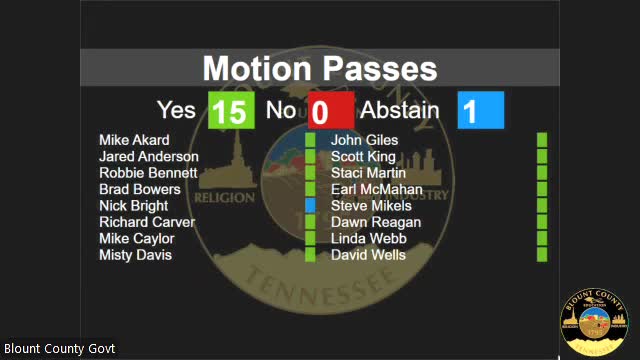
Other commissioners called for clarity. Commissioner Giles asked for specific definitions of “prohibitive” and “permissive”; several speakers noted legal definitions vary and recommended planning staff and the county attorney be involved in any substantive rewrite. The commission voted down a motion to postpone the item and instead approved the amended, nonbinding recommendation by voice vote, recorded as 14 yes, 2 no.
The adopted text (as amended) instructs the planning commission to consider converting aspects of the county’s zoning framework so the law is written to state what is prohibited rather than leaving permissive uses only to ad hoc interpretation; it also asks that when a use or request is denied, the county provide written reasons citing the specific county regulation, Tennessee law or federal law relied on. The resolution, by design, does not change policy immediately; it is a request that the planning commission examine whether and how to revise the zoning code.
The commission and several speakers noted the planning commission has a scheduled meeting on Jan. 23, 2025; the resolution will be transmitted to that body for consideration. Planning staff, the county attorney and the planning commission will determine whether any ordinance changes are necessary and, if so, bring specific proposals back to the commission for formal action.
The measure passed as amended; the language requiring conversion from a strictly “prohibitive” approach to a “permissive” approach was removed during amendment and the final adopted text was framed as a nonbinding recommendation.