Get Full Government Meeting Transcripts, Videos, & Alerts Forever!
Get email alerts on the General Plan Update topic
No spam. Unsubscribe anytime.
Planning commission begins update to 2019 general plan, flags housing, transit and annexation priorities
Summary
Commissioners and staff opened a broad discussion of updating Hideout’s 2019 general plan, emphasizing updated demographics, housing typologies (including more accessible single‑story units and incentives for affordable housing), transportation access and regional coordination for transit and trails.
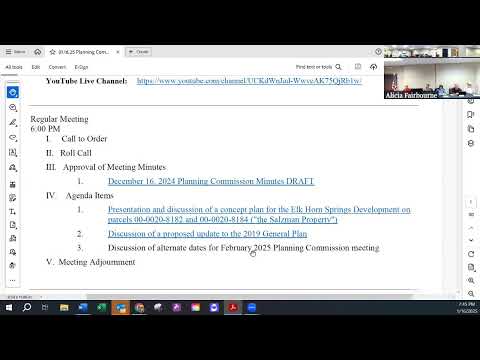
Hideout Town planning staff and commissioners opened a multi-month effort Jan. 16 to update the town’s 2019 general plan, focusing on updated demographic analysis, housing diversity, transportation connectivity, and priorities for annexation and economic development.
Planning staff said the existing plan used demographic data collected in 2017 and that the town now needs fresh population and housing analyses because the town’s boundaries and housing stock have changed substantially. “We know we're at about, I think, 750 right now,” Thomas (planning staff) said when discussing current dwelling counts; staff said a new demographic update and projections will inform housing, land-use and annexation sections of the revised plan.
Why it matters: the general plan guides land-use decisions, annexations, and priorities such as neighborhood commercial sites and transportation. Commissioners identified several potential updates they want the plan to address, including ways to encourage accessible single‑story or “age‑in‑place” housing, how the town can incentivize affordable or workforce housing given state constraints, and improving multimodal and regional transit connections.
Key discussion points - Housing and demographics: Commissioners noted an aging resident base and interest in more single‑story and downsizing options (casitas, ranch/ranch‑style homes, stacked flats offering single‑level living). Staff said the town needs an updated demographic and housing needs analysis to better tailor housing policy and to identify opportunities for incentivizing affordable units as part of MDAs or rezoning requests. - Inclusionary zoning limits at the state level: Staff explained state law changes that limit mandatory inclusionary zoning and said the town must rely on incentives and negotiated benefits in development agreements to secure affordable housing. Thomas said the state “disallowed inclusionary zoning as a requirement,” so the town should “incentivize it” during rezoning or MDAs rather than require it across the zoning code. - Transportation and connectivity: Commissioners asked staff to prioritize regional transit coordination, spine‑trail connections and improved access to the Richardson Flat/Richardson area parking/bus function. Staff and commissioners discussed the high cost of joining regional transit providers and noted parking constraints at local bus pickup points. - Economic development and neighborhood commercial: Commissioners repeated a desire to incentivize neighborhood commercial (grocer, cafes, small retail), noting that early residential buildout is a prerequisite for many retailers. The group discussed possible town-developer partnerships and the need to subsidize early commercial phases to attract tenants.
Next steps and process Staff outlined a phased approach: commission input on vision and goals, an updated demographic analysis, targeted element updates (housing, land use, transportation and natural environment), and public outreach including a community survey. Staff said planning will return with draft language and implementation ideas over the coming months and recommended producing a short, focused executive summary for public distribution after the update.
What was not decided No formal amendments to the plan were adopted at the meeting. Commissioners provided direction on areas to emphasize and asked staff to return with data, draft language and more specific recommendations.
Ending: multi-month update process Commissioners asked staff to prioritize updated population and housing numbers, clearer policies for housing typologies and workforce housing incentives, and improved language on regional trail and transit connections. The planning commission expects ongoing review and periodic returns to the commission through the update timeline.
Quotes used in this article come directly from the public meeting transcript and are attributed to the speakers listed in the article’s speaker list.