Get Full Government Meeting Transcripts, Videos, & Alerts Forever!
Get email alerts on the Recording Policy topic
No spam. Unsubscribe anytime.
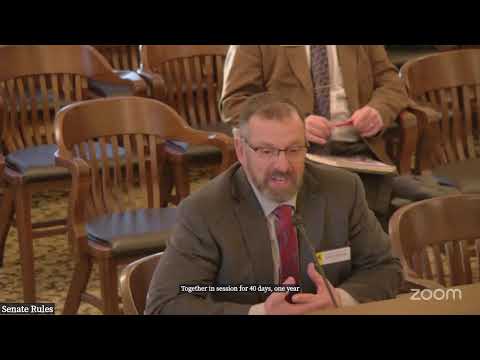
Panel reviews proposed rule to ban recording of private legislative conversations
Summary
Committee members reviewed a proposed Senate Rule 15-8 that would prohibit audio or video recording of private communications involving legislators, staff or guests without consent; members and staff discussed scope, practicality and alternative language.
The Rules & Procedure Committee on Jan. 16 reviewed a proposed Senate Rule 15-8 that would prohibit recording private communications of legislators, legislative staff and guests on the Senate floor and in other areas where legislative business occurs unless all parties consent.
The proposal, presented by staff, drew language similar to a House amendment that Representative Lolly brought to the House Rules Committee. The proposed rule states legislators have a “reasonable expectation of privacy in the private communications, including but not limited to communications with constituents,” and that “No legislator, legislative staff member, or guest shall use audio or video recording equipment to record the private communication of a legislator conducted on the floor of the senate or any parts of the capitol in its passages or at any place in which the legislature is conducting legislative business without the consent of all parties to the communication.”
Committee members and staff discussed scope and practical application. The director noted the rule is intended to address private conversations even if they occur during public committee hearings: “If I'm whispering to you and Senator Garew is taping our conversation and we we expect that, we have an expectation of privacy in our whispered conversation even in public meeting, then that is the sort of recording that this is trying to get.”
Members queried whether the rule would unintentionally limit ordinary recording of committee proceedings or public testimony; staff suggested the emphasis is on private communications, not the public gallery or testimony. The draft also includes alternative wording options that would clarify whether the prohibition applies “in any place in which the legislature is conducting legislative business” or to places where an individual legislator is conducting legislative business.
No formal action was taken; the committee asked staff to refine language and consider practical enforcement and definitions of “guest” and “private communication” before any vote.