Get Full Government Meeting Transcripts, Videos, & Alerts Forever!
Get email alerts on the International Development topic
No spam. Unsubscribe anytime.
World Bank says global growth to hold at 2.7% as IDA21 replenishment targets poorest countries
Summary
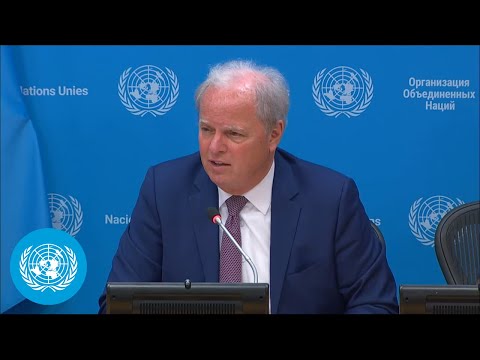
At a World Bank Group noon briefing, Axel von Tratzenberg summarized the World Bank’s Global Economic Prospects outlook and reported that the International Development Association’s 21st replenishment mobilized about $100 billion, with roughly $23.7 billion in donor contributions directed largely to Africa, fragile states and climate programs.
At a World Bank Group noon briefing, Axel von Tratzenberg, senior managing director for partnerships and development policy for the World Bank Group, said the global economy is expected to expand by 2.7% in both 2025 and 2026 and summarized findings from the bank’s upcoming Global Economic Prospects report. He also reported results from the International Development Association’s 21st replenishment (IDA21), saying the cycle mobilized about $100,000,000,000 with roughly $23,700,000,000 in donor contributions.
The replenishment, von Tratzenberg said, will concentrate support for the poorest countries: “about 70% will go to Africa,” and roughly 40% of the IDA21 allocations are directed to fragile and conflict-affected states. He added that about 45% of IDA21 resources are earmarked for climate-related work, split roughly evenly between mitigation and adaptation.
Why it matters: the figures reflect the World Bank’s plan to scale financing for low-income and fragile countries as global growth remains below pre-COVID decade averages. Von Tratzenberg told reporters the bank expects developing economies to grow near 4% in 2025–26 while advanced economies grow around 1.7%, and that global inflation should decline toward 2.7% in the same period.
In his summary of trends, von Tratzenberg highlighted longer-term changes in the world economy: developing countries now account for about 45% of global GDP, up from about 25% in 2000, and they currently generate roughly 60% of global growth. He also said more than 40% of exports from developing countries go to other developing countries, and that remittances from 2009–2023 represented about 40% of a measured total for developing economies.
On how IDA21 funds will be used, von Tratzenberg cited priorities including gender, infrastructure and energy access. He described a large Africa-focused electricity effort referenced in the briefing as the “M300” program, intended to expand electricity access; in his remarks he said the program targets reaching 300,000,000 Africans by 2030 and described substantial investment needs tied to that goal.
Report and operational context: von Tratzenberg said IDA17 was roughly $50–52 billion and that IDA resources have roughly doubled in the last decade. He said exchange-rate movements affected the U.S. dollar value of contributions to IDA21; in local currency, he said, contributions rose about 13% but currency devaluation left the dollar total near steady. He characterized the donor base as concentrated, noting the G7 accounts for about 60% of donor contributions and the European Union about 31%.
Questions from reporters touched on several topics. Gabriel Elizondo (Al Jazeera) asked how the World Bank decides annual support to U.N. agencies; von Tratzenberg described that support as “country-specific and need-driven,” particularly in fragile states where U.N. agencies may implement programs the bank cannot execute directly. He said the World Bank’s coordinated financial support to U.N. agencies over the last eight to nine years totals about $11,000,000,000, or roughly $1.2 billion per year on average, and named UNICEF and the World Food Programme among agencies that have received funding while also citing coordinated work with UNHCR, WHO and the WTO.
On inflation and tariffs, Margaret Bashir (Voice of America) asked whether consumers will feel relief if inflation falls. Von Tratzenberg cautioned that lower headline inflation does not automatically translate into more money in consumers’ pockets, stressing that price changes hit poorer households — who spend a larger share on food — more sharply. On tariffs, he declined to speculate about specific future policy announcements and said the bank reports factual developments; he noted both tariff and non‑tariff barriers can affect trade and that policy impacts differ across sectors and regions.
On debt, Iftikhar Ali asked whether the World Bank is making recommendations about high debt burdens in low‑income countries. Von Tratzenberg said many low‑income countries face debt distress or are at risk; he described the G20 common framework for debt treatment and said responses have ranged from reprofiling to haircuts in specific cases. He emphasized the importance of liquidity — positive net flows where disbursements exceed amortization and interest — and promoted greater transparency in debt contracting and management.
Von Tratzenberg also outlined internal measures the World Bank is taking to expand lending capacity, including adjustments to the equity-to-loan ratio and use of hybrid capital and guarantees. He said increasing the bank’s lending headroom is intended to expand support to both low‑ and middle‑income countries while mobilizing private‑sector financing in parallel.
The briefing closed after reporters’ questions; von Tratzenberg said a press release and the full report will be available on the World Bank website, and the moderator announced a forthcoming briefing with Philippe Lazzarini of UNRWA.