Get Full Government Meeting Transcripts, Videos, & Alerts Forever!
Get email alerts on the Homelessness Prevention topic
No spam. Unsubscribe anytime.
Office of Supportive Housing reports high prevention success; supervisors seek coordinated response for vehicle dwellers and San Jose outreach
Summary
The Office of Supportive Housing told the committee it has served households at or above capacity with prevention programs and provided $15 million in assistance over the past year; supervisors asked for a strategic plan, coordination with San Jose on vehicle-dweller policies and more targeted outreach to Latino and women-led households.
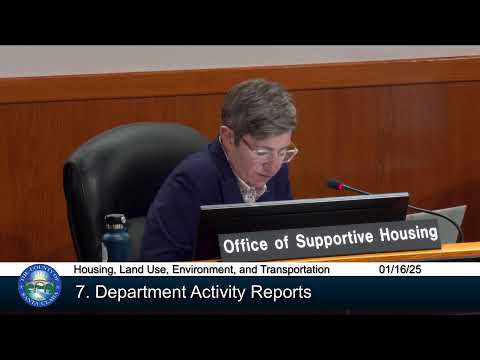
The Office of Supportive Housing on Jan. 16 reported to the Santa Clara County Housing, Land Use, Environment and Transportation Committee that its homelessness prevention system continues to operate at or above capacity and provided over $15 million in financial assistance in the past year to stabilize households.
Acting Director KJ Kaminsky, deputy director Hillary Armstrong and homelessness prevention manager Jessica Orozco presented monthly system metrics and a deeper dive into prevention programs. The office said 95% of households remained housed while receiving assistance and that 95% of households exited to permanent destinations. The prevention system's largest program reported average assistance near $7,000 per household, typically covering two or more months of rent.
The presentation highlighted demographic trends: 57% of households served are families with children, 64% of prevention clients self-identified as Hispanic/Latinx, and 73% of households are women-led. Orozco said those numbers underscore the role of financial assistance and culturally responsive services in preventing homelessness.
Public comment: Paul Sotto urged the county to account for populations displaced from East San Jose in previous years and criticized the county for failing to include those people in data and planning.
Supervisors discussed outreach, vehicle dwellers and coordination with cities. Supervisor Reyna pressed staff on how RV and vehicle residents are categorized and asked for a collaborative meeting with the city of San Jose, county departments and elected officials to align strategies for planned city enforcement and prioritization efforts. Acting director Kaminsky confirmed that people living in vehicles in places not meant for habitation are counted as unsheltered in the county's system and that the county's system is responsible as part of the broader regional continuum of care.
Supervisor Reyna moved to approve the Office of Supportive Housing report and requested additional items: a strategic plan outlining the department's goals, priorities and strategies; an offline meeting with San Jose and other city partners to coordinate responses to vehicle-dwelling enforcement and safe parking; and a prompt briefing on responsibilities when children are living in camps or vehicles. The motion was seconded and carried; roll-call recorded Vice Chair Arenas as yes and Chair Margaret Abi Koga as aye.
Other updates from the office and partners included preparations for the point-in-time count with more than 600 volunteers registered and 187 volunteers with lived experience participating, three affordable housing construction projects that received tax credits in December and near-term lease-ups for Roosevelt Apartments and Bellarmino development. The office said it expects to bring a full community plan update to the Board before June.
Committee members also discussed the county's safe parking programs. One supervisor noted their city had built a large program that relied in part on local general fund support and asked whether the county can support other cities that lack the capacity to establish safe parking lots. Staff said county partnerships and funding options are being explored.
Evidence spans from the transcript that support this summary are appended below.