Get Full Government Meeting Transcripts, Videos, & Alerts Forever!
Get email alerts on the Homeowner Property Tax Relief topic
No spam. Unsubscribe anytime.
Committee hears House Bill 169 to exempt 50% of residential value for 2025–26; implementation, backfill and system limits draw scrutiny
Summary
Representative John Locke presented House Bill 169, which would exempt 50% of fair market value (up to $1,000,000) of residential structures for tax years 2025 and 2026 and provide partial state backfill to local taxing entities; the committee took testimony but did not vote.
CHEYENNE — Lawmakers in the House Revenue Committee heard lengthy testimony on House Bill 169, a proposal to provide short‑term property tax relief by exempting 50% of fair market value for residential structures (capped at the first $1 million) for tax years 2025 and 2026 and to use state appropriations to partially reimburse affected local taxing entities.
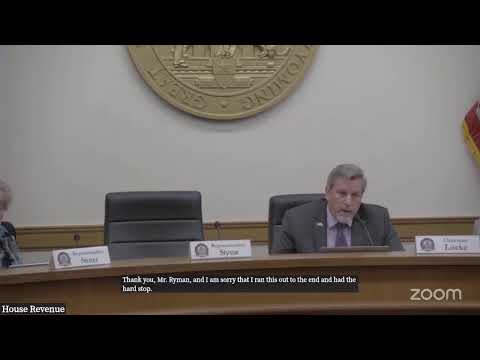
Representative John Locke (chairing the bill presentation) described the measure as a short‑term relief step while the legislature considers longer‑term property tax reform. "The intent of the bill was to allow us to get money into the hands of the residential property owners," he said, noting the bill does not limit the exemption to owner‑occupied homes and was drafted to speed implementation.
The bill would apply the 50% exemption to the fair market value of residential structures (defined in the bill to include single‑family homes, modular homes, mobile homes, townhomes or condominiums that are privately owned and intended for human habitation) and then instruct the Department of Revenue to distribute partial backfill to county treasurers. The sponsor included two appropriations totaling $225 million in the bill text: $100 million from the Legislative Stabilization Reserve Account and $125 million from the General Fund to support the reimbursement process. The fiscal note presented to the committee estimated the total reduction in taxes at roughly $395 million across affected taxing entities.
Brenda Henson, director of the Wyoming Department of Revenue, told the committee the bill raises a series of technical and administrative questions that affect timing and calculation. She noted the state’s computer‑assisted mass appraisal (CAMA) system cannot, with current configuration, perform multiple layered exemptions in the order that some members described for 2025. "Our Grama system can't accomplish that for 2025," Henson said, explaining the department could apply this bill’s 50% exemption or the long‑term homeowner exemption that is already in statute, but not both in the sequence some members prefer without vendor modification. She added the vendor believes the system could be adapted for 2026.
Committee members and witnesses also focused on how the exemption would interact with other recent property tax changes: the 4% cap on residential structure growth enacted in 2024; the long‑term homeowner exemption already in statute (applications for which the department has been accepting); and the veterans exemption (a fixed assessed‑value exemption that is currently backfilled by the state). Henson recommended the committee clarify legislative intent about the order in which exemptions and caps should be applied so assessors and treasurers can compute tax bills consistently.
County assessors raised warnings about local fiscal stability and administration. Dixie Huxtable, Converse County assessor and legislative chair of the Wyoming County Assessors Association, told the committee smaller counties and special districts could be particularly vulnerable to sudden revenue reductions. She also highlighted timing risks for veterans who rely on a $6,000 assessed‑value exemption that is applied on a different schedule than some of the exemption deadlines.
Local government groups reiterated concerns about fiscal impacts and service delivery. Jeremiah Grama of the Wyoming County Commissioners Association said some counties rely heavily on property taxes and warned that a substantial reduction without additional state revenue could force cuts to services or raise rates elsewhere. Erin Taylor of the Wyoming Association of Community College Trustees reminded members that community colleges are funded in part by local property taxes and that residential value is a stable, predictable revenue source for colleges.
Lawmakers asked several implementation questions: whether the exemption applies to land (the bill’s sponsor said the intent was to exempt the structure only), whether the cap and exemptions apply to rental units or second homes (the sponsor said the bill is broad and covers residential property as defined in the bill), and how and when reimbursements to taxing entities would be calculated and distributed. Henson explained mill levies are set after budget processes and treasurers report exemption‑related lost revenue to the Department of Revenue after levies are finalized; the appropriation’s sufficiency would therefore be known only after levies are set.
No final committee vote on House Bill 169 occurred during this hearing. Committee members agreed there are many moving parts that need resolution — most notably the order of exemptions, CAMA functionality for layered calculations, and the adequacy and distribution mechanism for the state backfill — before a vote can be scheduled.
Ending: The hearing underscored the technical complexity of short‑term property tax relief: lawmakers appeared sympathetic to providing immediate help to homeowners, but the Department of Revenue and local officials urged clear statutory instructions on calculation order and more time to ensure county assessors and treasurers can implement the change without unintended consequences.