Get Full Government Meeting Transcripts, Videos, & Alerts Forever!
Get email alerts on the Parking topic
No spam. Unsubscribe anytime.
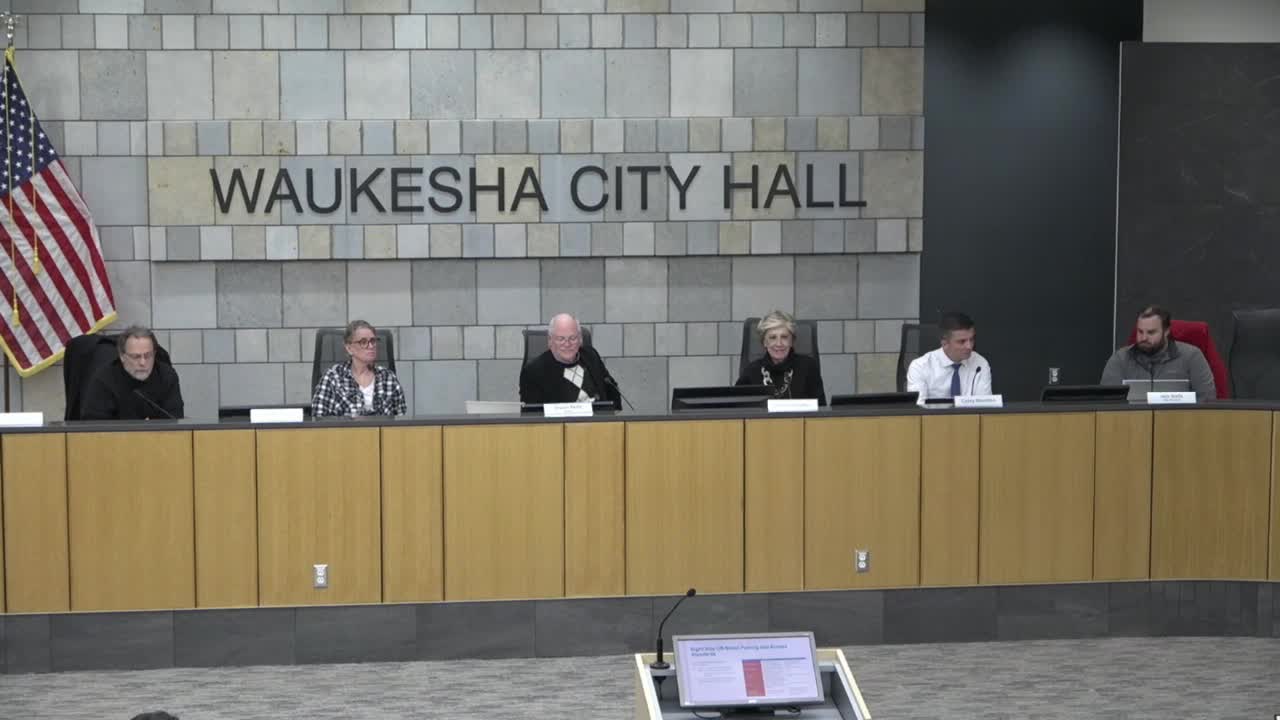
Waukesha planners discuss cutting parking minimums, adding maximums to curb oversupply of pavement
Summary
Commissioners and consultants discussed replacing large off-street parking minimums with lower "right-sized" minimums and possible maximums, exemptions near transit, fee-in-lieu options, and environmental trade-offs including stormwater and chloride runoff.
Commissioners considered proposals to modernize off-street parking rules by reducing or eliminating minimum parking requirements for many nonresidential uses and establishing maximums to avoid over-paving.
Consultants presented two main options: (1) eliminate off-street parking minimums entirely for certain uses and institute a maximum, or (2) right-size existing minimums downward and add a ceiling. The presentation used grocery stores as an example, noting national best practice might use a factor of about one space per 300 square feet rather than the larger local minimums that can generate hundreds more stalls than needed.
Speakers argued the change could reduce construction and maintenance costs, reduce impervious surface and stormwater runoff, and encourage multimodal transportation. Commissioner Keller noted historic standards were driven by retailer demand and changing shopping behavior: "Now that people are getting things delivered to their front door, do they really see the need to go to shopping centers like they did before?" The commission discussed allowing exemptions where projects have long-term agreements to use city parking facilities or where a site is proximate to transit.
Several commissioners and staff recommended a pragmatic approach: aggressively limit maximum parking but allow projects to justify additional spaces with a parking study or mitigation (for example, additional stormwater controls or permeable pavement). Commissioners also raised environmental concerns about chloride (road-salt) runoff from large parking areas and suggested fee-in-lieu or mitigation for additional parking beyond the maximum.
Staff said they will bring draft parking tables that include right-sized minimums, possible maximums, exemptions for transit-proximate sites, and a process to allow developers to justify higher counts with studies or payment of mitigation fees.