Get Full Government Meeting Transcripts, Videos, & Alerts Forever!
Get email alerts on the Housing Infill Program topic
No spam. Unsubscribe anytime.
Tulsa housing staff, consultants outline preapproved building program to speed and diversify infill housing
Summary
City housing staff and an external consultant outlined plans to develop a preapproved building (PAB) catalog intended to speed permitting, lower development costs and expand middle‑scale infill housing options in Tulsa.
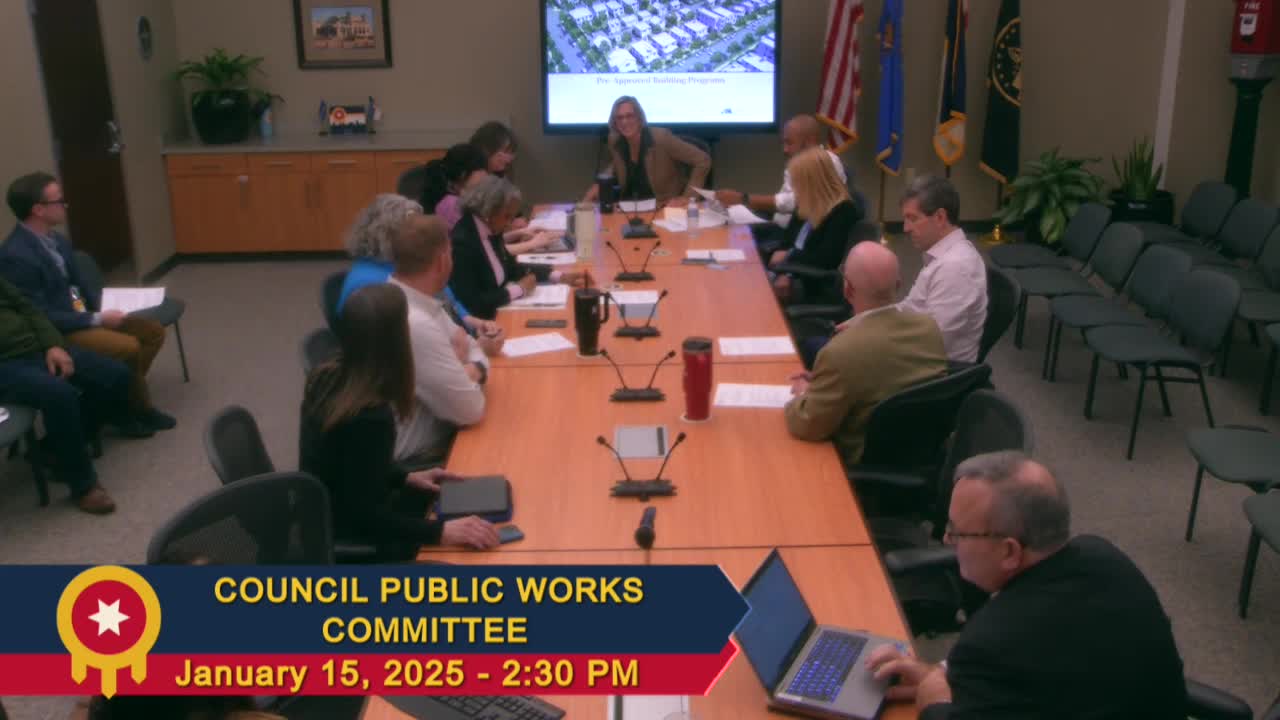
City of Tulsa housing staff and a consultant team told the Public Works Committee they will develop a preapproved building program (PAB) aimed at increasing the supply and variety of infill housing and lowering development costs for a broad range of builders.
Travis Holson, housing manager for the City of Tulsa, said the program is one of 33 action items from the task force on housing, homelessness and mental health and that the city will brief the full council monthly on implementation. “We will have an official launch event for this program the end of this month,” Holson said, and the city expects community outreach and stakeholder engagement to continue through the program’s design phase.
Jennifer Griffin, an architect and principal of Jay Griffin Design, described PABs as a catalog of predesigned housing types—often focused on middle‑scale options such as duplexes, triplexes and fourplexes—that can be preapproved or prereviewed so builders can move faster through permitting. “PABs are essentially tools that are used to help to, essentially support and incentivize better built‑in outcomes in your community,” Griffin said. She said the best programs pair design development with community input so building types fit neighborhood character.
Griffin and Holson reviewed examples from other cities. South Bend launched its program about two years ago: staff said 18 units have been constructed or permitted and roughly 98 additional units are in preconstruction or planning. Kalamazoo partnered with a local nonprofit to build 48 units using preapproved designs before opening them to the public. The consultant said those programs reduced architectural fees, shortened permitting timelines, and helped smaller nonprofits and individual owners enter the housing market.
Staff outlined a development timeline of roughly 12 months to produce a Tulsa catalog, with community engagement, lot and financial analysis, and implementation tools. Griffin said the catalogs commonly include multiple elevation options and a checklist of allowable deviations so that builders can still vary appearances without losing the expedited review benefit. For one cited example, a two‑bedroom, two‑bath unit was discussed by committee members as costing about $179,000 in a sample from another city; staff said Tulsa will calibrate price points and target neighborhoods in consultation with the housing assessment and market analysis.
Committee members pressed staff on several topics: how to accelerate uptake, whether the city should identify initial partner developers or nonprofits to seed projects, how to handle zoning and narrow historic lot widths, and how to pair the program with infrastructure or funding to make development feasible in neighborhoods with older utilities or appraisal gaps. Holson and Griffin said complementary programs—such as sewer lateral reimbursement or targeted acquisition funds—have been used in other cities to address those barriers and could be considered in Tulsa as the PAB program identifies priority locations.
Staff said the program will allow limited modifications: plan sets will include three elevation options and a nonexclusive city license so the plan set may be used for projects in city limits. Single‑ and two‑family preapproved plans can reduce plan review down to a site plan check in some jurisdictions; multiunit designs typically require a prereviewed package and local licensed professionals to complete structural or civil design details.
Council members also urged targeted outreach and resources to ensure equitable access, including bilingual materials (Spanish was specifically suggested) and direct engagement with local small builders and community groups. Members suggested pairing the catalog with portions of the $75 million housing discussion (as noted in committee remarks) for acquisition or implementation support. Staff said they will develop a website and public materials and welcome input on potential early projects and partners.
The meeting record shows committee discussion and multiple detailed questions; the transcript does not record a formal vote on program adoption. Staff indicated next steps: a launch event at the end of the month, a roughly 12‑month design and community engagement process, and follow‑up briefings to council.