Get Full Government Meeting Transcripts, Videos, & Alerts Forever!
Get email alerts on the Community Violence Prevention topic
No spam. Unsubscribe anytime.
Indianapolis Foundation reports crime-prevention gains from Elevation grants but warns ARPA support is ending
Summary
The Public Safety and Criminal Justice Committee heard data from the Indianapolis Foundation showing outcomes from four rounds of Elevation grants, including reductions in murders and nonfatal shootings and improved recidivism for participants; foundation staff and councilors discussed sustainability as ARPA funds phase out.
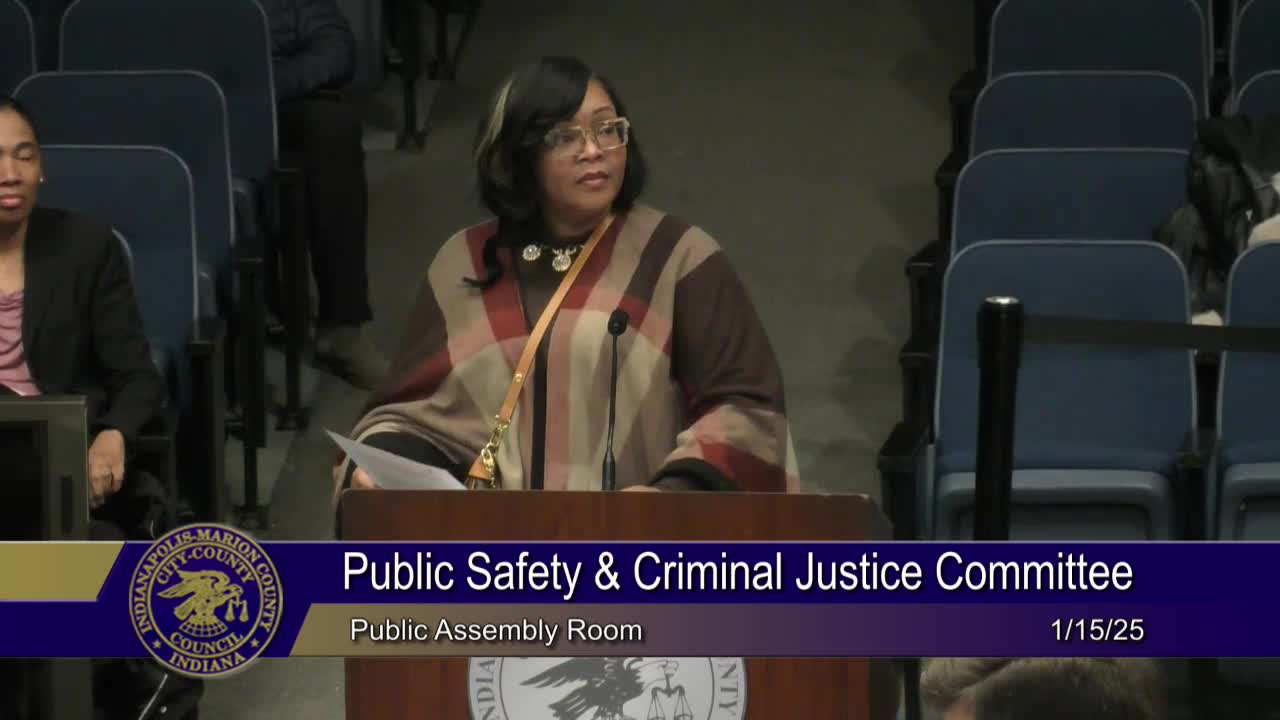
The Public Safety and Criminal Justice Committee heard a report Jan. 15 on the Elevation grant program, a multi-round fund administered by the Indianapolis Foundation using city and American Rescue Plan Act (ARPA) dollars.
The presentation, given by Josette Robinson, director of special programs and initiatives at the Indianapolis Foundation, summarized results from rounds one through four and the foundation's capacity-building work. Robinson told committee members the program aims to invest in grassroots, community-led efforts that address the root causes of violent crime.
Robinson said the Elevation program backed dozens of grassroots grantees and used city dollars for a "thriving neighborhoods" category. She reported that across four rounds the program supported 34 grantees and that city funds awarded totaled $3,914,950. Robinson said grantees received targeted technical assistance through a vendor identified in the presentation as ParTech Consulting Group, which provided workshops, coaching and other capacity-building supports.
Robinson highlighted several participant-level outcomes: she said 75% of individuals served by violence-reduction programs lived in high-crime ZIP codes listed in the presentation, 78% of adult participants remained free (not incarcerated) during the grant period, and youth recidivism was low'she said roughly 7% of nearly 4,000 youth had juvenile court cases filed during the grant period. Robinson also reported program-level results such as 82% of youth learning a new skill and 86% completing an education or training program they enrolled in.
The presentation said grantees reported improved relationships with law enforcement, stronger financial reporting and greater capacity to seek other funding. Robinson cautioned, however, that the results do not prove Cause and effect: "correlation does not imply causation," she told the committee.
Committee members pressed on long-term funding. Councilor Dan Boots asked about ARPA funding and Robinson confirmed ARPA support had ended; she said the foundation administered a final federal-funded round in 2024 and the projected city budget for Elevation in 2025 is $3 million. "We did approach the mayor and the city, requesting an increase in funds," Robinson said, but added the foundation will work with the smaller budget and focus on sustainability strategies for grantees.
Councilor Cristo Carlino and others asked how the foundation will use program data to leverage future philanthropic and federal grants; Robinson said the foundation is pursuing federal opportunities and providing sustainability workshops, mini-grants and grant-writing support to grantees.
Robinson and councilors also discussed implementation challenges for small organizations, including staffing, data collection and fiscal compliance. She described ParTech's role in offering 737 workshops and thousands of hours of technical assistance across rounds and said many grantees secured additional funding or in-kind support after participating.
The committee did not take formal action on the report. Several councilors thanked Robinson and said council oversight will continue as the city and foundation plan how to sustain community programs after ARPA-era funding declines.
Looking ahead, Robinson said the foundation will emphasize multi-year evaluation and capacity supports to help grassroots groups sustain services when one-time federal funds end.