Lifetime Citizen Portal Access — AI Briefings, Alerts & Unlimited Follows
Laguna Madre Water District outlines $72.75M seawater desalination plan, seeks May bond election
Loading...
Summary
The Laguna Madre Water District presented plans for a seawater reverse-osmosis facility capable of producing 5 million gallons per day, and said it will ask voters in a May 3, 2025 bond election to authorize additional local funding to close an estimated $59 million construction funding gap.
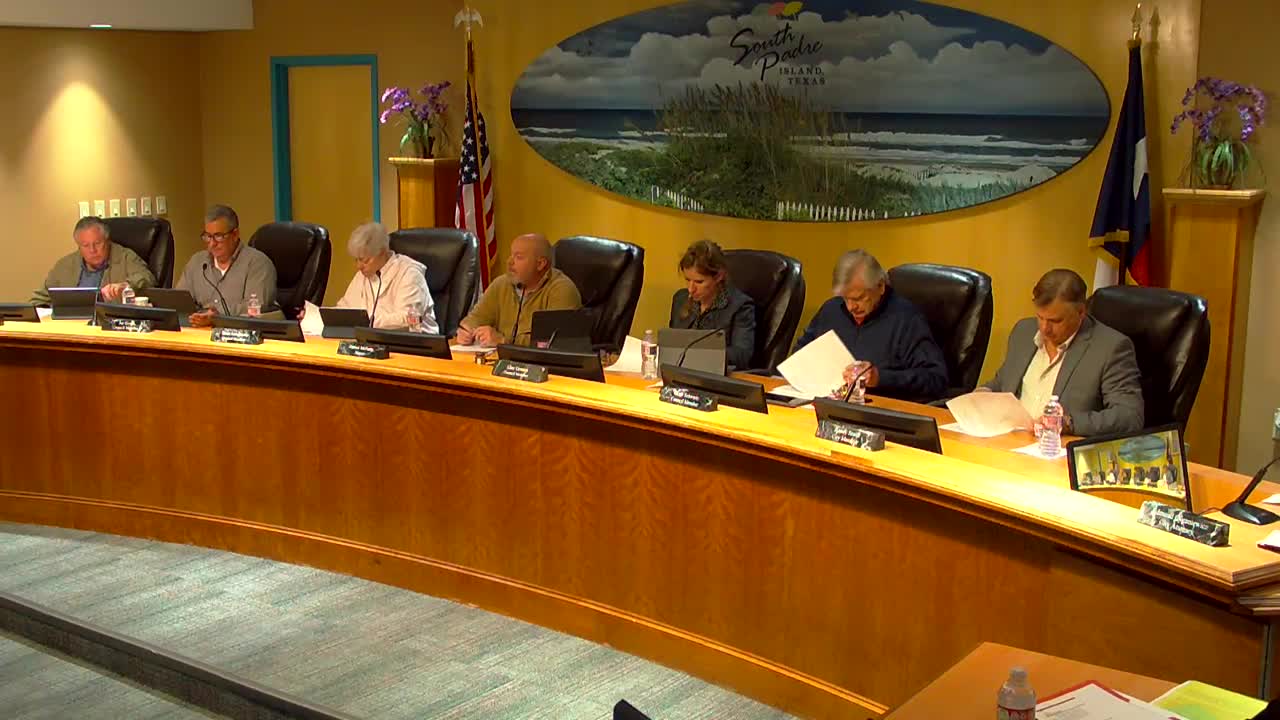
Charles Ortiz, presenting for the Laguna Madre Water District, briefed the South Padre Island City Council on a proposed seawater reverse-osmosis desalination facility intended to provide a drought‑resistant water supply and reduce reliance on Rio Grande surface sources.
Ortiz said the proposed facility would produce up to 5,000,000 gallons per day (MGD) when it comes online and that a new seawater intake and a second diversion from the Port Isabel Turning Basin to Water Treatment Plant No. 1 are planned. “The goal of the proposed project is to provide a drought resistant, sustainable water supply for the Laguna Madre Water District through the construction of a seawater reverse osmosis facility,” Ortiz said.
He told the council the district plans to place a bond proposition on the May 3, 2025 election and said the district must call the election by its February 12 meeting to meet the timeline. Ortiz said remaining authorization needed to complete construction is approximately $59,000,000, after accounting for prior authorizations and recent commitments.
Ortiz presented an opinion of probable project cost of $72,750,000 and gave a construction subtotal of $62,700,000 from line-item estimates: $18,000,000 for the intake structure, $1,200,000 for the raw water pipeline, $37,500,000 for reverse osmosis additions, $3,000,000 for waste discharge infrastructure, $1,000,000 for environmental mitigation, and $2,000,000 for construction management. He said previously authorized funds from a May 14, 2011 voter authorization reduce the local share.
On funding, Ortiz said the district has secured a $10,000,000 commitment from the State Water Implementation Fund for Texas (SWIFT) that will cover planning, acquisition and design work, and that the bureau application to the U.S. Bureau of Reclamation had a favorable notice. “We did get the notice that we were a successful applicant yesterday,” Ortiz said, describing a federal cost-share arrangement that will reduce the district’s remaining local authorization. Ortiz cautioned negotiations on the federal financial agreement were ongoing and would need to be closed in coming months.
Ortiz said the U.S. Army Corps of Engineers in January 2024 issued a final report confirming the viability of using the Port Isabel outfall extension for concentrate disposal, and that microfiltration work now under construction is intended to complement blending of Rio Grande and seawater sources. He said the district has an industrial discharge permit under technical review with the Texas Commission on Environmental Quality for concentrate discharge.
Ortiz said the intake structure is being sized to handle up to 20 MGD of raw water to allow future expansion (up to 7.5 MGD treated capacity in a later phase), while the initial funded phase would deliver 5 MGD. He also described a tax-rate impact example using a $250,000 property value: under a conservative estimate the bond could equate to about $175 per year for such a homeowner, but he characterized that figure as preliminary.
Council members asked about prior bond funds and the status of Plant No. 1 microfiltration work; Ortiz said the 2020 bond paid for system improvements and microfiltration equipment now staged for startup and that the Plant No. 1 start-up is targeted for November 2025. He said a pilot study and final design remain part of the planning steps already funded from the $10,000,000 state commitment.
Ortiz acknowledged community concerns about environmental impacts, concentrate discharge and cost. He told the council the project would use industry best practices to mitigate impacts and that public voters will decide whether to authorize the tax bond this May.
The presentation did not include a council vote on the desalination project; Ortiz described the project status, funding needs and next steps for calling a bond election and negotiating federal grants.