Get Full Government Meeting Transcripts, Videos, & Alerts Forever!
Get email alerts on the Emergency Services Districts topic
No spam. Unsubscribe anytime.
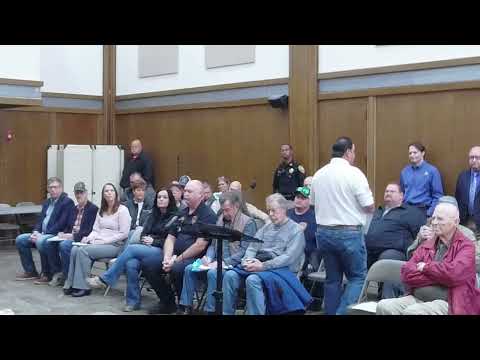
Washington County commissioners approve ballot election for Emergency Services District No. 1 after heated public hearing
Summary
The Washington County Commissioner's Court voted 3-2 on Tuesday to create Washington County Emergency Services District No. 1 and call an election under Chapter 775 of the Texas Health and Safety Code, after a lengthy public hearing.
The Washington County Commissioner's Court voted 3-2 on Tuesday to create Washington County Emergency Services District No. 1 and call an election under Chapter 775 of the Texas Health and Safety Code, sending the request to voters in the affected area.
The public hearing that preceded the vote drew more than a dozen speakers representing residents, volunteer firefighters and others from the Chapel Hill and Myersville areas. Supporters said an ESD would provide a stable revenue source for aging apparatus, protective gear and increased call volume; opponents said a new property tax would be permanent and unfair to residents already paying county taxes.
The vote came after extended testimony. Chris Casada, fire chief of Washington Volunteer Fire Department, said volunteer departments have relied on fundraising and sporadic county support and cannot reliably plan for replacement apparatus. "We will not see this engine completed until 2026, 10 years from beginning this process," Casada said, describing a multi-year delay and rising costs: what began as a $125,000 estimate for an engine upfit now approaches $425,000. He said fundraisers cannot cover those costs and that unpredictable revenue leaves departments unable to plan.
Other supporters described the personal cost to volunteers and the public-safety risk of failing equipment. "One set of turnout gear, including an air pack ... is $8,500 for one firefighter," paid and volunteer firefighter Cade Clark told the court, listing sample equipment prices. Dustin Brown, captain and president of the Chapel Hill Volunteer Fire Department, said recent development and an increase in high-value homes make funding more urgent and urged the court to "allow the people to decide" by placing the measure on the May ballot.
Opponents called the ESD a permanent tax and argued the county should expand support instead. Doug Mauer, a longtime firefighter, said the proposed district would mean "double taxation" for properties that already fund services through county taxes and that a countywide solution would be preferable. Victor Mirsky, a resident, said households on fixed incomes cannot absorb another tax.
Speakers clarified technical points during the hearing. Todd Birch, a Chapel Hill resident who said he had worked with the local department, explained that the petition would give the ESD authority to tax up to 10 cents per $100 valuation, but that a five-member ESD board would decide the actual rate. Ira Kovler asked the court to address its statutory duty under the Health and Safety Code's five-factor test and recommended the court find the petition feasible and allow voters to decide.
In the formal record vote, Commissioner Mayeski voted aye; Commissioner Hannah voted no; Commissioner Bullock voted no; Commissioner Horn voted aye; and Judge Derenberger recorded an aye, producing a 3-2 majority. The motion language in the minutes states the court "create the Washington County Emergency Service District number 1 and grant petition and call election as authorized under chapter 775 of the Texas Health and Safety Code." The court did not set the tax rate; that authority rests with the ESD board if voters approve the district.
Commissioner Bullock, who voted no, later explained that the court recently received more complete operating budgets from volunteer departments under a memorandum of understanding and said she considered a countywide approach or a county assistance district (a sales-tax option) preferable to multiple, separate taxing districts. She said her "no" vote reflected a view that the petition was premature given new budget transparency, not an opposition to better funding for fire service.
The court closed the hearing and recorded the motion. The order grants the petition and calls an election; timing of the election and administrative steps (candidate appointments to the ESD board if voters approve) will follow the procedures required under Chapter 775 and local election administration.
The hearing included detailed testimony about equipment lead times, grant delays and rising replacement costs; several speakers urged letting the voters in the affected area decide. The petition and the court's finding forward a local ballot measure that, if approved by voters, would create a separate taxing entity governed by a board of commissioners who would set rates and oversee expenditures.
The court's action creates a pathway to a public election on the ESD. If voters approve the district, the ESD board — not the court — will set the tax rate and manage funds for the district's purposes as allowed by Chapter 775.