Get Full Government Meeting Transcripts, Videos, & Alerts Forever!
Get email alerts on the Anti Dei In Governmental Programs topic
No spam. Unsubscribe anytime.
House committee approves bill to bar government programs that promote institutional discrimination, adds clarifying amendments
Summary
House Bill 147, which would ban certain government practices described as promoting differential treatment based on immutable characteristics and create a new statute in Title 9, passed the House Education Committee after sponsor and agency explanations and several amendments to clarify the scope of instruction and discussion.
Representative Rachel Rodriguez Williams introduced House Bill 147 to the House Education Committee on Jan. 15, urging members to approve a measure she described as prohibiting state institutions from engaging in practices that promote differential treatment on the basis of race, color, ethnicity, religion, sex or national origin.
Rodriguez Williams said the bill would create a new chapter in Title 9 (proposed Wyoming Statute 9‑25‑101 in the bill) defining “diversity, equity, and inclusion” programs as those that “promote differential or preferential treatment of individuals or classify individuals on the basis of race, color, religion, sex, ethnicity, or national origin,” and that it would make such institutional practices unlawful for governmental entities. “Wyoming government should not take any action that treats individual Americans differently or segregates them because of immutable characteristics,” she said.
Department of Education counsel Dickie Shaner told the committee State Superintendent Megan Degenfelder supports the measure and that it expands the scope of concerns raised earlier at the University of Wyoming. Several public witnesses and organizations offered mixed testimony.
Supporters included Nathan Winters of the Family Policy Alliance and several Moms for Liberty chapter leaders who said the measure protects individuals from being labeled or compelled by state institutions to adopt identity-based doctrines. Charles Curley of Hot Springs County Moms for Liberty urged the committee to adopt the bill, citing the principle that people should be judged by character rather than group identity.
Opponents and those urging caution said the bill as drafted could have unintended consequences. Brian Farmer of the Wyoming School Boards Association asked that the committee remove a stray word (“not”) on page 3, line 6 and warned that the text as written could be read to prohibit classroom instruction about historical court decisions or civil‑rights topics. “As written right now, what that means is I can't talk about Brown v. Board of Education in a class,” Farmer said, urging language that preserves academic discussion while prohibiting compelled ideological training.
Tate Mullen of the Wyoming Education Association and social studies teachers raised the possibility of a chilling effect in classrooms if the statute was interpreted to bar discussion of institutional racism or historical inequities. A student, Sofia, said the bill risks allowing the state to dictate which ideas are permissible on campus and could lead to watered‑down instruction on difficult topics.
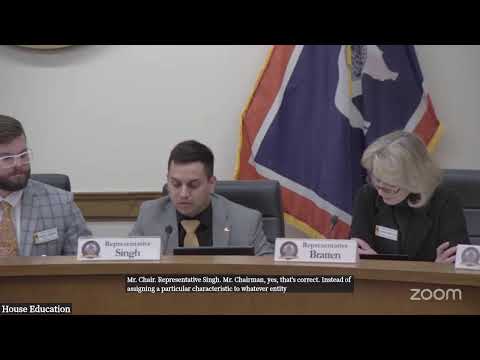
Committee members debated and adopted a sequence of amendments to clarify intent. The committee removed the apparent stray word “not” on page 3, added language separating “engage in institutional discrimination” from “require instruction,” and then revised the text to prohibit “instruction promoting institutional discrimination” rather than broadly prohibiting instruction. Representative Daniel Singh offered and won an amendment specifying that “nothing in this section shall prohibit discussion and instruction” — language the sponsor left to the committee to consider. After those changes, the committee voted to pass the bill as amended.
On the final roll call for “do pass as amended,” the committee recorded nine ayes and the bill passed the committee.
What’s next: HB147 will advance as amended; committee members and several witnesses said further statutory cleanup may be useful to ensure that the prohibition targets institutional practices and compelled trainings rather than ordinary classroom discussion or academic inquiry.