Get Full Government Meeting Transcripts, Videos, & Alerts Forever!
Get email alerts on the Land Use And Development topic
No spam. Unsubscribe anytime.
Wellington council approves sale of Kay Park to Related Ross and EIM for mixed-use project and private school
Summary
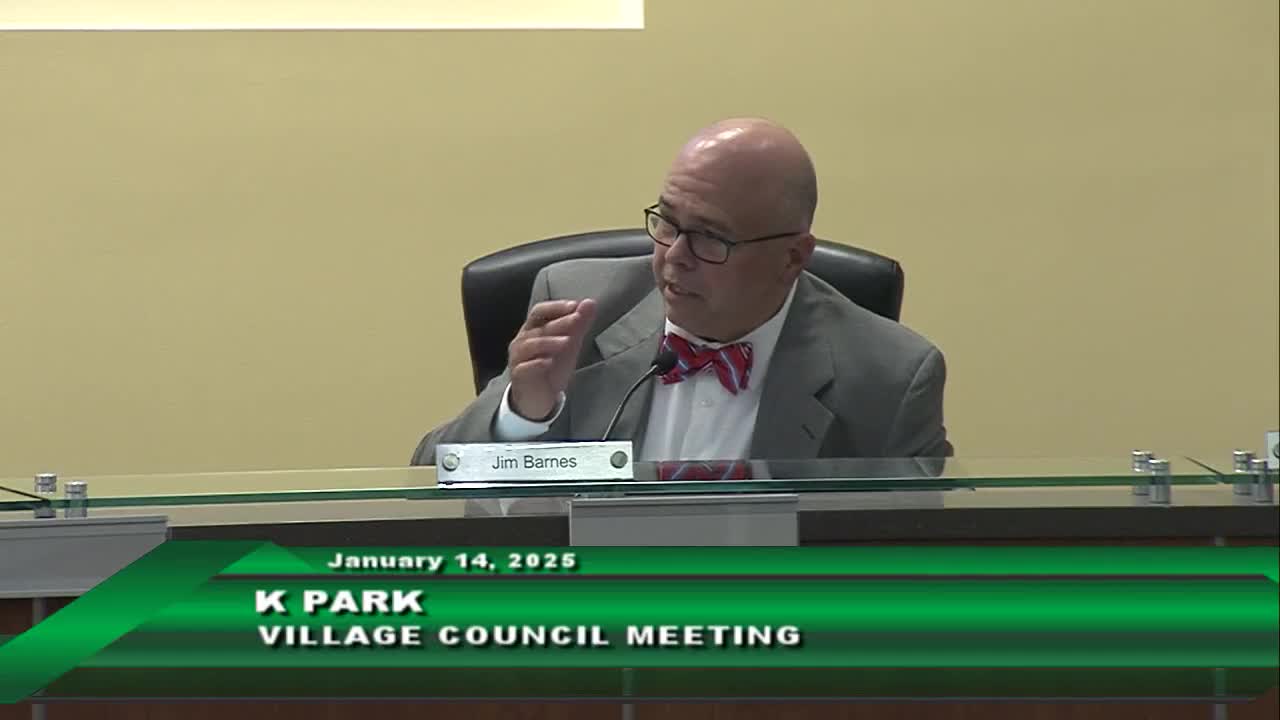
The Wellington Village Council voted 5-0 on Jan. 14 to approve two purchase-and-sale agreements to sell Kay Park to Related Ross and to Education in Motion for a proposed mixed-use village and a nonprofit private school.
The Wellington Village Council voted 5-0 on Jan. 14 to approve two purchase-and-sale agreements that would sell Kay Park (the site referred to in materials as “Kpark”) to a Related Ross-controlled entity and to Education in Motion (EIM) for a proposed mixed-use development and a private nonprofit school.
Council members approved two separate resolutions, labeled AC 2025-1 and AC 2025-2, after staff and the village’s outside counsel summarized negotiated terms and representatives for the developer and the proposed school answered questions. The council passed both motions by voice vote with the outcome recorded as 5-0 in favor.
The agreements set projected purchase prices and minimums. For the Related Ross-controlled parcel the negotiated price equates to about $885,714 per acre with a projected total near $31,000,000; the contract includes a minimum purchase price of $28,340,000. For the parcel to be sold to EIM the price is roughly $457,000 per acre with a projected total near $16,000,000 and a contract minimum of $14,628,706. Purchasers and the village agreed to an acreage-adjustment methodology tied to final surveys and legal descriptions.
Outside counsel George Pincus summarized protections for the village, including: a 180-day inspection/due-diligence period for each buyer; a 365-day approvals period for the buyers to secure land-use and zoning entitlements; the ability for buyers to terminate at the end of those periods; and standard as-is purchase terms. Pincus said the contracts also include repurchase options the village may exercise if a buyer defaults, with specified appraisal procedures and a repurchase discount (a $1,000,000 discount on the Related parcel repurchase price and a $516,000 discount on the EIM parcel repurchase price). “These are about as protective as we can get for the village,” Pincus said.
The agreements also include development commitments and sequencing intended to preserve the village’s commercial objectives. The Related Ross contract requires a minimum retail/restaurant build before certain residential approvals: Pincus and staff characterized the requirement in two ways during the meeting — the written contract establishes a minimum of 65,000 square feet of retail/restaurant on the Related parcel before residential phases advance, and council members emphasized a phased development requirement that ties residential entitlements to completion of the commercial component (council discussion described this as requiring 50% of commercial development to be finished before residential proceeds). The EIM parcel will be restricted by zoning for sectarian educational use, according to staff presentation.
Closing is conditional on completing the entitlement process. Staff and counsel told the council that, if both purchase-and-sale agreements are approved and the buyers do not terminate during due diligence or entitlement periods, the timeline anticipates approximately 180 days of inspection, 365 days for approvals, optional buyer extensions in 30‑day increments (each extension requiring an additional deposit), and a 30‑day closing period after approvals — putting a full closing (if everything proceeds) roughly at about 18 months from the effective date.
Representatives for Related and for the proposed nonprofit school presented project concepts and timeline. Related’s presenter described the design approach as a low-rise bespoke mixed-use village with retail, restaurants, possible hotel and residential components and public realm features. Education in Motion and the New School Wellington team described a two-phase school buildout with an eventual capacity near 1,700 students and a founders’ scholarship program; Marianne Rand, representing the school, stated the founders had committed the equivalent of 20 full scholarships per year prioritized for Wellington residents in the early years.
The council and staff emphasized the contracts do not authorize immediate sale or construction. Staff said the next procedural steps — if the contracts remain in force — would include a staff-generated partial replat of the property, a staff-initiated comprehensive plan amendment to create a multiple-use plan development designation, and then the buyers’ development entitlement process (rezoning, master plan, and development orders), all of which will require public hearings before Planning & Zoning and the council. Staff said those entitlement stages are where the community will have the most opportunity to review and influence project details such as traffic mitigation, lighting, buffering, and site design.
Public comment during the hearing ran long and mixed. The council heard many residents and neighborhood associations in favor, citing anticipated restaurant and retail options, local private‑school access, and economic investment. Supporters included representatives of the Central Palm Beach County Chamber and several nearby homeowners’ associations. Opponents and concerned residents stressed the loss of public green space at Kay Park, the potential effect on the struggling Wellington Green Mall, added traffic on State Road 7/441 and neighborhood roads (including Stripling and the Versailles entry), nighttime lighting for athletic fields, construction impacts and the scale of residential components. Several residents urged a moratorium or additional studies before selling a public park parcel; others asked for stronger written guarantees on green space, landscaping, buffers, noise walls, field-lighting limits and long-term scholarship guarantees for Wellington students.
Council members and staff repeatedly said traffic and neighborhood impacts will be central topics in the entitlement phase. Staff told the council the detailed traffic, drainage, lighting and environmental studies will be completed as part of the master-plan and rezoning submissions and will be required prior to final development approvals.
What happens next: the purchase-and-sale agreements are now authorized by the two council resolutions passed Jan. 14; buyers enter their inspection/due-diligence periods. No land closing occurs while inspections and entitlement approvals are pending. If buyers complete entitlements and the village’s conditions are satisfied, the contracts call for closings thereafter. If either buyer terminates during the inspection or approvals periods, the village retains specified deposit and repurchase protections.
Votes at a glance: two separate resolutions to approve purchase-and-sale agreements were adopted by voice vote, each recorded as passing 5-0.
Ending: Council members and village staff said they expect a lengthy entitlement process with many public hearings and committed to additional public outreach and detailed traffic and design studies as the next steps.