Get Full Government Meeting Transcripts, Videos, & Alerts Forever!
Get email alerts on the Parks And Recreation topic
No spam. Unsubscribe anytime.
Consultants recommend phased approach: outdoor pool fix, optional indoor aquatics, turf field house or full recreation center
Summary
Consultants CSL and Studio CKA presented a final recreation feasibility study on Jan. 14 recommending the city first stabilize and rebuild the outdoor pool and then consider one or more larger investments—an indoor aquatics center, a turf field house or a full recreation center—each with different costs and operating profiles.
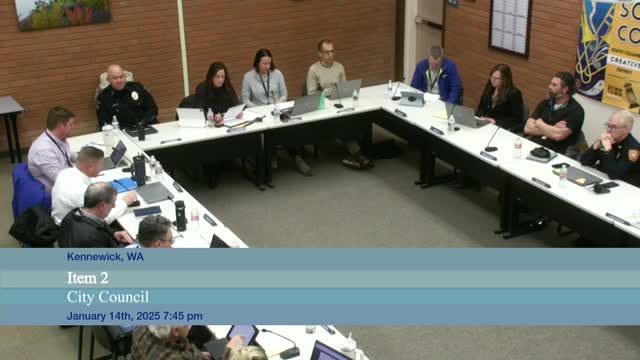
Consultants CSL and Studio CKA presented a final recreation‑center feasibility study to the Kennewick City Council at the Jan. 14 workshop, offering a phased approach that starts with stabilizing and improving the city’s deteriorating outdoor pool and lays out several options for subsequent investments: a standalone indoor aquatics center, an indoor turf field house, renovation/expansion of the Kennewick Activity Center, or a full‑service recreation center that bundles aquatics and gymnasium/community spaces.
Short term: outdoor pool improvements. The consultants proposed a multi‑phase plan for the outdoor facility that they said could keep the pool operational while constructing a new bathhouse and a new recreational leisure pool alongside a competitive lap pool. The presentation estimated the combined phased investment at just under $12,000,000 and included a conservative pro forma that shows an estimated annual operating subsidy of roughly $130,000 in early years.
Medium and long term options and cost/operating outlooks. Consultants presented four principal capital options: - A 55,000‑square‑foot indoor turf field house (estimated construction cost about $24,000,000). Consultants projected it could generate operating surplus and estimated about $225,000 annual operating surplus by a stabilized year and roughly 5,000 annual hotel room nights by year four from tournaments and regional use. - A roughly 20,000‑square‑foot standalone indoor aquatics facility (estimated construction cost about $22,000,000) to provide year‑round aquatic programming and supplement the outdoor complex. - A renovated and expanded Kennewick Activity Center with a roughly 21,000‑square‑foot addition (estimated cost about $13,000,000) to add courts and community programming space. - A full 61,850‑square‑foot recreation center combining aquatics, gyms and community space (estimated construction cost about $51,000,000). Consultants modeled a larger facility that would serve mainly local residents and estimated an annual operating subsidy on the order of several hundred thousand dollars (their conservative estimate was roughly $373,000 annually), while also projecting several thousand annual hotel room nights and other economic benefits from events and programming.
Funding, governance and next steps. The report analyzes multiple funding tools, including bonds, a Metropolitan Park District (requires voter approval and a new taxing district), public facilities district options, developer contributions and targeted sales or lodging taxes; consultants noted no single funding source typically covers a project of this scale. They discussed governance options—city operation via Parks & Recreation, third‑party management, or formation of a district for larger builds—and included comparative pro formas for each option. Consultants emphasized these are conceptual pathways; no funding decisions were requested at the workshop.
Council questions focused on debt service, operating subsidies, demand assumptions and timing. Council member Jason McShane asked about per‑year debt service on a $10 million borrowing as a point of reference; staff said market rates vary and exact debt service depends on final financing and market conditions. Consultants reiterated the need to weigh short‑term community needs (year‑round aquatics) against long‑term regional event opportunities (indoor turf or larger rec center) and recommended using the feasibility study to inform capital prioritization work already scheduled in late February.
Next steps: staff said the trails and recreation plans will be scheduled for future council adoption items and that the city will bring prioritized capital options back in a late‑February workshop to inform the next budget cycle. The study does not commit the city to any financing or construction; it is a planning tool to inform future decisions.