Get Full Government Meeting Transcripts, Videos, & Alerts Forever!
Get email alerts on the Community Development topic
No spam. Unsubscribe anytime.
George Kaiser Family Foundation outlines Invest North plan for Hawthorne, Whitman neighborhoods
Summary
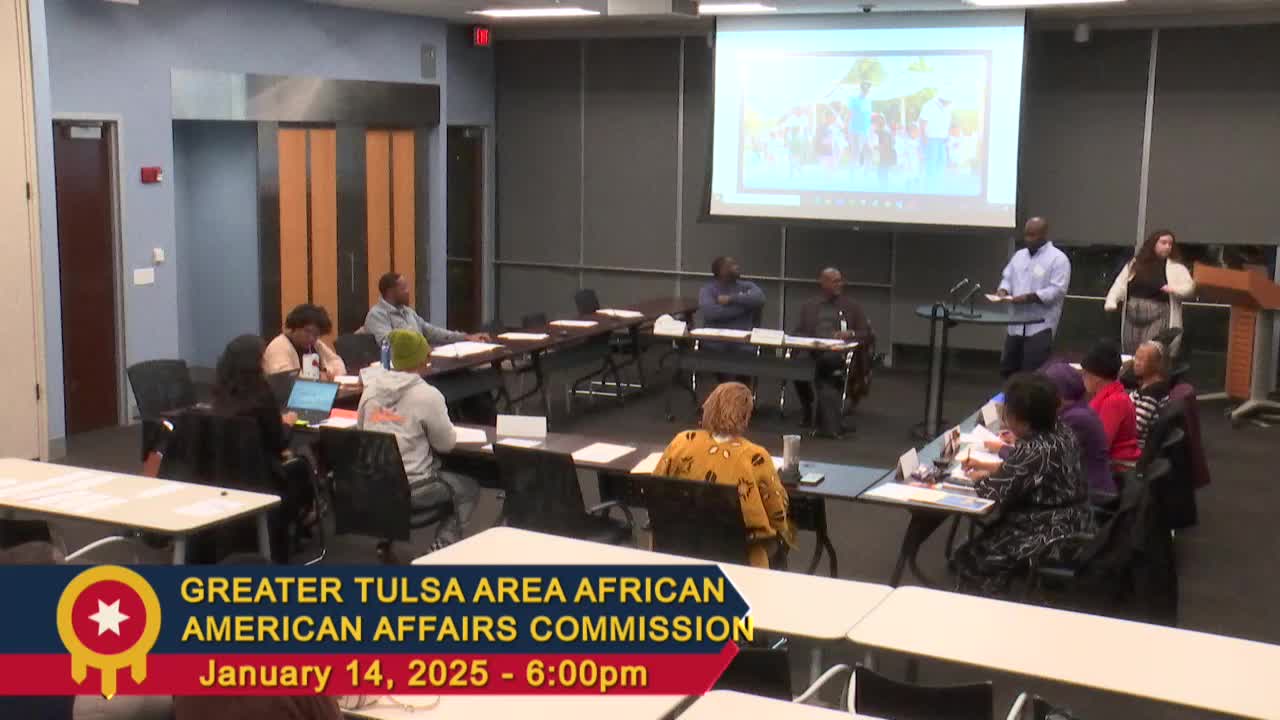
Brandon Oldham, senior program officer at the George Kaiser Family Foundation, told the Greater Tulsa African American Affairs Commission on Jan. 14 that the foundation’s Invest North initiative will concentrate investments in historically Black neighborhoods in North Tulsa — including Hawthorne and Whitman — with the goal of expanding families’ pathways to prosperity.
Brandon Oldham, senior program officer at the George Kaiser Family Foundation, told the Greater Tulsa African American Affairs Commission on Jan. 14 that the foundation’s Invest North initiative will concentrate investments in historically Black neighborhoods in North Tulsa — including Hawthorne and Whitman — with the goal of expanding families’ pathways to prosperity.
“We call this initiative Invest North because we believe that the neighborhoods lack nothing but investment,” Oldham said. He listed four core focus areas: housing, community wellness, generational wealth and youth development and said the foundation has defined a geographic area for measurement that extends roughly from Apache on the south to 56th Street North.
The initiative will support a set of already announced and planned projects. Oldham highlighted the Envision Comanche redevelopment — a project he described as a roughly $190,000,000 investment — and said phase 1, dubbed Phoenix at 36th N, will be mixed income. “The Comanche project will be mixed income. So a third, a third, a third in terms of deep affordability, sliding scale, and then market rate,” he said. Oldham said Habitat for Humanity is partnering on neighborhood-scale homebuilding and pointed to a separate Woodshire development of about 30 homes that has broken ground.
The foundation is also backing parks and trail work, Oldham said. He described Chamberlain and Berry parks as undergoing “complete revitalization” that included resident-led design, and he cited the Flat Rock Creek Trails project — roughly 216 acres of flood plain land — as a plan to create green-space amenities similar to Turkey Mountain. Oldham said the trails work will proceed in phases and that the project requires additional fundraising; he did not give a completion date for the trails.
Oldham said some housing timelines are set. He told the commission that Woodshire’s infrastructure work is underway and, “if all goes to plan,” the 30 homes from that effort could be finished by the end of next year. He said Chamberlain work will be completed first in a multi-year park timeline and estimated the park work’s schedule at about three years overall.
Oldham emphasized resident-centered planning. “We want to work alongside and behind these residents. It is not about what I want or what we want, as a foundation. It is what the residents want and how they see their neighborhoods improving,” he said. To that end, the foundation has supported place-making tours, resident surveys and quarterly convenings of nonprofit partners and residents that began in 2022.
During public questions, Jennifer Grant, identified as executive director of South Lake Charles School, asked how Invest North will guard against displacement and gentrification as new amenities arrive. Oldham said the foundation’s approach centers “legacy residents,” uses down-payment assistance and mortgage-readiness work, and attempts to delay public announcements until residents have been fully engaged to limit speculative market pressure. He acknowledged the private market will also be part of solutions but said targeting programs and supports at current residents is a priority.
Other specifics Oldham provided: he said the foundation’s target neighborhoods are majority Black (about 65% or higher), that roughly 6% of properties in the defined area are tax-exempt (nonprofit or faith-owned), and that Invest North’s stated quantitative goal is to “double the number of families earning a living wage by 2035.” He also said the foundation has opened a local office in a white building on 36th Street North (the building’s owner was named as Angie Thomas) and is standing up neighborhood-level organizations including a group called Northside Neighbors.
Oldham identified work already under way: a Wilshire Trails development connected to Habitat for Humanity, park renovations that began after resident engagement, youth internship partnerships with McClain, and a planned bodega concept and community center at the Envision Comanche site. He said Flat Rock Creek could include a future fishing pond and that the trails will be a mix of paved and granular surfaces.
Oldham did not provide complete funding sources for all elements he described. He said Envision Comanche represents a major investment but did not break down the financing for the $190 million figure. He described some projects as relying on a mixture of foundation support, nonprofit partners and private developers, and said additional fundraising is still needed for the trails and other components.
The presentation generated several follow-up questions from residents about timing, affordability bands, and what housing types would be available. A resident who identified themself as Vondell asked for phase timelines; Oldham reiterated the Woodshire target completion, the three-year park timeline, and that trails work remains fundraising-dependent. On housing sizes, Oldham said floor plans ranged from roughly 1,900 square feet up to larger homes and that Habitat and smaller-scale developers will be included to provide a range of starter and family-sized homes.
The foundation’s Invest North work, Oldham said, tries to coordinate previously separate plans and to “break silos” among local partners, citing collaborations with the Phoenix Development Council and the North Tulsa Economic Development Initiative. He closed by asking commission members and community groups to stay engaged: “It has truly been a labor of love and an honor, to have an opportunity to work alongside many of the people in this room,” he said.
What remains open: precise funding breakdowns for project elements, firm completion dates for the Flat Rock Creek trails and full affordability details for every housing tranche. Oldham provided specific timelines where projects have broken ground or have committed partners, but several items still depend on fundraising, developer schedules, and interagency approvals.
Invest North’s presentation focused on neighborhood-scale investments and resident engagement rather than any formal city action or vote. The commission discussion that followed was informational; no policy decisions or motions were recorded during the presentation.
Ending: The foundation plans further resident engagement and to open the 36th Street North office soon; Oldham said Invest North will continue quarterly partner convenings and encouraged commissions and community groups to participate in upcoming project design and outreach sessions.