Get Full Government Meeting Transcripts, Videos, & Alerts Forever!
Get email alerts on the Property Assessments topic
No spam. Unsubscribe anytime.
Skagit County assessor cites strong vertical equity in property assessments
Summary
Skagit County Assessor Danny Hagan told commissioners the county's assessment metrics show improving vertical equity across value tiers, citing Department of Revenue and Lincoln Institute analyses and listing specific statistical measures and next steps for transparency and appeals.
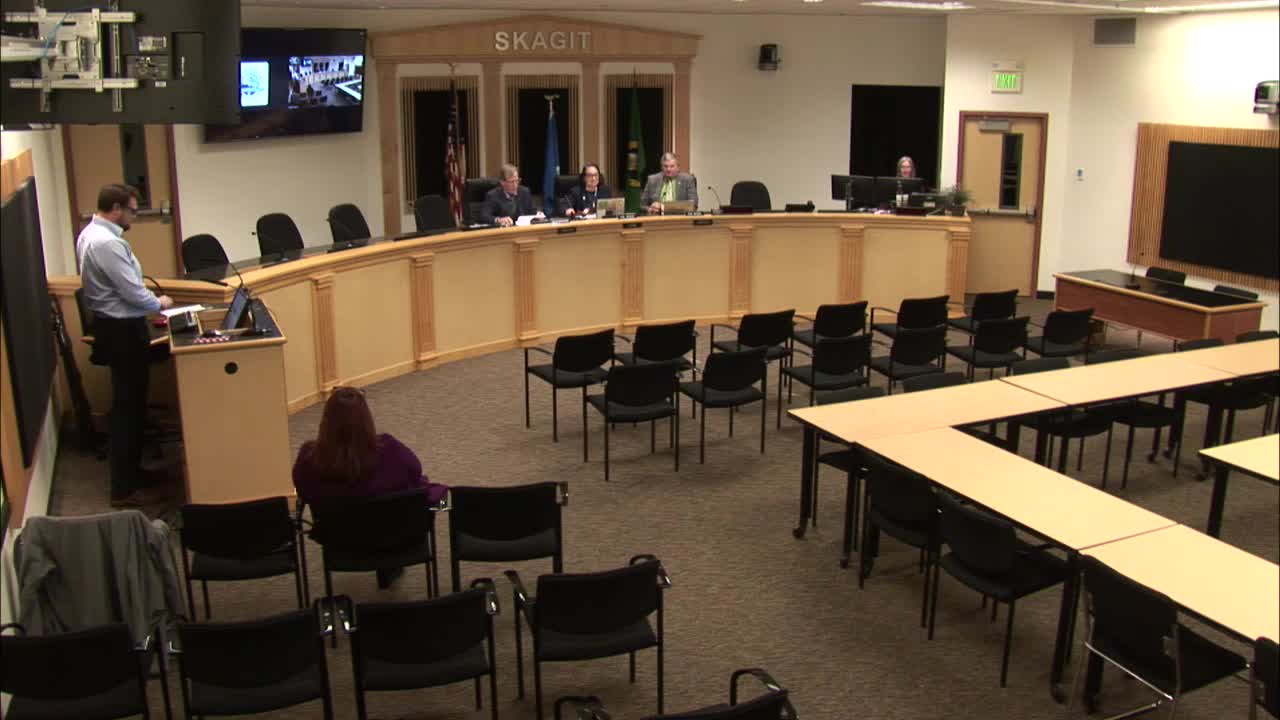
Skagit County Assessor Danny Hagan told the Board of County Commissioners on Jan. 14 that the county’s property-assessment program shows measurable progress in achieving vertical equity across property value ranges.
Hagan said the presentation, which drew questions from commissioners, reviewed common appraisal measures and third‑party analyses and showed that Skagit County’s recent ratio studies and statistical measures place the county among the top-performing jurisdictions in Washington.
Hagan said the review focused on “vertical equity and property assessments” and that the office uses sales-ratio studies, the Washington State Department of Revenue reports and tools from the Lincoln Institute of Land Policy to evaluate proportionality across value tiers. He told the board that, in the Mount Vernon School District analysis cited in his presentation, staff reviewed 12,695 residential parcels and 379 sales — about a 3 percent sales sample — and adjusted assessed values after analysis to raise the overall sales ratio from 89.6 percent to 93.9 percent.
Why it matters: Vertical equity measures whether higher-value properties bear a proportionate share of the tax burden compared with lower-value properties. Hagan told the board that if high-value properties are systematically underassessed, the overall system can become regressive and shift a larger relative burden to lower-value homeowners.
Hagan highlighted multiple metrics the assessor’s office uses to track fairness. For 2023, he reported a coefficient of dispersion (COD) of 10.974 for the county — inside the industry benchmark range the office cited — and a price-related differential (PRD) of about 1.01. He said the office’s price-related bias (PRB) was 0.003, “extremely close to 0,” a measure Hagan said indicates little systematic bias in assessments by value tier.
Hagan said the county supplements Department of Revenue metrics with the Lincoln Institute’s vertical equity application for additional third‑party validation. “This free, user friendly application has since become an invaluable resource for Skagit,” he said, and the assessor’s office has posted the county’s vertical equity report to the assessor’s website.
Commissioners pressed on methodology and limits. Commissioner Wiesen asked about sample size and the role of sales data: “All these ratios and formulas and everything, they’re all based on the fact that a sale took place. Correct? Correct.” Hagan described how the office groups properties into larger “buckets” so there are enough sales for reliable statistical analysis and said staff choose bucket boundaries to balance specificity with sample size.
Hagan also described challenges that can affect vertical equity analysis: limited sales of high‑value or unique properties, market variability for custom features, appeal-activity differences across owners and resource constraints in smaller jurisdictions. He said Skagit County has invested in technology, staff training and regional collaboration to address those challenges and to help maintain public trust. He specifically mentioned use of street‑level imagery and the county’s Assessment/CAMA system (PACS) supported by Harris Govern, and he thanked Chief Deputy Annette Devoe for operational support.
Hagan closed by emphasizing continuous improvement and outreach. “We are committed to equity. This is not saying that we have arrived but we are gonna continue to work at it,” he said, and encouraged property owners to use online tools such as Property 1 Stop and the appeals process when they believe an assessment is incorrect.
The presentation materials and the county’s Department of Revenue–sourced metrics are posted on the assessor’s website, and commissioners asked staff to keep the board informed of any follow-up community outreach or methodological changes.