Get Full Government Meeting Transcripts, Videos, & Alerts Forever!
Get email alerts on the Sheriff Training Facility topic
No spam. Unsubscribe anytime.
Durham commissioners approve $16.5 million LOB for sheriff training facility after hours of public comment
Summary
After more than two hours of public comment divided sharply between supporters and opponents, the Durham County Board of Commissioners approved a limited-obligation bond appropriation to fund a new sheriff’s training facility, 3–2.
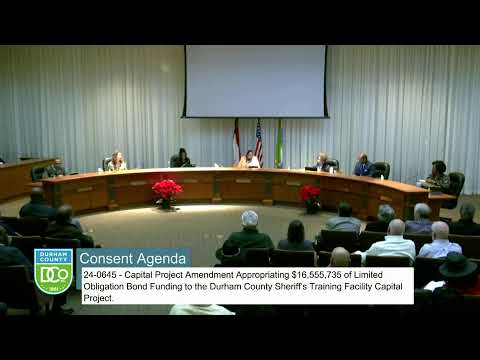
The Durham County Board of Commissioners voted 3–2 on Jan. 13 to appropriate $16,500,000 in limited-obligation bond (LOB) funding for a new Durham County Sheriff's Office training facility, approving capital project amendment 25 (CPA 022) after extended public comment and debate.
The vote followed more than 40 speakers during public comment who offered sharply divergent views on whether the county should take on new debt for the project. Supporters said the current training space is dilapidated and hampers recruitment and professional development; opponents said the county should prioritize mental-health services, housing and public-health interventions over capital investment in law enforcement.
Commissioners who voted in favor — Vice Chair Dr. DeShawn Lee, Commissioner Valens (Valentine) and Commissioner Burton — said deputies need modern facilities and training to perform required public-safety duties. Opponents, Chair Alom and Commissioner Jacobs, cited persistent community concerns about transparency in the sheriff’s operations and argued the county should have clearer plans for programmatic alternatives and oversight before approving the funding.
Speakers at the meeting detailed personal and programmatic perspectives. Chelsea Earls, a child care provider and parent, told the commissioners that Durham Public Schools’ staffing shortfalls and gaps in special-education services leave families strained and asked the county to “prioritize our needs to join in on the, you know, taking care of each other in this financial crisis that's only gonna get worse. Please join us and prioritize that over policing.”
Supporters stressed safety and training needs. Mark Olsinski, a former municipal IT director, said proper training reduces failure and urged commissioners to back the facility. Brenda Pollard, a local chaplain, recounted a case where the HEART program — Durham’s alternative responder pilot — helped a person in crisis and said she supports both HEART and the sheriff’s request. Several other speakers asked the board to expand non-police crisis-response programs such as HEART instead of financing large capital projects for law enforcement.
Commissioner Jacobs, who voted no, summarized concerns about duplication and oversight: the Sheriff's Office is one of the county’s largest recipients of local funding and she asked for more detailed data on capital and operational spending, detention center costs, and 911 call-center operations before committing to large new debt. Jacobs cited the community safety and wellness task force's recommendations and requested more transparency from the sheriff’s office.
Vice Chair Dr. Lee and Commissioner Valentine argued the board could fund training while continuing to expand alternatives such as HEART and work toward consolidated 911 operations. Lee described the decision as a balance between ensuring deputies have adequate training and pursuing co-responder and prevention programs.
The motion to approve the capital project amendment was moved by Vice Chair Dr. DeShawn Lee and seconded by Commissioner Valentine. The final recorded outcome was “approved, 3 to 2.” The board did not publish a recorded roll-call in the meeting minutes; the two commissioners who publicly stated they would not support the measure before the vote were Chair Alom and Commissioner Jacobs.
The decision sets aside LOB funds for the project; the county will now proceed with the capital appropriation and next procurement steps. Commissioners and staff said they plan follow-up oversight and additional reporting, and several commissioners called for ongoing discussions with the public and with the sheriff's office about program-level outcomes, jail conditions and HEART expansion.
The meeting record shows the county received extensive public comment and an unresolved set of transparency and oversight requests from residents and community groups. Commissioners who opposed the funding emphasized that additional accountability steps must precede future spending; commissioners who supported it emphasized the county’s statutory responsibility to fund elected constitutional officers and the need for trained deputies.
The new training facility appropriation is expected to be implemented through the county’s capital-improvement process; commissioners said they will continue to monitor related detention-center and public-safety metrics and pursue coordination on HEART expansion and 911 consolidation in subsequent work sessions.
Ending: The board approved the appropriation for the training facility amid a split vote and a public-record demand for more data and transparency about the sheriff’s office, jail operations and alternative crisis-response investments.