Get Full Government Meeting Transcripts, Videos, & Alerts Forever!
Get email alerts on the Audit topic
No spam. Unsubscribe anytime.
Cap Metro quadrennial audit finds one documentation lapse, offers eight recommendations
Summary
A Weaver and Tidwell performance audit covering fiscal 2020–2023 found Cap Metro met state performance indicators, identified one documentation finding about a prior quadrennial submission and offered eight management recommendations including contract-framework updates and website clarifications.
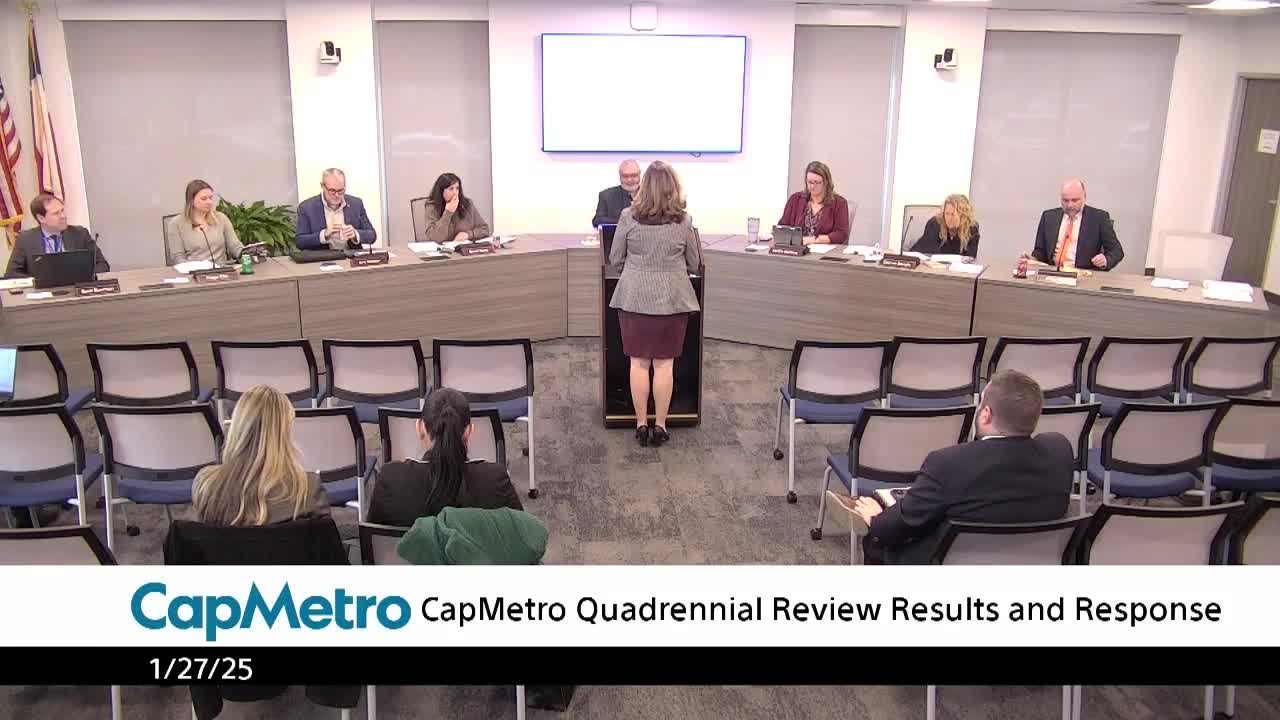
Cap Metro presented results from its quadrennial performance audit at a public hearing Jan. 27, saying auditors found the agency met state performance-indicator requirements but identified one finding related to documentation of a prior audit submission and offered eight recommendations for management.
The audit, conducted by Weaver and Tidwell and covering fiscal years 2020 through 2023, is the state-required quadrennial performance review distinct from annual financial audits and the Federal Transit Administration (FTA) triennial federal compliance audits. Deputy CEO Carrie Butcher said the review is intended to provide information to state legislators, officials and local officers and to support continuous improvement at the agency.
“We view these audits as a real opportunity for continuous improvement for us,” Deputy CEO Carrie Butcher said. She told the board the auditors found Cap Metro met the Chapter 451 performance-indicator requirements and generally operated efficiently and effectively across the topics reviewed.
Auditors reviewed three statutory tasks: (1) measurement of nine state-defined performance indicators, (2) compliance with applicable state laws (the firm screened roughly 400 statutes for applicability), and (3) a focused review of one subject area — this cycle, administration and management — as agreed with the agency. For task 1, auditors reported declines in cost-efficiency measures tied to pandemic-era factors such as higher wages to retain operators, supply-chain-driven cost increases and lower fare recovery during ridership decline; auditors made two recommendations for continuing to improve service reliability and cost effectiveness. For task 2, auditors reported compliance with roughly 172 applicable state laws but logged one finding: Cap Metro could not produce documentation proving the agency had submitted the prior quadrennial audit to the appropriate state authorities. Butcher said the agency is confident the prior report was submitted and is available on the state website; the finding stemmed from missing internal receipts and the departure of the staff member who had handled the prior submission. The agency has already implemented a standardized submission process to prevent recurrence.
The administration review (task 3) produced no formal findings and included four recommendations. Those recommendations include: refining an agencywide contract-management framework (targeted completion: July), developing standardized guidance for departmental procedures (targeted completion: end of year), conducting a deep review of recent changes to operations oversight and applying lessons to the upcoming rail transit procurement (targeted completion: end of year), and continuing expansion of professional-development opportunities. Butcher told the board the agency agrees with the recommendations and will pursue the changes.
Auditors also recommended two website clarifications: clearer privacy language and explicit notice that trespassing on agency property is a misdemeanor. Butcher said the privacy language has been updated and the trespassing language will be added by the end of the month.
Board members asked for clarification about the scope of the audit regarding organizational changes and Project CONNECT. Butcher responded that auditors focused on the agency’s structure and metrics as they related to service delivery during the review period and did not evaluate future expansion plans. “Our current deliverables, not the expansion plans that we had on the table,” she said.
No members of the public offered comments during the hearing. After questions from board members, the chair adjourned the meeting at 12:19 p.m.
The presentation and the agency’s response emphasize implementation of the audit recommendations and internal process changes to address the single documentation finding and to pursue the eight management recommendations offered by Weaver and Tidwell.