Get Full Government Meeting Transcripts, Videos, & Alerts Forever!
Get email alerts on the Global Economy Wesp 2025 topic
No spam. Unsubscribe anytime.
UN DESA launches WESP 2025: projects 2.8% global growth, warns developing countries lag
Summary
UN Department of Economic and Social Affairs released the World Economic Situation and Prospects 2025, forecasting 2.8% global growth in 2025 while highlighting uneven recovery, high debt burdens for developing countries, opportunities and risks from critical minerals, and the uncertain economic effects of AI and trade policy.
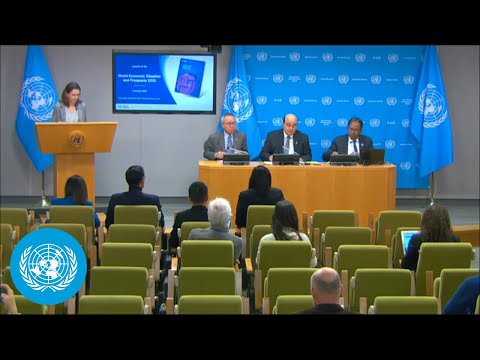
Under-Secretary-General for Economic and Social Affairs Lee Drouin Hoa and senior UN DESA economists on Thursday released the World Economic Situation and Prospects (WESP) 2025, projecting global growth of about 2.8% in 2025 while warning that the recovery remains uneven and that many developing countries face severe fiscal and development constraints.
The report, presented by Lee Drouin Hoa, Shantanu Mukherjee (Director, Economic Analysis and Policy Division, UN DESA) and Hamid Rashid (Chief, Global Economic Monitoring Branch, UN DESA), said lower inflation, monetary easing and a rebound in international trade underpin a relatively stable outlook but that growth remains “well below the pre‑pandemic average of the 3.2% recorded over 2010 to 2019.” Lee Drouin Hoa said, “the world economy has largely avoided a broad based contraction despite the unprecedented shocks of the last few years and the most prolonged period of the monetary tightening in the history.”
The report’s headline forecast and why it matters
UN DESA projects global growth of around 2.8% in 2025, roughly matching 2024, with global inflation forecast to fall from an estimated 4% in 2024 to about 3.4% in 2025. Shantanu Mukherjee summarized the situation as “a period of stable subpar growth.” He added that easing by central banks has already contributed to modest turnarounds in investment and cross‑border financing and a sharp rebound in global trade in 2024.
Why developing countries are more vulnerable
UN DESA’s analysis emphasizes that developing countries face larger and more persistent headwinds. The report forecasts growth of about 4.3% for developing countries in 2025 and 4.2% in 2026 — below the roughly 5.2% average in the decade before the pandemic. Mukherjee warned that inflation remains “noticeably higher” in developing countries (about 6% in 2024 and projected 5.1% in 2025) and highlighted a strain on public finances: “the median developing country was 11.1 percent of its revenues went for [debt servicing],” while African countries on average allocated over a quarter of revenues to debt service.
The WESP notes these fiscal pressures leave limited space for public investment needed to achieve the Sustainable Development Goals (SDGs), and it highlights that growth in over 90% of least developed countries is projected to fall short of the 7% target often cited as necessary to accelerate SDG progress.
Critical minerals, governance and value addition
The report identifies the rising global demand for minerals critical to the energy transition (nickel, lithium, cobalt and others) as an opportunity for resource‑endowed developing countries, but warned the benefits are not automatic. Hamid Rashid said the sector “presents huge potential” but stressed that “good governance and other factors would play a very important role.” The presenters recommended country‑specific industrial and innovation policies, local value‑adding (midstream and downstream processing), technology transfer, labor and ESG standards, exchange‑rate management and fiscal frameworks to avoid the “resource curse.”
UN DESA estimated investment needs for critical minerals at roughly $150 billion per year for 2023–2030, while current annual investment was described as “less than $40 billion,” underlining a significant financing gap.
Trade, tariffs and model limits
During questions, presenters said their trade forecasts are based on policies in place as of early December and do not model every announcement. When asked whether recent tariff threats would alter the 2025 trade projection, UN DESA explained they “look at actual policies” and wait for policy moves to be implemented before adjusting models. Mukherjee and Rashid noted that tariffs can create both trade creation and trade diversion effects, so net impacts on global trade remain uncertain until responses and counter‑responses materialize.
AI, distributional effects and policy responses
On artificial intelligence, Shantanu Mukherjee said the timing and scale of economic transformation from AI are uncertain but urged nations to “be prepared for AI in terms of building up your human capacity.” Hamid Rashid added that AI’s effects are likely to produce winners and losers and stressed the need for fiscal and social policies to manage distributional impacts, asking whether tax frameworks can capture gains from data‑driven firms.
Regional outlooks and vulnerabilities
The presenters provided regional snapshots: South Asia overall was expected to perform well in 2025 with India continuing strong growth, but the outlook varies across countries such as Bangladesh, Sri Lanka and Pakistan. Western Asia (including Gulf oil producers and Turkey) was expected to see improved growth driven partly by higher oil production; UN DESA cautioned this baseline assumes no major escalation of regional conflicts. Africa faces persistent inflation and weak per‑capita growth in many countries.
Action and international cooperation
UN DESA framed WESP 2025 as a call to action to address debt sustainability, curb illicit financial flows, strengthen domestic resource mobilization, and scale international cooperation — including through forums such as the Financing for Development processes and international tax cooperation — to mobilize resources for SDG investments. Lee Drouin Hoa said urgent action is needed to “close the gap in technology, financing and infrastructure that hindered equitable growth.”
The release concluded with a question‑and‑answer session with journalists from several outlets. The report and its regional tables were cited as the source for the detailed figures discussed during the presentation.