Get Full Government Meeting Transcripts, Videos, & Alerts Forever!
Get email alerts on the Alcohol Sales At Gas Stations topic
No spam. Unsubscribe anytime.
Milpitas planning staff recommends routing alcohol-license applications near schools, adds operational conditions for gas-station sales
Summary
Planning staff presented data on alcohol licenses at Milpitas gas stations and recommended routing applications to nearby schools and other "sensitive uses," updating conditions of approval and adding standard operational limits; no ordinance was proposed and commissioners asked for case-by-case review guided by police crime data.
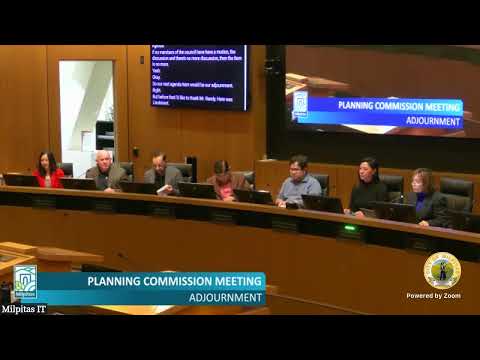
Planning staff told the Milpitas Planning Commission on Jan. 8 that they will begin routing applications for new alcoholic beverage control (ABC) licenses to nearby schools, day-care centers and other sensitive uses and will add standard conditions of approval aimed at limiting display and sales practices at gas stations.
The change was presented as procedural and policy updates by Associate Planner Randy Baez during a staff report on ABC licenses and alcohol sales at gas stations. Baez told commissioners staff compiled city and state data, reviewed nearby jurisdictions and proposed steps the city could take without a zoning ordinance amendment. "Staff will route alcohol requests to schools, places of assembly, day cares, and any other sensitive uses the planning director deems necessary," Baez said, adding that notices would be mailed for uses within a 1,000-foot radius and that conditions would be updated to include limits on sales and advertisements and require ID readers.
Why it matters: Commissioners raised concerns about DUI arrests and community impacts near several gas stations and asked that police crime statistics be refreshed for each new application so the commission can consider targeted conditions. Commissioners and staff repeatedly emphasized striking a balance between public-safety concerns and economic development rather than immediately adopting a citywide buffer or ban.
Key facts
- City data: Milpitas has 18 gas stations; three were licensed to sell beer and wine at the time of the report and one additional station had been recently entitled, bringing the total to four licensed sites.
- State law: Staff reviewed AB 2897, which limits new ABC licenses in areas of "undue concentration" and requires a public-convenience-or-necessity finding when those limits are exceeded. Baez described how the city currently uses the conditional-use-permit (CUP) process and municipal code findings to assess those requests.
- Police data: The Milpitas Police Department provided a chart of DUI arrests near gas stations for 2024. Lieutenant Speckenhauer said the map shows arrests concentrated along major thoroughfares — including the Calaveras corridor, Dixon Road and the Montague/Landis areas — and cautioned that arrests may reflect stops or collisions on those corridors rather than consumption at a specific business: "These areas are major thoroughfares...so whether it's an enforcement action or an accident that was taken in the area that resulted in a DUI arrest," he said.
What staff proposed
- Routing: When the city receives an application, staff will provide a copy to sensitive uses within a 1,000-foot radius so those operators can review the proposal early and discuss conditions with the applicant.
- Standard conditions: Staff said it will add standard, automatically applied conditions based on practices in nearby cities — for example, limiting alcohol displays near cash registers or fuel islands, specifying age requirements for employees during late-night hours, requiring secure storage and ID readers, and restricting advertising at fuel pumps.
- Ordinance option deferred: Staff said more restrictive measures such as separation distances (500 feet, 1,000 feet, etc.) or enhanced findings could be pursued via a zoning ordinance amendment if the City Council prioritizes it. "The commission may consider the following measures which may first require council prioritization of an amendment to the zoning ordinance before staff can initiate any work," Baez said; staff did not recommend an immediate ordinance and invited the commission to direct further study if desired.
Commissioner comments and concerns
- Commissioner Kang asked that the DUI map be updated for each new off-site application so commissioners have current data to inform findings; Lieutenant Speckenhauer agreed that the department can update the chart on request but noted it may not be refreshed monthly.
- Commissioner Awasti urged operational limits on container sizes and single-can sales, suggesting restrictions such as prohibiting single-can sales and limiting small, high-alcohol "shot" bottles to reduce on-site or immediate post-purchase consumption and diversion to minors.
- Commissioner Calkins and others recommended handling conditions on a site-by-site basis through CUPs rather than a citywide ordinance at this time, reserving the option to revisit if problems emerge.
Next steps and context
Staff said the police data used in the presentation covered 2024 and that they will implement routing and update conditions administratively. If the commission seeks ordinance changes (for example, formal separation requirements), staff said the commission could vote to recommend a zoning amendment to the City Council for prioritization; the amendment process would require more than four hours of staff work and a separate council-level action.
Votes at a glance
Several routine items were approved earlier in the meeting, separate from the ABC presentation: the meeting agenda, minutes for Oct. 9 and Nov. 13, 2024, and the 2025 Planning Commission meeting schedule were each approved by roll-call vote. Each motion passed with all members present voting "aye." (See Actions for full motion language and vote records.)
Staff and police contacts at the meeting recommended using targeted crime data and early routing to sensitive uses as the first step; no immediate change to the zoning code was adopted at the Jan. 8 meeting.