Get Full Government Meeting Transcripts, Videos, & Alerts Forever!
Get email alerts on the Capital Bond Election topic
No spam. Unsubscribe anytime.
J O Combs board hears financial analysis on possible capital bond, three-size scenarios presented
Summary
Financial advisor Stifel presented three bond-size scenarios ($40M, $60M, $80M) and showed how each could be structured so the district's bond tax rate would remain near current levels; board discussed timeline, polling and a next-step committee process.
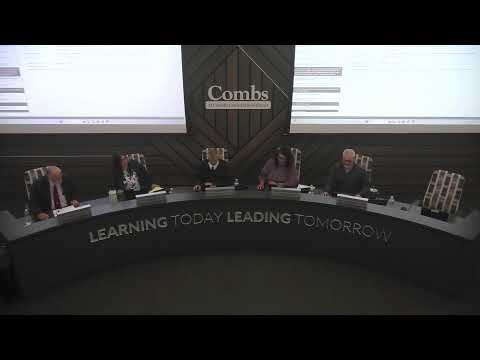
Board President Ray and district leaders presented an initial financial briefing on a possible capital bond election, and Mike LaValle of Stifel walked the governing board through assessed-value trends, bonding capacity and three sizing scenarios the district could present to voters.
LaValle said the district's assessed valuation has grown substantially in recent years and that growth drives how much the district can borrow. Using conservative assumptions, Stifel modeled three sale programs — $40 million, $60 million and $80 million — each sold in multiple series over several years. LaValle showed the projected incremental tax impact attributable to new bonds (expressed per $100,000 of taxable value): roughly $0.42 for a $40 million program, $0.56 for $60 million and $0.69 for $80 million, and translated those to annual costs (about $42, $56 and $69 per $100,000 tax value, respectively).
The presentation emphasized that because long‑term debt from the district's 2016 election is declining and the district's taxable base has been growing, Stifel can structure new borrowing so the combined bond tax rate would be similar to or below recent bond-year levels rather than produce a large immediate rate spike. LaValle said the assumptions used an illustrative 5% interest estimate for planning (actual interest rates can vary) and that Stifel projected assessed‑value growth conservatively for planning purposes; the firm will replace placeholders with official valuations when county figures are released in February.
Board members and staff discussed next steps. Superintendent Dr. Wyman said the district will assemble a citizens' advisory committee, solicit a political consultant to perform voter polling, and use those poll results plus the committee's recommended project list to decide whether to place a bond question on an upcoming ballot. Dr. Wyman and other staff noted timing considerations for placing an election in November and recommended calling an election in late spring or early summer if the board decides to proceed so voter materials and the pamphlet can be prepared.
Board members asked about potential external factors. LaValle and staff flagged an expected large commercial taxpayer (identified in the presentation as the LG plant) that could raise assessed valuation when it is added to the tax rolls; staff said that project's valuation typically appears on the rolls about 18 months after completion and would reduce the relative tax impact of any bond request. LaValle also summarized statutory mechanics for calculating bonding capacity and noted the district’s theoretical bonding capacity is materially larger than the example bond sizes, giving flexibility in timing and sizing.
Dr. Wyman and staff emphasized the district will not automatically put a question on the ballot. They said they will first solicit quotes from political consultants, run a targeted survey of likely voters, assemble a needs committee to recommend projects and only bring an election resolution to the board if polling and the committee recommendation support it.
The presentation included detailed backup slides Stifel said would be used for voter pamphlets and staff planning if the board instructs them to proceed.
Ending — The board did not take a vote on whether to call an election; members directed staff to continue planning steps (identify consultant, form committee and return with polling and a recommended project list). Stifel's slide packet and the district's recommended timeline are to be used in committee and polling work ahead of any decision about an election.