Get Full Government Meeting Transcripts, Videos, & Alerts Forever!
Get email alerts on the Wolf Reintroduction topic
No spam. Unsubscribe anytime.
Colorado Parks and Wildlife outlines local wolf reintroduction plan, monitoring and guidance for Roaring Fork Valley residents
Summary
Colorado Parks and Wildlife officials described planned releases, monitoring limits, permit options and steps residents and producers can take to reduce conflicts as the agency implements Prop 114 reintroduction requirements in western Colorado.
Colorado Parks and Wildlife officials outlined local plans and safety guidance on wolf reintroduction and monitoring at a public meeting in the Roaring Fork Valley, saying the agency is required by state statute to restore a sustainable population of gray wolves west of the Continental Divide and is planning further releases this season.
The presentation focused on where wolves may be released, how the animals will be tracked and managed, what protections and permit authorities are in place for livestock producers, and practical steps residents can take to reduce conflict. Agency staff emphasized limits to real-time tracking and reiterated that releases are restricted to state or cooperating private lands; federal lands would require a separate NEPA process.
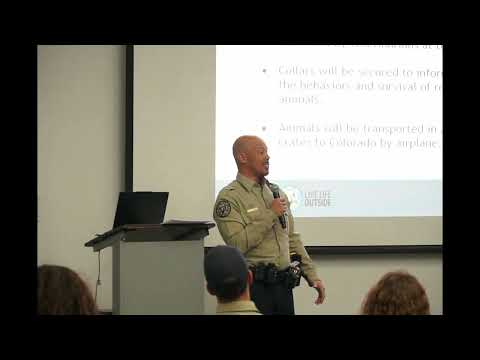
Matt Yamashita, the area wildlife manager for Colorado Parks and Wildlife (CPW) who works from the Glenwood Springs office, said Prop 114 created a statutory obligation that the agency must carry out. “Prop 114, when that proposition was passed, turned into state statute. That statute mandates that we as an agency, Colorado Parks and Wildlife, reintroduce and we manage for a sustainable population of gray wolves within Colorado,” Yamashita said. He told the audience CPW’s immediate goal is to establish packs — breeding pairs and offspring — so managers can begin to define territorial ranges and apply established tools for conflict reduction.
Why it matters: CPW must balance a legally mandated reintroduction with concerns from residents and livestock producers about depredation, public safety and local land uses. Officials said their near-term aim is to build an initial breeding population so the agency can move from emergency-stage responses to standard wildlife-management tools.
Key details and timeline
• Release targets and sourcing: CPW said it intends to introduce roughly 10–15 wolves annually for the first three to five years with an initial five‑year goal of establishing 30–50 wolves in Colorado. The agency reported that last year’s translocations began in December 2023 and that this season it is arranging captures in British Columbia to supplement earlier transplants from Oregon.
• Release constraints: By statute, initial releases must occur west of the Continental Divide and CPW is authorized to release animals only on state-owned lands or private properties where the landowner gives permission. CPW staff described administrative 60-mile buffer zones from the Utah and Wyoming borders that are intended to reduce frequent cross‑border movement and the need for cross‑jurisdictional recapture.
• Monitoring and collars: CPW fits released wolves with GPS collars that record a location every four hours but upload data to satellites only once every 16 hours. Yamashita said that terrain and tree cover can delay uploads for days, so collar points are not real‑time. “Whenever our agency gets a pin on it, it's old news,” he said.
• Mortality and investigations: The agency reported three wolf deaths after the 2023 releases, including one animal that was shot; the U.S. Fish and Wildlife Service is leading the criminal investigation into the shooting and CPW officers are assisting. CPW said carcasses are sent to a forensic facility (in Ashland, Oregon) for necropsy when a federally protected wolf dies.
• Captures and removals: CPW described the administrative capture of animals from the Copper Creek group after confirmed livestock depredations. Five members of that pack were taken into captivity; staff said the pack’s future — whether those animals would be returned to the wild — remains under commission review.
Permits, depredation compensation and producer options
CPW staff outlined three permit types intended primarily for livestock producers but potentially available to other property owners in documented conflict situations: a noninjurious hazing permit (for noise and scare devices), an injurious nonlethal hazing permit (authorizing rubber buckshot, beanbag rounds and other measures that may cause nonlethal injury), and permits that authorize lethal removal in narrowly defined circumstances (an ‘‘in‑the‑act’’ permit when an animal is actively depredating and a chronic‑depredation permit when losses persist). Yamashita said all such permits require CPW authorization and reporting to the Fish and Wildlife Service while wolves remain federally listed.
CPW confirmed producers may apply for compensation for confirmed livestock losses and that the state has paid claims for verified depredations. Agency staff said compensation and the chronic‑depredation definition will be discussed at an upcoming Colorado Parks and Wildlife Commission meeting and that payments are administered under the statutory framework accompanying the reintroduction program.
Practical guidance for residents and recreationists
CPW officers recommended the same conflict‑avoidance measures residents already use for bears and mountain lions: keep dogs on leash, secure pets and livestock at night in predator‑resistant enclosures (electric fence where appropriate), secure food and trash when camping, remove attractants, and use noise or lights to haze animals when necessary. Curtis Tesh, CPW’s upper Roaring Fork Valley officer, said, “Wolves are mostly afraid of humans and will avoid humans. They don't want to be near you folks.”
Staff advised people to report sightings through CPW’s wolf sighting form and to include scale cues (a known object such as a dollar bill in photos) so biologists can better distinguish wolves from large coyotes or domestic dogs. CPW also encouraged residents to sign up for agency news releases and to follow maps and updates posted on the CPW website.
Community questions and public engagement
Residents pressed CPW on site selection, timing and notification of releases on or near private property, and whether federal lands will be used. CPW said it will notify producers who are near a selected release site and will work with private landowners who offer sites, but staff will not publicize precise release locations or dates for safety and animal‑protection reasons. Officials said using National Forest lands for initial releases would require a NEPA process and that the agency had not initiated a federal environmental review for release operations; staff cited both time and cost as limiting factors for a large federal review.
Budget and program scale
At the meeting CPW staff cited earlier estimates and current spending associated with reintroduction work: the presentation said an initial proposal had estimated costs “somewhere around” $8.8 million (as presented) and that year‑one spending was about $4.7 million. Agency staff directed questions about budget caps and long‑term funding to the state legislature and the Joint Budget Committee.
What CPW directed staff to do
CPW said it will continue capture trips to British Columbia this season, continue to collar and monitor released animals, prioritize release site feasibility (state or cooperating private lands), pursue coordination with tribal nations for southern release zones, and continue outreach through the CPW website and the Parks and Wildlife Commission.
Ending note
Officials closed by asking the community to stay engaged and to follow CPW resources. Yamashita thanked attendees for civil discussion and urged residents to report sightings and follow the agency’s guidance so staff can “keep the wolves wild.”