Get Full Government Meeting Transcripts, Videos, & Alerts Forever!
Get email alerts on the Housing Policy topic
No spam. Unsubscribe anytime.
County outlines housing‑element timeline, warns of builder’s‑remedy risk; residents oppose possible Tarpy Flats application
Summary
Staff told the Planning Commission the county’s 6th‑cycle housing element update is overdue and must be revised and resubmitted to the state this spring; commissioners and members of the public urged prioritizing community‑area sites and raised concerns about a builder’s‑remedy application for Tarpy Flats (1101 Olmsted Road).
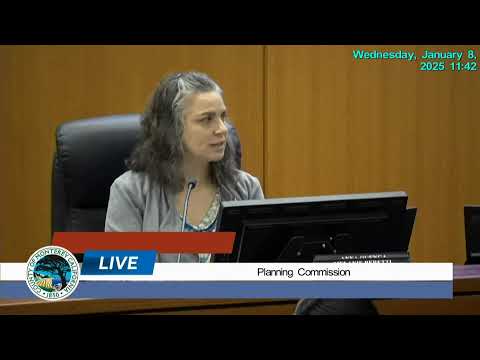
Monterey County staff told the Planning Commission on Jan. 8, 2025 that the county’s 6th‑cycle housing element is out of compliance with state law (the submittal was due Dec. 2023), that the county has received a findings letter from the California Department of Housing and Community Development (HCD), and that staff is targeting a revised submittal to the state in March 2025 and certification by late summer 2025.
Staff presented the housing element’s purpose — demonstrating how the county will accommodate its Regional Housing Needs Allocation (RHNA) for 2023–2031 — and summarized the current RHNA allocation for unincorporated Monterey County: 3,326 units total across income levels. Staff said the county’s draft sites inventory and “buffer” planned capacity totals 6,233 units to provide flexibility, but HCD’s findings raised questions about the site inventory methodology, particularly how the county estimated affordability and unit counts on “large sites” (sites over 10 acres). HCD’s letter (Nov. 18, 2024) required additional evidence that opportunity sites can realistically develop at the assumed densities and affordability levels.
Staff described policy questions for the commission’s guidance. Among them: how to treat two University of California‑owned Marina‑area sites (site 7, the larger Blanco Triangle site in unincorporated land; and site 53, a smaller parcel inside Marina city limits), whether to rely on builder’s‑remedy applications as presumed future units for the plan, and how to identify additional or backup sites if the county’s buffer falls below the minimum 15% required by state law. Staff said the county has received eight housing applications to date, some of which are being reviewed under prior and new versions of state law. The county is also preparing a programmatic environmental impact report (PEIR) concurrent with the housing element update and noted rezoning to implement any adopted sites must occur concurrently with certification.
Commission discussion and public comment focused on three themes: urgency of finalizing the housing element to avoid losing local discretion, prioritizing community‑area sites where infrastructure and community plans exist, and opposition to development at Tarpy Flats (1101 Olmsted Road). Commissioner Shaw opposed adding sites located in areas that lack an adopted community plan and stressed infrastructure constraints — notably wastewater capacity in North Monterey County — as a reason to avoid designating new high‑density sites outside community areas. Other commissioners said that, given persistent delays in community plan completion, site‑by‑site decisions that place housing in appropriate community‑area locations may be necessary.
Multiple members of the public and local organizations spoke against potential development at Tarpy Flats (1101 Olmsted Road). Speakers representing Save Tarpy Flats and Communities for Sustainable Monterey County said the site contains sensitive biological resources, vernal pools, habitat for the California tiger salamander, archaeological resources and tribal cultural interest, and they urged preservation and conservation transfer to land trusts. Several residents described wildfire‑exit constraints and public‑safety concerns in the Tarpy Flats/Jack’s Peak area. An email read into the record by staff echoed opposition and questioned whether the Tarpy Flats site would qualify for builder’s‑remedy treatment.
Staff and the commission agreed the county must balance community plans and infrastructure readiness against meeting RHNA and preserving a minimum buffer. Commissioners gave staff broad guidance to prioritize community‑area locations where feasible, to consider University‑owned Marina sites in the inventory (but not necessarily both if that conflicts with the City of Marina’s plans), and to prefer previously screened “backup” sites over re‑opening sites that had been eliminated without extensive additional review. Several commissioners asked staff to be cautious about automatically including builder’s‑remedy applications as planned inventory items but said staff should consider viable builder’s‑remedy proposals on a site‑by‑site basis if the proposals appear likely to meet state law requirements.
Staff said it will take the commission’s input to the board of supervisors and continue to refine the sites inventory, the PEIR and the rezone program. Staff reiterated the county’s target dates: post a revised draft for the required public review period, submit a second draft to HCD in March 2025 (60‑day review), and seek certification and concurrent rezoning in late summer 2025. Staff warned that until the housing element is certified and rezones are complete the county remains exposed to the builder’s‑remedy provisions, which can limit local discretion on qualifying projects.