Get Full Government Meeting Transcripts, Videos, & Alerts Forever!
Get email alerts on the Ems topic
No spam. Unsubscribe anytime.
EMS and community paramedicine report: hospital delays, overdose interventions, and shelter access improvements
Summary
Department leaders reported ongoing ambulance delays at hospitals, increasing winter call volumes and several program successes in community paramedicine: EMS 6 reported a 71% reduction in high users, SORT and other teams linked overdose survivors to treatment, and shelter referral pathways improved for holidays and weekends
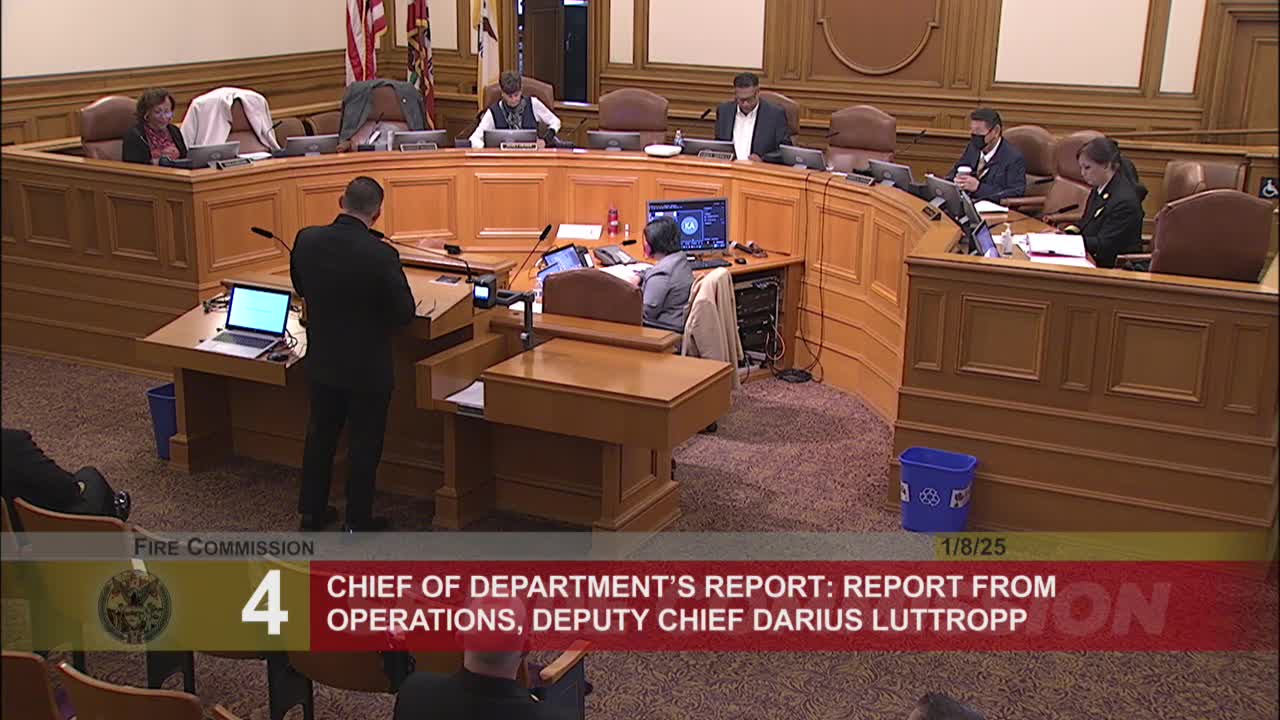
San Francisco Fire Department EMS and community paramedicine leaders reported on Jan. 8 that ambulance delays at hospitals and winter call-volume spikes remain operational challenges while community paramedicine programs continued to expand care connections.
Assistant Deputy Chief Tony Malloy told the commission that data-cleaning is underway for certain performance indicators but that the department has seen instances where ambulances are delayed at hospitals for more than two hours while awaiting patient acceptance. He said the department is coordinating with the county's local EMS agency (LEMSA) and hospitals on monthly meetings to reduce those delays. Malloy also noted December saw heavier overall call volume compared with November and that cardiac-arrest survival metrics are under review by quality teams.
April Sloan, who presented the Community Paramedicine (CP) report, described program-level outcomes. She said EMS 6 achieved a 71.43% reduction in top high users in November by coordinating intensive wraparound care for people who had been transported repeatedly. SORT and CP teams used case conferences and referrals to EDs, recovery centers and residential treatment placements; Sloan described at least one instance where a person with multiple transports restarted medication and reduced subsequent utilization after coordinated intervention and admission to an acute diversion unit.
Sloan said street crisis teams have had steady staffing and response times and that the city has secured access to shelter beds on holidays and weekends — a change she credited to partnerships with the Healthy Street Operations Center and the Department of Homelessness and Supportive Housing. She also referenced the statewide implementation of SB 43 and noted San Francisco was among early implementers to discuss lessons learned with other counties.
Why it matters: ambulance offload delays affect EMS system capacity and response times; community paramedicine work aims to reduce repeat use by connecting high-frequency callers to services. Program leaders said coordinated referrals and newly available shelter access showed measurable benefits in individual cases.
Commissioners asked for follow-up regional breakdowns of calls (for example the 6th Street corridor and Tenderloin) and asked staff to monitor overdose and hospital-delay metrics as part of ongoing quality review.