Get Full Government Meeting Transcripts, Videos, & Alerts Forever!
Get email alerts on the Capital Improvements Plan topic
No spam. Unsubscribe anytime.
Wake Forest reviews FY25–30 capital improvements plan, outlines bond issuance and priority projects
Summary
Town staff presented a five-year Capital Improvements Plan update including funding strategies, outstanding debt, projects funded for FY25, projected bond issuances and priority items such as downtown streetscape, wayfinding signage, parks restrooms, stormwater staffing and rolling stock.
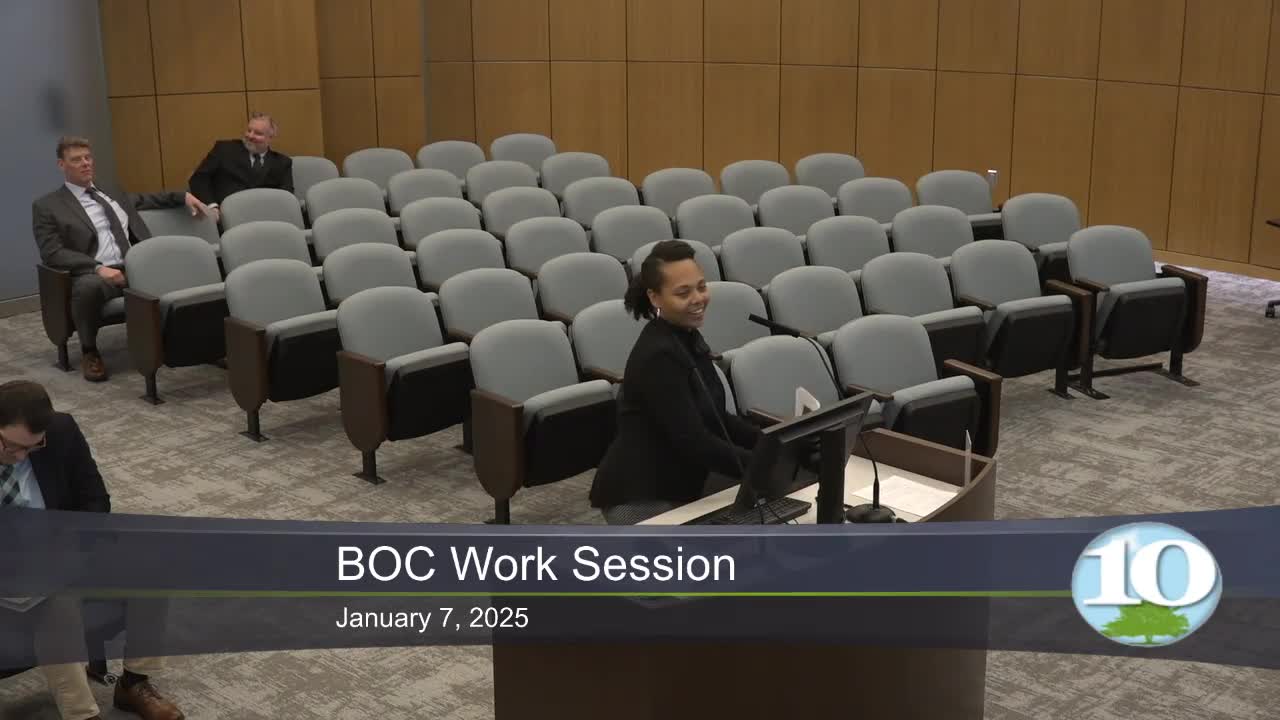
Michelle Daniels, the town’s Budget and Performance Manager, presented an update to Wake Forest’s five-year Capital Improvements Plan on the council’s agenda, describing the plan’s scope, funding strategies and near-term priorities. “It’s a 5 year plan,” Daniels told the mayor and commissioners, and said the town updates the CIP annually to align projects and financing with the budget process.
The CIP identifies projects with total costs over $25,000 or with useful lives greater than five years, and includes vehicles, equipment replacement and asset maintenance. Daniels said departments submitted requests in late October and staff then refined requests through management review; the council will prioritize first-year projects that are incorporated into the annual budget. She told the council that departments requested roughly $49,000,000 for the upcoming cycle, while the town adopted about $12,000,000 for FY25.
Daniels reviewed the town’s current debt and bond program. She said Wake Forest had $38,800,000 in outstanding debt attributed to the town (about $1.9 million in the electric fund and $36.9 million to governmental activities), and a total debt figure of $110,600,000 that includes $75,000,000 in authorized but unissued general obligation bonds from a 2022 voter-approved referendum. The town completed an initial bond issuance in October 2024 of about $23,500,000 at a 3.18% interest rate over 20 years; Daniels said the town anticipates issuing another $3,500,000 for generator replacements this quarter and roughly $1,200,000 for rolling stock by the end of the fiscal year. Projected future issuances include approximately $27,000,000 in 2026 and $26,000,000 in 2028 to cover the remaining authorized amount.
Daniels said the town remains within internal policy and state limits on debt-to-valuation ratios (she cited a figure just under 1.4%) and reported debt service ratios well under the town policy of 15% (she gave 8.32% for governmental and 9.21% for general fund expenditures).
Council members asked about specific projects and priorities listed in the CIP booklet. Items discussed included:
- Downtown streetscape: Council members confirmed a project estimate of $1,300,000 for new streetscape work in front of the food hall and for engineering of future sections near Brooks and Town Hall.
- Wayfinding signage: The council heard the program will be phased — downtown installation this year, the remainder outside downtown next year, and gateway signs the following year — with a total estimated cost of $1,600,000 spread over multiple years.
- Parks and recreation restroom installations: Commissioners noted restroom projects (listed for parks including Smith Creek Soccer Center, Tyler Run, Miller Park and Flaherty Tennis) remain high priority and are tied to the 2022 bond referendum; Daniels said restroom funding is included in the next planned issuance scheduled for 2026.
- Fleet and equipment: Daniels identified upcoming rolling stock issuance requests and referenced design fees for Fire Station 6 that would be captured next year with construction slated for FY27 or FY28.
- Stormwater program and staffing: The council discussed the newly established stormwater management program and the prospect of funding a dedicated stormwater crew in FY25. A public works speaker explained the current hybrid team focuses on outfall maintenance and occasional sinkhole responses; a proposed new crew would be dedicated solely to stormwater maintenance and asset management (not concrete or asphalt work) and would operate with separate equipment to honor the stormwater utility fee’s promise of dedicated service.
- License plate readers: Council members asked about expanding license plate readers; a public safety staff member said the town currently operates 25 units and the CIP contemplates adding 10 more, subject to state law limitations on placement along DOT roadways.
- Traffic safety data and intersection review: Council members asked for updated collision data at the US-1 and Purnell/Jenkins area; staff said an analyst is compiling collision data across high-risk intersections and that results will be presented when complete.
Daniels described the town’s funding strategies for capital projects — current revenues (taxes, user fees, sale of power), capital reserves, impact and facility fees, debt instruments (installment purchase agreements and GO bonds), grants and other sources. She noted Wake Forest recently updated recreation impact fees and adopted a transportation fee.
The council discussed grant-seeking capacity; one commissioner urged the town to pursue more grant opportunities and suggested hiring or contracting grant-writing services to expand the town’s ability to fund projects. Staff indicated they are open to that recommendation.
Daniels closed by asking the council to approve a January 21 meeting date to return the CIP for formal action; the council scheduled further consideration of the CIP for its meeting in January.
Ending — The CIP presentation covered funding, debt capacity, and a range of prioritized projects that the council will refine before final adoption at a future meeting. Staff said they will provide additional collision and capital project detail as requested by commissioners.