Get Full Government Meeting Transcripts, Videos, & Alerts Forever!
Get email alerts on the Government Campus Master Plan topic
No spam. Unsubscribe anytime.
Boca Raton Council sets schedule for government campus public‑private partnership, directs staff to begin interim agreement talks
Summary
At a Jan. 7 special meeting, the Boca Raton City Council discussed unsolicited proposals under Florida Statute 255 and reached consensus on a revised timeline for presentations, ranking and negotiations; the council also agreed in principle to move the police headquarters and to consider temporary leased office space while redevelopment proceeds.
The Boca Raton City Council on Jan. 7 laid out a revised schedule for reviewing unsolicited proposals to redevelop the city government campus under Florida Statute 255 and directed staff and consultant CBRE to begin preparing interim-agreement templates and related analyses.
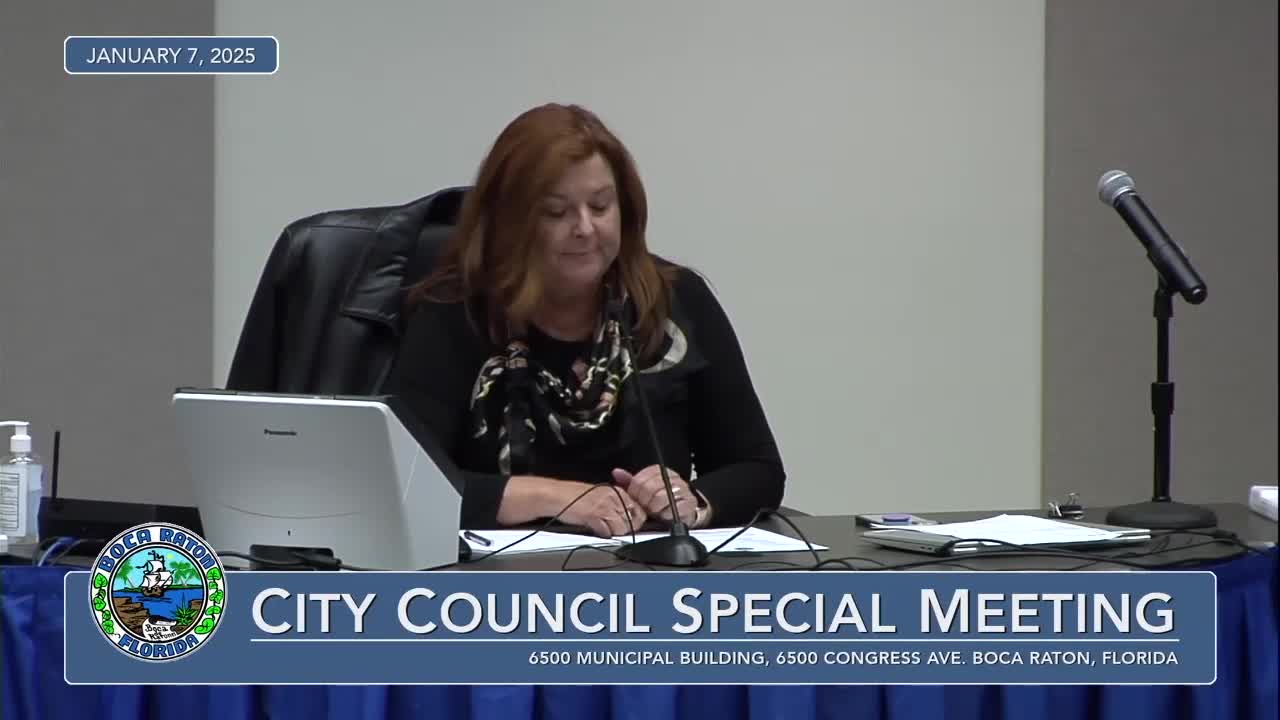
Mayor Singer called the special meeting to align council and staff expectations ahead of the Jan. 9 submission deadline and said the council would accept public input throughout the process. “Public comment reigns supreme throughout all of this because we value that input,” Mayor Singer said.
Why it matters: The proposals would guide redevelopment of downtown parcels that include City Hall, the police headquarters and recreational fields, and the council emphasized the long-term financial and land-use implications. The City’s Community Redevelopment Agency (CRA) has a limited remaining term, council members noted, increasing urgency to establish a viable financing and phasing plan that can produce tax increment revenues before the CRA’s sunset.
Council members discussed an aggressive schedule proposed by staff and CBRE, but ultimately agreed to build extra time for public review. The timeline the council settled on at the meeting calls for: proposer presentations to the council on Jan. 27; a ranking of proposers on Feb. 11; an open-house style public review tied to the top-ranked proposer after that ranking; and a target agenda date in mid-March for consideration of an interim agreement to begin more-detailed negotiations. Mike McShay of CBRE told the council, “we are making ourselves completely available,” and said an interim agreement can generally be prepared in one to two months.
Council members also clarified planning assumptions the proposers should expect: the council expects the police headquarters to be relocated to the Spanish River Boulevard site, while maintaining a downtown police substation; it wants an integrated public realm and pedestrian connections; and it is open to leasing temporary office space for city functions to allow phased redevelopment of the campus. Council member Thompson framed the procurement choice as selecting “a dance partner” — a developer to negotiate with before final designs are produced — and emphasized the many subsequent steps that will include public review.
Several council members urged staff and CBRE to produce clear program and financial metrics before the presentations so proposers and the public can evaluate submissions on a consistent basis. CBRE and staff were asked to refine a recommended city-office square‑footage target and to provide a valuation basis for the land and revenue projections. At the meeting, a staff reference for modern office planning suggested roughly 180–220 square feet per employee; using a 200‑square‑foot benchmark with a 330‑employee estimate would imply roughly 66,000 square feet of office, not including chambers or special spaces — a planning input the council directed staff to refine within about two weeks.
Public commenters urged the council to slow the process in some respects and to publish environmental, social and economic analyses. Lorraine Blank, a nearby resident, said neighbors had not had sufficient time to review proposals and asked the city to publish any environmental and social assessments. Alfred Bonner, another neighbor, urged the council not to sacrifice open space and requested clearer commitments on the amount of public realm and recreation to be preserved or replaced. Architect and resident George Garcia urged the council to produce program criteria before evaluating proposals.
The council directed staff to: finalize a more precise city‑hall space requirement and report back before the Jan. 27 presentations; prepare land‑valuation and financial modeling inputs with CBRE; begin drafting a form interim agreement and associated exhibits with outside counsel and CBRE; and arrange public review opportunities including presentation days and an open house tied to the top‑ranked proposer. No formal binding agreement or selection was made at the Jan. 7 meeting.
What’s next: Proposals are due Jan. 9. The council will hear presentations on Jan. 27, expect a ranking Feb. 11, and staff will return with an interim-agreement item in mid‑March. The council repeatedly emphasized that substantive design and final project terms will be shaped after selecting a preferred partner and through further community engagement.