Get Full Government Meeting Transcripts, Videos, & Alerts Forever!
Get email alerts on the Capital Budget Cip topic
No spam. Unsubscribe anytime.
Cedar Falls presents $473 million five‑year capital improvement plan emphasizing Hearst Centre, nutrient upgrades
Summary
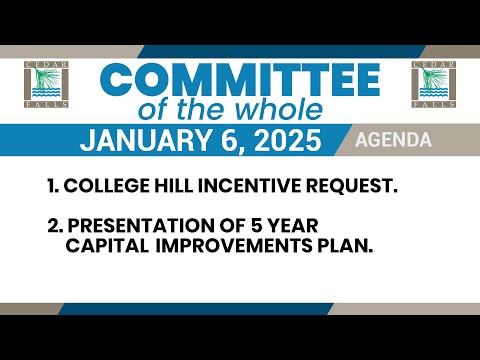
Director Jen Rodenbeck presented the city’s five‑year Capital Improvement Plan to the Committee of the Whole, outlining 214 projects totaling about $473 million and asking the committee to forward the plan to Council for the public hearing and adoption process.
Director Jen Rodenbeck presented the City of Cedar Falls’ five‑year Capital Improvement Plan (CIP), outlining 214 projects with an estimated combined cost of about $473 million and multiple funding sources, and the Committee of the Whole voted to send the plan to the City Council for formal consideration.
Rodenbeck told the committee the CIP is a planning document that does not itself authorize spending but gives staff direction for budgeting and project preparation. The plan lists roughly $333 million proposed from city sources and about $140 million from non‑city sources; it also enumerates approximately 50 different funding sources used across projects.
Rodenbeck highlighted several major projects:
- Hearst Centre: CIP shows a $10.5 million new build assumption (up from a remodel) with private fundraising of $3.0 million (about 28% of the project), a proposed $1.5 million gaming grant request, and $500,000 in general revenue set aside annually over four years to reach a $2.0 million local commitment. The CIP shows a mix of GO bond proceeds, capital projects funds and hotel/motel tax in the funding plan.
- Nutrient‑reduction upgrades at the wastewater treatment facility: estimated at roughly $142 million to meet EPA/DNR nutrient requirements, with design anticipated to take 18–24 months and construction scheduled in the 2027–2030 window; the plan uses some ARPA funds and anticipates additional borrowing and rate adjustments to cover remaining costs.
- Streets and intersections: Union Road reconstruction (West 27th to University Avenue) is planned with design in 2025 and construction bidding in 2026; Viking Road/Prairie Parkway intersection improvements and Viking Road reconstruction are on the schedule with TIF and local option sales tax noted as funding sources.
- Parks: staff recommended a consolidated "park master plan implementation" line item rather than project‑level allocations to let the parks master plan identify priorities; the CIP includes a phased approach and initial allocations in the bond sales noted.
Rodenbeck also reviewed equipment replacement timing, including an aerial ladder truck replacement already accepted for bid and a future rescue/pumper targeted in 2030, and the annual alley and street repair programs. She noted the CIP assumes modest tax and rate impacts over five years (Rodenbeck cited roughly a 2% increase across the five‑year period) and also noted risks from state tax changes (House File 718) and assessed value trends.
Committee members asked questions about FY2026 budget impacts, the timing of bond sales, ongoing operational costs for the Hearst Centre, and whether payments tied to school projects could be delayed. Rodenbeck and other staff noted that the CIP guides budgeting but actual authorization will be coordinated through the annual budget and that the council will see project‑level authorization and contracts as needed.
A motion to forward the CIP to the full City Council for public hearing and adoption at the next regular council meeting passed on a voice vote. Staff said the formal public hearing and adoption are scheduled for the next council meeting (the director referenced Jan. 21 as the plan adoption meeting).