
Kennewick outlines top state priorities: property tax flexibility, public‑works funding and clarity on juvenile interrogation
Get AI-powered insights, summaries, and transcripts
Subscribe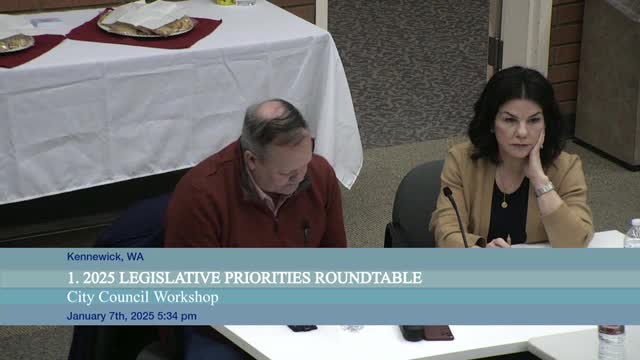
Summary
City leaders briefed legislators on priorities for the 2025 session including a request for options to increase property-tax limits to 3% or CPI (whichever is lower), concern about proposed cuts to the Public Works Assistance Account, and a request for clarity on juvenile interrogation statutes.
Kennewick city leaders used a Jan. 7 special meeting with state legislators to outline local priorities for the 2025 legislative session and to ask for consideration of several changes that affect municipal operations.
City staff and council members said the council recently adopted a biennial budget with a $5 million shortfall that required using reserves and creating a transportation benefit district for pavement preservation. Staff noted the city relies heavily on state shared revenues and state grants and asked legislators to avoid actions that would reduce those shared revenues to cities.
On property taxes, the council said it supports a proposal likely to be filed that would allow jurisdictions to increase property tax levies by 3% or by the consumer price index (whichever is lower), instead of the current 1% cap. The proposal discussed in the meeting would return some local choice to city councils, the city said, and would require local councils to adopt increases explicitly.
Staff also raised concern about the governor’s proposed reduction to the Public Works Assistance Account, telling legislators the governor’s draft reduces that account by $100 million and that would harm local infrastructure funding. The council asked for continued support for Public Defense funding and for maintaining state funding for the Basic Law Enforcement Academy training (which the city said the state funded at 100% in the prior biennium).
On justice system process, staff asked legislators to provide statutory clarification on juvenile interrogation and said city staff will monitor prefiled bills. The city also asked for help addressing systemic cost pressures, including inflation and public-employee related costs, and to pursue options to keep more tax dollars local.
City officials asked legislators to prioritize transparency and efficiency in state spending and indicated they would supply legislators with data and contacts to help make the local case during committee hearings. Council members also asked for guidance on guardrails to limit potential property‑tax increases, noting political and constituent concerns about a perceived slippery slope.