
Officials discuss preserving Rock Wall landmark, state park and open‑space priorities
Get AI-powered insights, summaries, and transcripts
Subscribe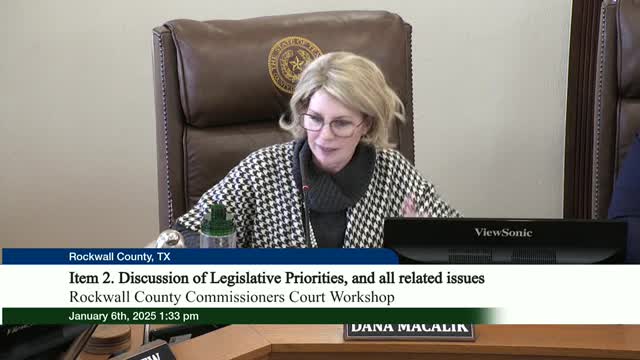
Summary
Rockwall County commissioners and city mayors discussed classifying the county’s namesake rock wall as a heritage tourism site, pursuing a state park along Lake Ray Hubbard and preserving Blackland Prairies, tying those ideas to economic development and the county’s strategic plan.
Commissioner (name not specified) told the court on Jan. 6 that historic preservation — particularly protecting the county’s namesake rock wall — was a priority that emerged from the county’s strategic planning process. She said the family that owns land where the rock wall lies has expressed interest in some kind of public‑private partnership and that county support could help secure grants from the Texas Historical Commission.
Speakers linked heritage tourism to economic benefits. The official cited Texas Historical Commission data (as discussed in the meeting materials) that placed annual historic tourism spending in Texas at roughly $7.3 billion and said heritage travelers spent about $30 more per person than non‑heritage travelers in 2019. Rockwall leaders proposed a program of exploratory work, grant applications and possible purchase or easement negotiations with the property owner to create a formal site.
Separately, commissioners discussed open‑space proposals highlighted in the county’s open‑space master plan: creating a state park on the Lake Ray Hubbard floodplain that could connect into Collin and Dallas counties; protecting segments of the Blackland Prairies; and promoting trails, bike lanes and non‑motorized transportation. Multiple speakers said the county should pursue funding and legislative support to protect contiguous open space and fund trails and non‑motorized corridors.
The court asked staff and partners (including the Rockwall Area Chamber of Commerce and state tourism officials) to draft resolution language and explore grants and partnerships. No appropriation was approved at the meeting; participants described the work as exploratory and recommended bringing formal resolution language back to the court in mid‑January.