Get Full Government Meeting Transcripts, Videos, & Alerts Forever!
Get email alerts on the Solid Waste Management topic
No spam. Unsubscribe anytime.
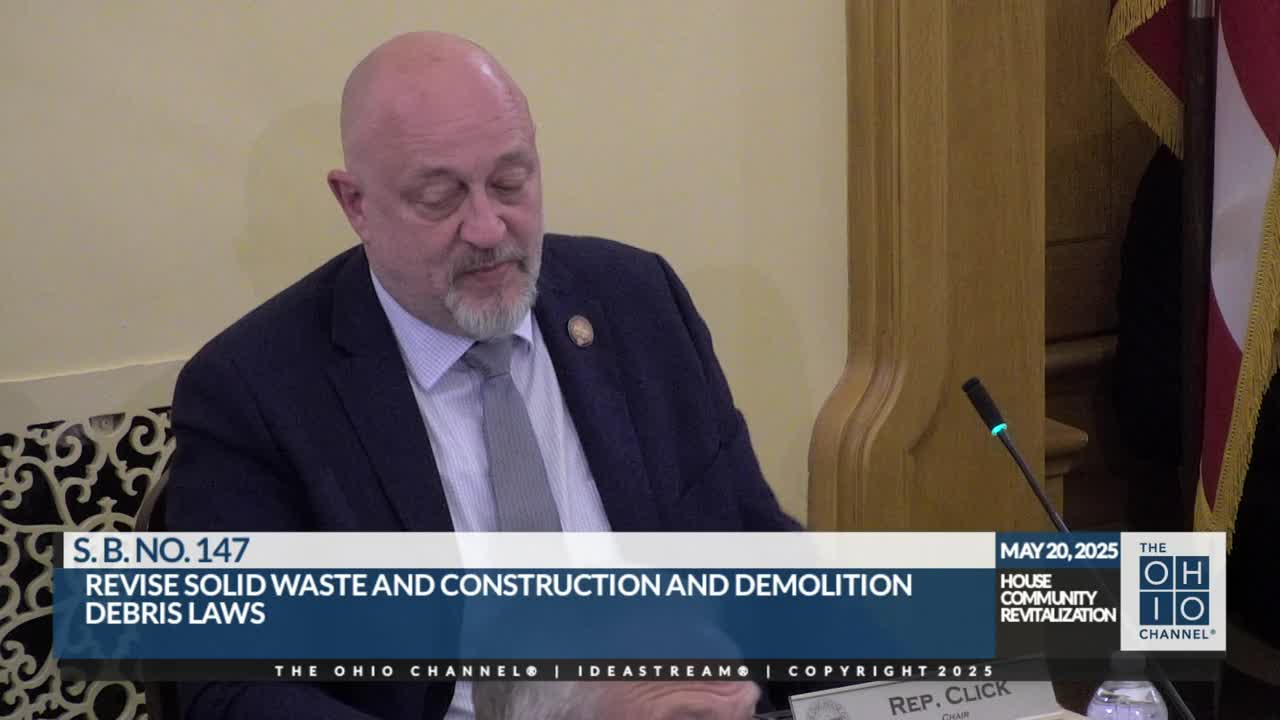
Ohio committee adopts amendments to Senate Bill 147 after hours of testimony over Seneca County landfill
Summary
The House Community Revitalization Committee accepted three amendments to Senate Bill 147 and heard competing testimony from industry, public-health officials and local leaders about fees, out‑of‑state waste and the Seneca County (Sunny Farms/Wind Waste) landfill.
The House Community Revitalization Committee on Oct. 27 advanced amendments to Senate Bill 147 after hearing more than three hours of testimony on proposed changes to Ohio's solid‑waste fee structure and local oversight.
Chairman Click moved, and the committee approved by voice consent, three amendments that (1) clarify how a county can withdraw from a joint solid waste management district and leave the regional authority to operate under its existing bylaws; (2) allow counties that are parties to a memorandum of understanding, or a court overseeing such an MOU, to allocate planning funds for newly formed solid‑waste districts; and (3) harmonize a phased‑in construction and demolition debris (CNDD) disposal fee so the new fee during the first two years can be charged only at an “authorized county” — language the amendment ties to a county population threshold and, as amended, applies to Seneca County. The chair said there were “no objections,” and each amendment was added to the bill by unanimous voice consent.
The committee then took testimony on the amended bill. Katie Rafferty Evans, testifying for the National Waste and Recycling Association as an interested party, described the private sector's role in waste collection and said the industry prefers not to be a “tax collector” but recognizes a need to fund regulatory oversight. Hamilton County Health Commissioner Greg Kesterman, speaking for the Association of Ohio Health Commissioners, urged a uniform fee for waste disposed at solid‑waste facilities to prevent misclassification of construction debris and to preserve municipal solid waste (MSW) landfill capacity, saying, “First, it will stop Ohio from being the dumping ground for the East Coast.”
Representing the Seneca County landfill operator, Brian Ezyk of Wind Waste Innovations testified in opposition and sought to rebut complaints from neighbors and the local health district. “Fact, no medical professional has ever linked illness or disease to the wind waste facility,” Ezyk said, and he repeatedly described extensive investments and frequent inspections of the site. He characterized some local enforcement actions as punitive and argued the amendments would be unconstitutional under commerce‑clause and uniformity‑clause theories as advised by his counsel.
Seneca County Commissioner Anthony Paradiso, who testified in support of the bill as amended, said the county's experience with the landfill — including substantial growth in the facility's footprint and repeated legal and regulatory disputes — motivated the county to seek local control and new revenue for oversight and remediation. Chuck Deonker, chair of the Ohio Environmental Health Association Solid Waste Technical Committee, urged a statewide approach rather than a provision limited to Seneca County, arguing that Ohio receives millions of tons of out‑of‑state waste each year and that a uniform fee would better prevent misclassification and fund local health departments.
Other witnesses included Tony Long of the Ohio Chamber of Commerce, who recommended greater use of recycling and waste‑to‑energy technologies, and Greg Kesterman, who explained that different landfill designs and regulations apply to CNDD and MSW facilities and that allowing lower‑fee CNDD material into MSW sites can accelerate MSW capacity loss and hamper environmental protections. Committee members questioned witnesses about inspection frequency, consent orders, leachate incidents, community impacts and opportunities for local mediation; Wind Waste acknowledged it operates under a consent order tied to past emissions but said many consent requirements have been incorporated into its current air permit.
The committee did not take a roll‑call vote on the bill itself during the public hearing; the transcript records adoption of the three amendments by voice consent and no further formal votes recorded on the substitute bill during the session. The committee chair closed testimony and adjourned.
Votes at a glance
- Amendment AM0455: Motion to accept language clarifying county withdrawal from a joint solid waste management district; passed by voice consent (no objections) and added to the bill.
- Amendment AM0451: Motion to permit counties (or a court supervising an MOU) to allocate planning funds to newly formed solid waste districts; passed by voice consent (no objections) and added to the bill.
- Amendment AM0502: Motion to harmonize CNDD fee phase‑in and restrict the new CNDD disposal fee during the first two years to an “authorized county” (population threshold referenced in testimony); passed by voice consent (no objections) and added to the bill.
Why this matters
The bill and the admitted amendments would change how disposal fees are applied and how counties might split from regional solid‑waste districts. Committee witnesses and local officials said fee structure and fee distribution affect incentives for where waste — including out‑of‑state loads transported by rail — is disposed, the capacity of municipal landfills, and funding available to local health departments for inspections and remediation. Supporters argued the tailored amendments give Seneca County tools to address local impacts; critics urged a statewide fee reform to eliminate perverse incentives and to ensure consistent funding for environmental oversight across Ohio.