Get Full Government Meeting Transcripts, Videos, & Alerts Forever!
Get email alerts on the Housing Redevelopment topic
No spam. Unsubscribe anytime.
Area Plan Commission backs PUD to convert historic Cargus building into 127 apartments; residents express gentrification worries
Summary
The Area Plan Commission voted 8-0 to recommend rezoning the former Cargus Furniture factory at 1501 W. Maryland St. from M-3 to a Planned Unit Development to allow an estimated 127 apartments. Neighbors raised concerns about affordability and displacement during the public hearing.
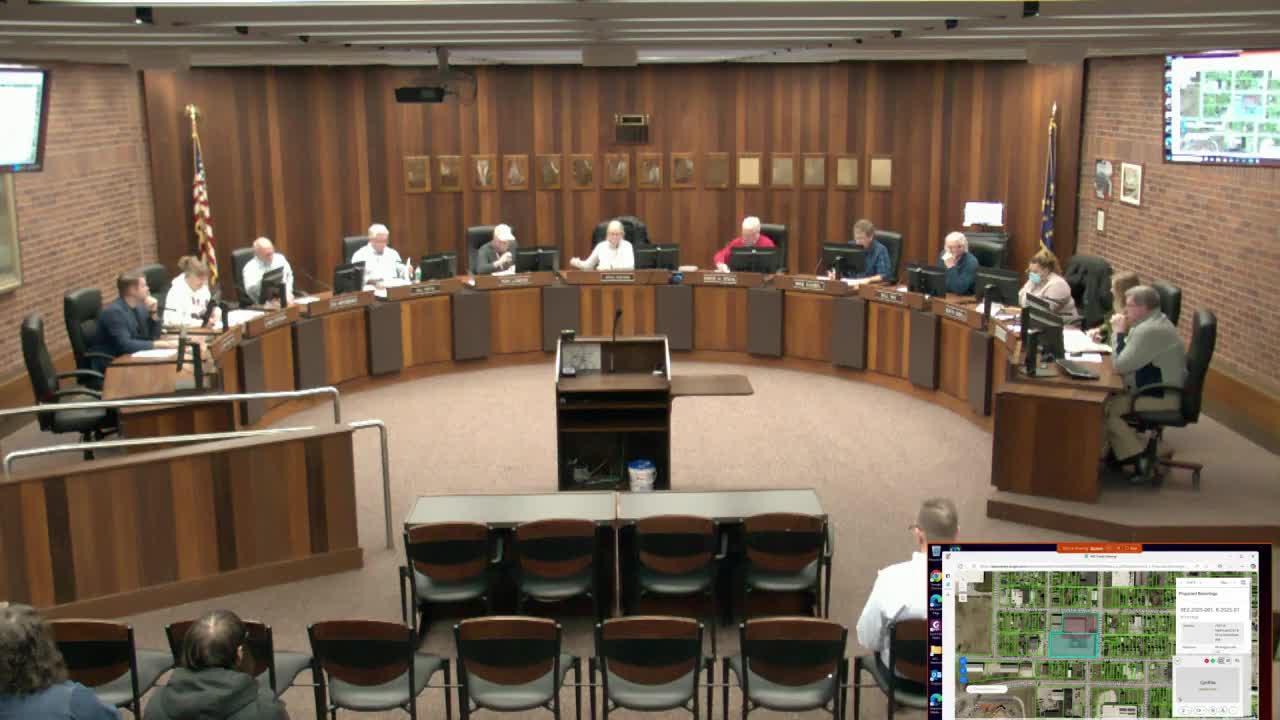
The Area Plan Commission on Feb. 6 voted 8-0 to recommend that the City Council approve rezoning of the former Cargus Furniture factory (1501 West Maryland Street and 1516 Fountain Avenue) from M-3 industrial to a Planned Unit Development (PUD) to allow a multifamily project with an estimated 127 residential units.
The proposal, submitted by Morla Corp. on behalf of owner John Anderson, would record the submitted site plan as part of a PUD ordinance. Ron (staff) told commissioners no use-and-development commitments were filed with the application and said the site is in an area of mixed uses and legal nonconforming residences. The staff report noted the site was originally built as a furniture factory in 1889, expanded in 1919, and has been vacant since 2014. The applicant purchased the property in 2023 and is proposing rehabilitation of the existing industrial facility into multifamily housing.
Why it matters: the requested PUD would change an industrial-designated block into higher-density residential, adding dozens of housing units in the urban core. Proponents said reuse of the vacant historic structure advances neighborhood revitalization goals; opponents said the project risks displacing longtime, low-income residents and may not benefit current neighbors financially.
Project engineer Jim Morley said the plan "is a great use of an old building," noting developers prefer the PUD route to avoid repeated variance requests. "They're taking an old historical building and reusing it and turning it into apartments, about a 127 of them," Morley said. He and the applicant told the commission that several zoning variances would otherwise be necessary because of existing building placement and other nonconforming features.
Chad Fraser, speaking for the Chain Neighborhood Association and living on West Missouri Street, said the association was "very skeptical of the project in general." Fraser told the commission the neighborhood is among the city's poorest and that adding market-rate units risks raising taxes and undermining residents' ability to remain in place.
Ted O'Connell, director of Jacobsville Development, said the redevelopment plan for the neighborhood calls for more mixed-income housing and said attracting mixed-income units "does fit in with what we're looking to do." O'Connell said the project could help connect Franklin Street and North Main and serve as a catalytic investment.
During a question-and-answer period commissioners asked whether the project would provide affordable units and about its capital stack. Morley said the development is "a little mix" between market-rate and workforce housing and "it's not a low income tax credit facility." He said the developer expects financing from multiple sources: the READY program, state-level funding, and possibly tax increment financing — but he said he was "not positive" about the precise details.
Commissioner Cassie Cabell, addressing neighborhood concerns during roll call, said: "To the residents, I have been where you stand, and I've also been where Mr. Morley stands. And while it may not seem like it will benefit the neighborhood, the chances are higher that it will more than likely help the neighborhood more than it hurts the neighborhood." Commissioner Stevens also voted yes and added support for the project as a start toward neighborhood improvement.
The motion to recommend approval passed on a roll call of 8 yes, 0 no. The commission's approval is a recommendation; the rezoning will next be heard by the City Council on Feb. 24, 2025.
Clarifying details drawn from the public hearing: the staff report flagged that the request is inconsistent with the 2035 future land use map's industrial designation for this particular block but noted the surrounding plan and neighborhood-revitalization goals support denser residential infill; the applicant did not file a use-and-development commitment at the time of filing; the site plan identifies changes to setback, parking and landscaping standards that would be incorporated into the PUD ordinance if approved; the developer estimates roughly 127 units; the building was vacant since 2014 and purchased by the applicant in 2023. Morley said the capital stack includes READY program funds and state-level money and possibly a TIF, though he said he was not certain of all sources.
Next steps: the rezoning will be considered by the City Council at its Feb. 24 meeting; any PUD ordinance would record the approved site plan and the developer would be required to adhere to that recorded plan.
Votes and formal action: the commission recorded a motion to recommend approval that passed 8-0. The commission's vote was a recommendation only; final zoning approval requires City Council action.