Get Full Government Meeting Transcripts, Videos, & Alerts Forever!
Get email alerts on the Transit Land Development topic
No spam. Unsubscribe anytime.
Supervisors Back SFMTA Joint‑Development Policy, Add Direction to Prioritize Community and Affordability
Summary
The San Francisco Board of Supervisors' Land Use and Transportation Committee voted 3-0 Monday to recommend to the full Board a resolution supporting the San Francisco Municipal Transportation Agency's joint development goals and policy and approved an amendment directing the agency to model alternatives that maximize community development, housing affordability and sustainable design.
The San Francisco Board of Supervisors' Land Use and Transportation Committee voted 3-0 Monday to recommend to the full Board a resolution supporting the San Francisco Municipal Transportation Agency's (SFMTA) newly adopted joint development program goals and policy, and approved an amendment directing the agency to model alternatives that prioritize community development, housing affordability and sustainable design.
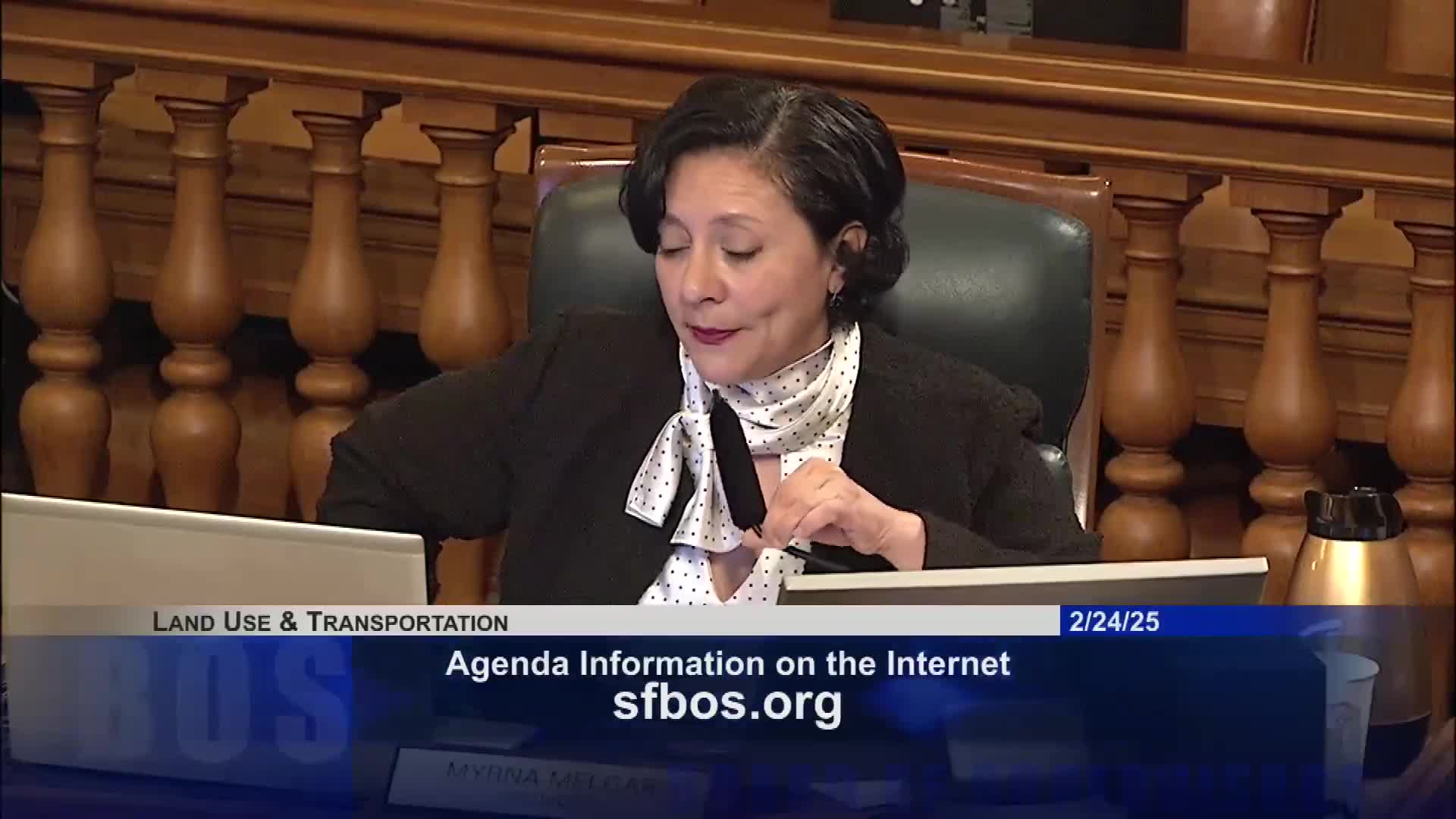
The committee, chaired by Supervisor Mirna Melgar, adopted the amendment offered by Vice Chair Cheyenne Chen and then voted to forward the resolution to the full Board as amended. The committee's action followed a presentation by Wade Wyckoff, SFMTA joint development program manager, and more than an hour of public comment primarily urging stronger affordability requirements for SFMTA parcels.
The resolution expresses support for the SFMTA board's unanimous adoption of a policy intended to guide development of more than 90 agency properties across the city. Wyckoff told the committee that joint development "is a way to help ourselves through diversifying our funding sources without burdening taxpayers," and described the policy as a framework to identify a 25-site portfolio for further evaluation and to require compliance with the California Surplus Land Act.
Wyckoff said the agency has narrowed more than 90 properties to about 25 with potential for joint development and that a preliminary consultant analysis of a 4-to-12 site evaluation produced a long-term annual revenue range of roughly $12 million to $47 million for those scenarios. He warned, however, that some of that revenue would be reinvested in facilities such as bus yards and "may not be net new to service," though it would provide funds for the agency overall.
Supervisor Mirna Melgar, the committee chair, said the resolution is rooted in the goal of preserving the SFMTA's financial health so the system remains accessible and affordable. "The financial health of the agency should be first and foremost," Melgar said, adding that the policy does not preclude 100% affordable housing on SFMTA sites.
Public commenters and community groups urged stronger affordability and public‑use protections. A speaker identified as representing "the council community housing organizations" said that "25% should not be the single standard for San Francisco,'' and urged supervisors to prefer higher levels of affordability on public land. David Wu of Soma Filipinas and other South of Market advocates argued that SFMTA parcels such as the Moscone Center Garage and the Fifth and Mission Garage should be prioritized for "100% affordable housing and community-serving uses." Zachary Friel of South of Market Action Network said joint development "comes at too high a cost for our communities" if it results primarily in market-rate housing.
Vice Chair Cheyenne Chen offered the amendment that the committee adopted; she told the panel she wanted the resolution to "urge the SFMTA to model a range of alternatives for the properties in its portfolio that maximize community development, housing affordability, and green sustainable development goals." The committee recorded three ayes (Chen; Supervisor Bilal Mahmood; and Chair Melgar) on the amendment and three ayes on the subsequent motion to transmit the resolution to the full Board as amended.
Wade Wyckoff told the committee the policy requires residential projects to comply with the city's inclusionary and affordable housing requirements and to follow the more stringent elements of the California Surplus Land Act, including designating at least 50% of land at large properties for residential uses and reserving at least 25% of units for households at 80% of area median income or below. Wyckoff said that 25% at that income level is currently double the city's inclusionary requirement and described the portfolio approach as a way to achieve equity across projects rather than project-by-project ad hoc decisions.
Speakers from campaigns and neighborhood groups urged the supervisors to protect public land from being converted primarily to market-rate development, reminding the committee that transit investments can raise surrounding values and contribute to displacement. Some speakers requested clearer guarantees that revenue-generation would not come at the expense of deeply affordable housing.
The committee vote sends the resolution and the Chen amendment to the full Board of Supervisors for consideration. The SFMTA policy and future project proposals would be subject to subsequent planning, environmental review and any required land disposition procedures under state law.
The committee took no final action to change planning or surplus‑land statutes; it registered a recommendation to the full Board and directed the SFMTA to model alternatives that weigh the agency's financial needs against community and affordability objectives.
The full Board is scheduled to receive the item at its March 4, 2025 meeting, where supervisors who were not on the committee will have the opportunity to debate and vote on the resolution and any companion legislation.