Get Full Government Meeting Transcripts, Videos, & Alerts Forever!
Get email alerts on the Sports Entertainment District topic
No spam. Unsubscribe anytime.
San Antonio officials outline financing, traffic and neighborhood plans for proposed downtown sports-and-entertainment district
Summary
City staff, consultants and transit officials briefed the City Council on a proposed downtown sports-and-entertainment district — including a convention-center expansion, possible NBA arena, AlamoDome improvements, infrastructure costs and a community engagement plan — but no binding deals or votes were taken.
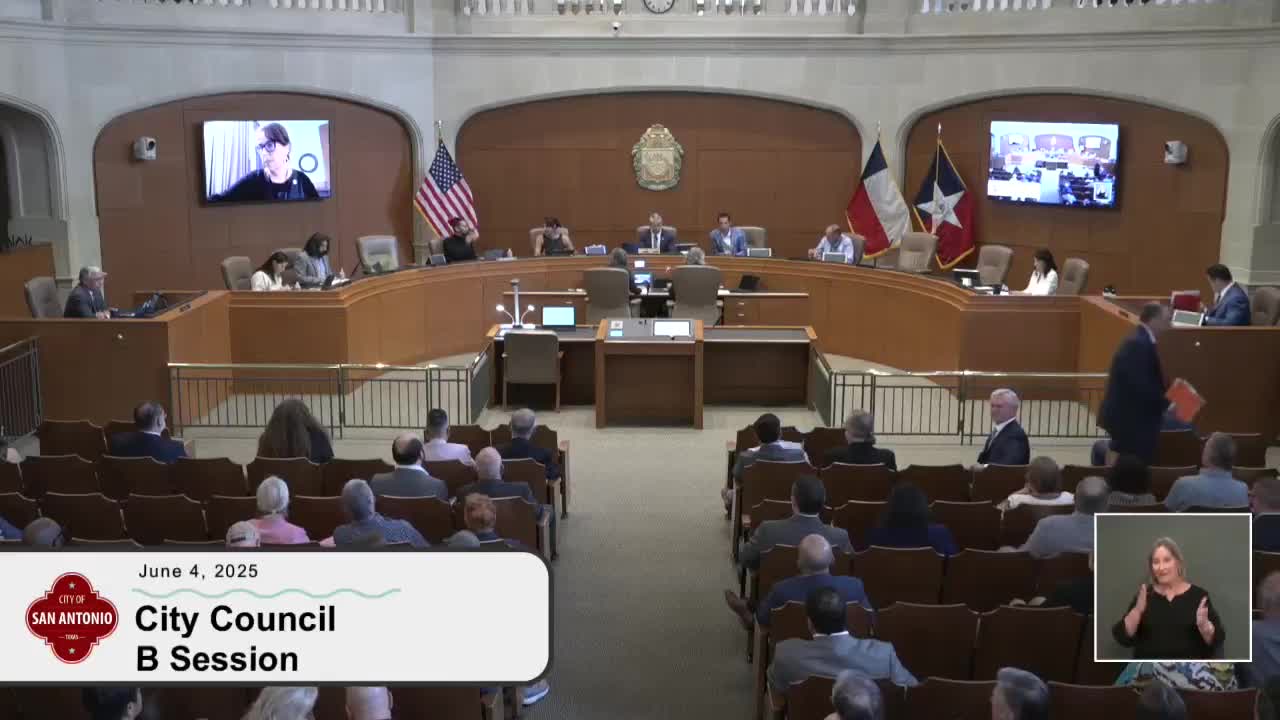
City staff on Wednesday presented a draft finance and infrastructure plan for a proposed downtown Sports and Entertainment District that would tie together a $750 million expansion of the Henry B. González Convention Center, a proposed NBA-grade arena and longer-term improvements to the Alamodome and surrounding streets.
City Manager Eric Walsh said the city is pursuing a financing approach that relies on new, project-specific revenue streams rather than recurring operating dollars. “We’re approaching this with no city dollars, out of our any of our operations,” Walsh said during the presentation.
The plan presented to the City Council lays out a multi-source financing framework. Officials said the likely revenue mix would include: continued portions of the city’s hotel-occupancy tax, newly captured state revenues through a Project Finance Zone (PFZ) the city recently created, tax increment revenues from a Hemisphere-area TIRZ, private development ground-lease revenues and a county venue tax. City staff said those pieces would be combined — not used singly — to support bond financing for city contributions to projects in the district.
Ben (city staff) told the council the convention-center expansion has been budgeted for planning purposes at $750 million. He said the arena concept remains in the $1.3 billion–$1.5 billion range, and the near-term infrastructure program to support the district is estimated at $220 million–$250 million. Officials also listed a $60 million appraisal-based estimate to acquire the Institute of Texan Cultures property from UTSA and said they are budgeting roughly $100 million in operational capital for the Alamodome over the next decade while longer-term renovation options are studied.
Transportation and public-safety planning were central to the briefing. Tom Carter, senior vice president for Pape Dawson Engineers, described a phased set of traffic, pedestrian and parking improvements for the immediate (1–5 year) horizon and a larger set of transit, land-bridge and plaza ideas for later phases. Carter said work focuses on protecting nearby neighborhoods (Lavaca, Dignowity, Denver Heights and King William) while improving event access and circulation. “Our main goals for today are to talk about traffic improvements, pedestrian access, district parking, transit access,” Carter said.
VIA Metropolitan Transit staff outlined transit and park-and-ride capacity the agency says it can bring to the district. Rod (VIA representative) said the Robert Thompson Transit Center can marshal 21 buses at once and that VIA can carry “10,000 people within a 2-hour period” from park-and-ride sites, while the system’s regular downtown routes add additional hourly capacity.
Council members asked for more specificity on financial commitments from the Spurs, the county and private developers; on enforceability and monitoring for any community benefits agreement; and on traffic and public-safety modeling. Staff said negotiations with the Spurs and potential private development partners are ongoing and that a nonbinding term sheet addressing ownership, operations, traffic/security plans and developer revenue guarantees would be brought to the council later this summer. Staff also said the team had begun reviewing community-benefit agreements from other cities and found wide variation in targets, funding approaches, durations and enforceability.
Community engagement will begin this summer. City staff and consultant Able City plan two‑day district workshops — one in each council district — with bilingual surveys, focus groups (housing, transportation and parking, local business opportunities, public/community space) and public open houses. Laurie (city staff) said the workshops will inform a set of guiding principles staff will return to council with before any ballot call. Walsh said staff expects to provide a report on engagement and infrastructure options to council by mid‑July, and noted that a November ballot placement would require action before the state’s August 18 deadline.
No formal votes or binding commitments were taken at Wednesday’s briefing. Council members voiced broad support in principle from some quarters and concerns from others, particularly about timing, transparency, the scale of public debt and guarantees that benefits would accrue to nearby neighborhoods and workers. Staff said they would return with more detailed financial models, a scheduled timeline for negotiated terms and the results of an economic-impact analysis under way by the city’s consultant team.
Next steps listed by staff included continued negotiations with the Spurs and potential development partners, refinement of the bond and PFZ financing models, completion of the economic impact analysis and the start of the citywide community workshops this summer.