Get Full Government Meeting Transcripts, Videos, & Alerts Forever!
Get email alerts on the Shoreline Protection Sandbags topic
No spam. Unsubscribe anytime.
Bill would let shoreline owners keep 2020 sandbags on Great Lakes; environmental groups oppose
Summary
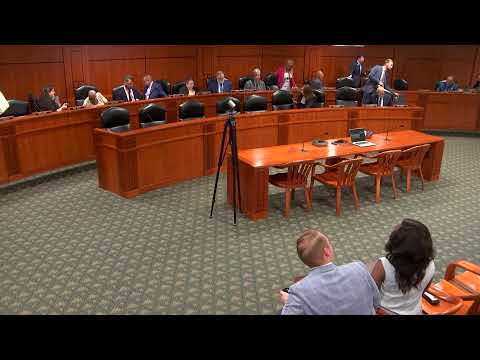
The House Committee on Natural Resources on Thursday heard testimony on House Bill 4835, sponsored by Representative Andrews, which would allow shoreline property owners along the Great Lakes and Lake St. Clair to retain so-called "soft erosion control" sandbags placed during the 2020 high-water event without first obtaining a temporary permit from EGLE.
The House Committee on Natural Resources on Thursday heard testimony on House Bill 4835, sponsored by Representative Andrews, which would allow shoreline property owners along the Great Lakes and Lake St. Clair to retain so-called "soft erosion control" sandbags placed during the 2020 high-water event without first obtaining a temporary permit from the Department of Environment, Great Lakes, and Energy (EGLE).
Supporters, led by Representative Andrews, said the measure would reduce costs and environmental harm associated with repeated emergency armoring and with excavation to remove buried bags. Andrews told the committee that homeowners had quoted costs of about $1,520,000 to install the sandbags originally and that removal is expensive and disruptive. "Waiting on a permit can be the difference between whether you lose your house or not," Andrews said during testimony.
Under the bill as explained at the hearing, soft erosion-control structures would be allowed only on the shorelines of the Great Lakes and Lake St. Clair (not inland lakes); must be constructed of biodegradable materials or specified soft permeable textiles that do not contain BPA; must be installed according to manufacturer instructions; may not extend into the waters or impair public walkability when water is below the ordinary high-water mark; and may remain in place as long as the majority of the structure is buried, not exposed or showing signs of degradation. Property owners would still be required to provide written notice to EGLE with contact information, a description of the installation location and materials, and other information the department requires. Hard armoring (rock, riprap, walls) would still require the normal permitting process.
Environmental groups and public-interest witnesses opposed the bill. Emily Smith and Samantha Pickering of the Michigan Environmental Council testified that the proposal risks privileging private property preferences over the public trust doctrine that preserves public access and protection of navigable waters. "This bill would prioritize landowners' rights over public access rights," Smith told the committee, citing the state's public trust obligations and the Michigan Constitution. Testimony from other organizations — including Alliance for the Great Lakes, Sierra Club of Michigan, Huron River Watershed Council, Michigan Microplastics Coalition, FLOW (For Love of Water), and Michigan League of Conservation Voters — expressed similar concerns about long-term pollution and the potential for microplastic formation if synthetic materials are used.
Opponents emphasized scientific uncertainty about what the bill calls "biodegradable" materials and warned that many so-called bioplastics require industrial composting conditions to break down and otherwise fragment into microplastics. One witness said polypropylene and polyester — materials named in committee discussion as allowable under some bill language — are commonly detected in Great Lakes microplastic surveys and can persist and move through ecosystems.
Committee members pressed on enforcement and local-government roles. Representative Vanderwal and others said the bill needs clearer language about whether EGLE or local governments would carry primary enforcement responsibility; Andrews acknowledged that he and sponsors expect to refine enforcement and local-ordinance language in a working substitute (a "sub") before a final vote. The committee clerk reported that EGLE had emailed opposition after the hearing began.
Members also raised practical and equity concerns: Representative Saint Germain and Representative Preston described cases where homeowners lacked insurance or resources to move houses and argued that allowing sandbags to remain may prevent larger environmental disasters (for example, a house collapsing into the lake with appliances and household materials). Opponents countered that leaving structures in place indefinitely could damage adjacent shoreline and public access.
No final vote on House Bill 4835 was taken during the hearing. Representative Andrews said the sponsor and stakeholders expect to work on a substitute to address local-government concerns, enforcement standards, and clearer definitions of allowable materials before the committee considers a final recommendation.
Votes and written testimony were entered into the record on both sides; the committee clerk read a series of supporting and opposing written submissions, including local officials and a number of conservation and environmental organizations.